215922 274 Revision A
5.7.5 Checking Engine Coolant Level
Coolant is cycled through the engine to help reduce internal heat. The coolant must be at the appropriate level for the
cooling system to work correctly. Check the coolant level in the pressurized coolant tank daily.
DANGER
To prevent bodily injury or death from the unexpected startup of the machine, always stop the engine and remove the
key from the ignition before leaving the operator’s seat for any reason.
NOTE:
Ensure the engine has cooled down prior to checking.
1. Shut down the engine, and remove the key from the ignition.
2. Open the hood. For instructions, refer to 5.3.1 Opening Hood, page 239.
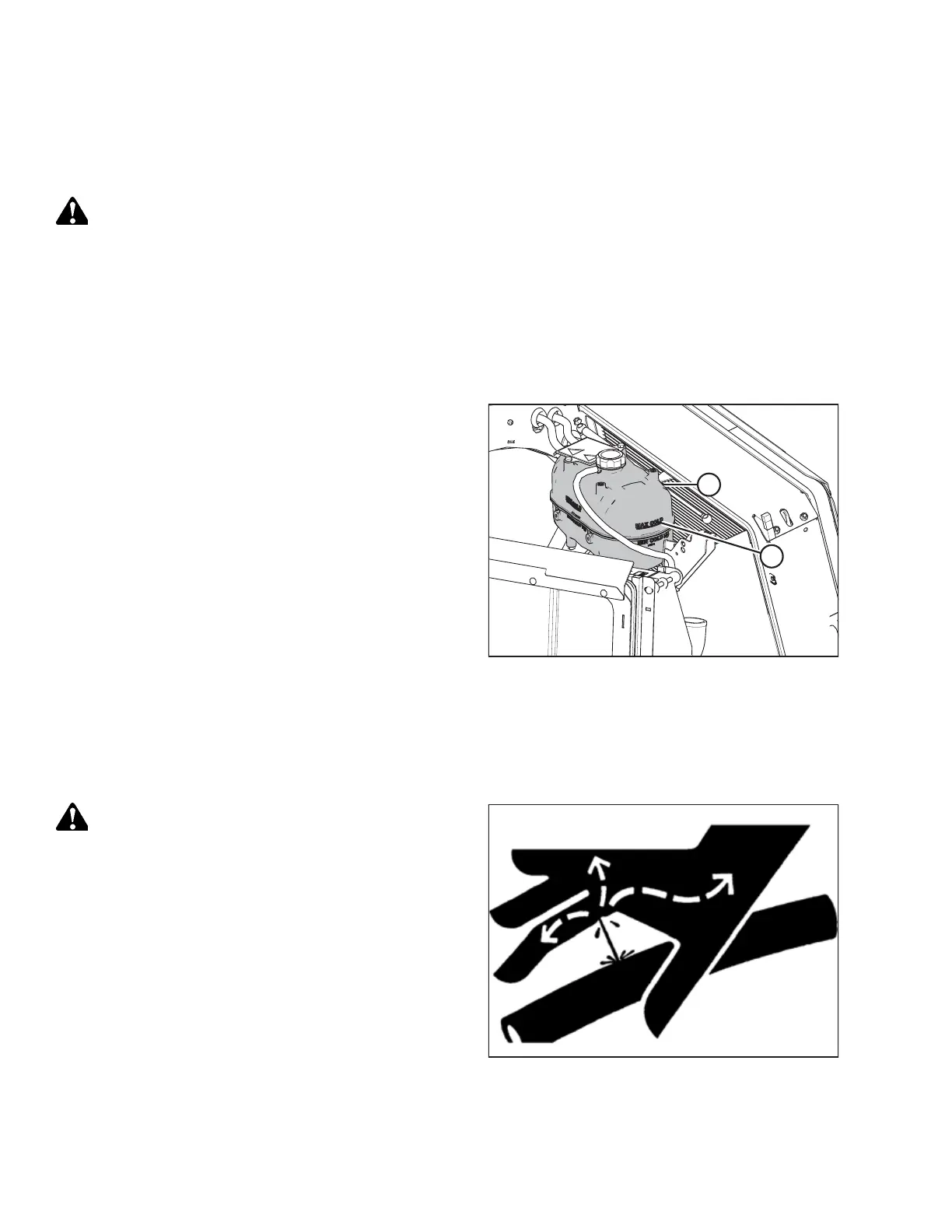
Figure 5.54: Coolant Recovery Tank
3. Locate coolant recovery tank (A).
4. Visually inspect the coolant level. Ensure that the coolant
level is at MAX COLD line (B). If the coolant level is too low,
add more coolant. For instructions, refer to Adding Coolant
after System Drain, page 317. For fluid quantities, refer to
5.1.4 Lubricants, Fluids, and System Capacities, page 232.
For coolant specifications, refer to 5.1.2 Coolant
Specifications, page 231.
5. Close the hood. For instructions, refer to 5.3.2 Closing Hood, page 240.
5.7.6 Hoses and Lines
Check hydraulic hoses and lines daily for signs of leaks.
Figure 5.55: Hydraulic Pressure Hazard
WARNING
• Avoid high-pressure fluids. Escaping fluid can penetrate the
skin causing serious injury.
• Relieve pressure before disconnecting hydraulic lines.
Tighten all connections before applying pressure.
• Keep hands and body away from pin-holes and nozzles
which eject fluids under high pressure.
• If ANY fluid is injected into the skin, it must be surgically
removed within a few hours by a Doctor familiar with this
type of injury or gangrene may result.
• Use a piece of cardboard or paper to search for leaks.
• Any service components must be genuine MacDon parts.
• All connections must be properly torqued. For
specifications, refer to 8.1 Torque Specifications, page 399.
MAINTENANCE AND SERVICING



 To Next Page