64Z5301A
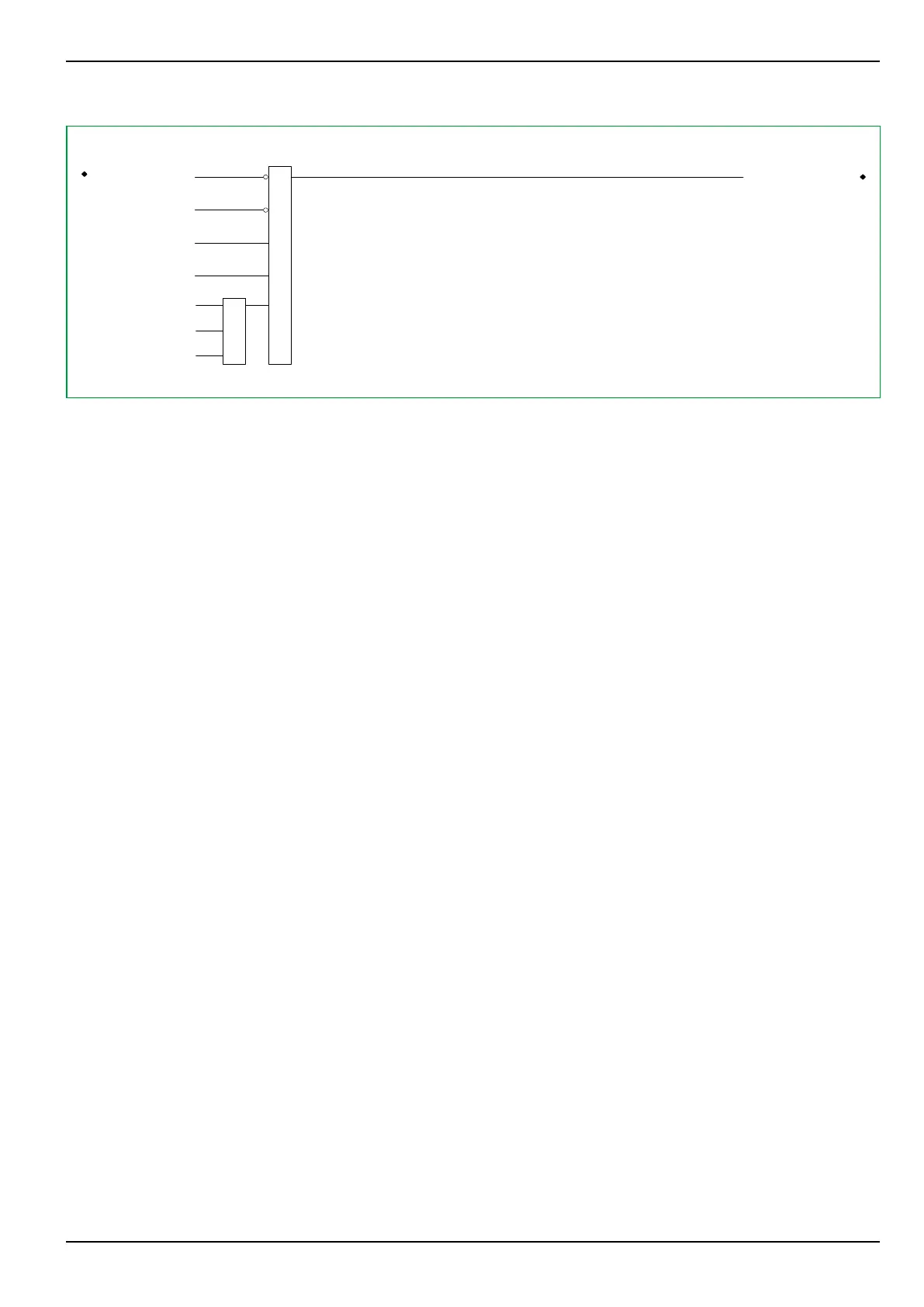
MAIN:
Protection active
306 001
CTS:
Blocking EXT
[ 036 160 ]
DIFF:
Inrush blk. 1 trigg.
[ 041 118 ]
DIFF:
Inrush blk. 2 trigg.
[ 041 119 ]
DIFF:
Inrush blk. 3 trigg.
[ 041 120 ]
MAIN:
Gen. trip signal
[ 036 251 ]
CTS:
Enabled
[ 036 080 ]
CTS:
blocked
460 400
≥1
≥1
Fig. 3-150: Blocking of current transformer supervision
3.29.3 Monitoring Condition
If CTS is ready, it will monitor the positive- and negative-sequence currents from
all transformer ends (a, b, c, d).
A CT fault is detected when the following conditions are simultaneously present:
●
The positive-sequence current exceeds the set threshold I
pos>
in at least 2
winding ends. This means that CTS can operate only if a minimum load
current is present in the protected object.
●
The negative- to positive-sequence current ratio exceeds a high set
threshold value I
neg
/I
pos>>
in a single winding end.
●
In all the other ends, the negative- to positive-sequence current ratio is
smaller than the low set threshold value I
neg
/I
pos>
, or no significant current
is present (i.e. the positive-sequence current is lower than the I
pos>
threshold).
In such a case, there is a fault in the secondary circuit of the CT at the
transformer end where a high negative-sequence current is present.
Because this function uses negative-sequence currents, it can only detect
unbalanced CT faults. In practice, this does not present a problem as the
occurrence of a three-pole CT fault is very unlikely.
3 Operation P634
P634/EN M/R-42-A // P634‑311‑653 3-197


 To Next Page