then blocked, if it has been set accordingly (for example by assigning REF_1 to
end a: REF_1: CTS effective PSx = Yes).
3.29.5 Reset
Latched CTS signals can be reset using control parameters or through an
appropriately configured binary signal input as well as by a general reset
command.
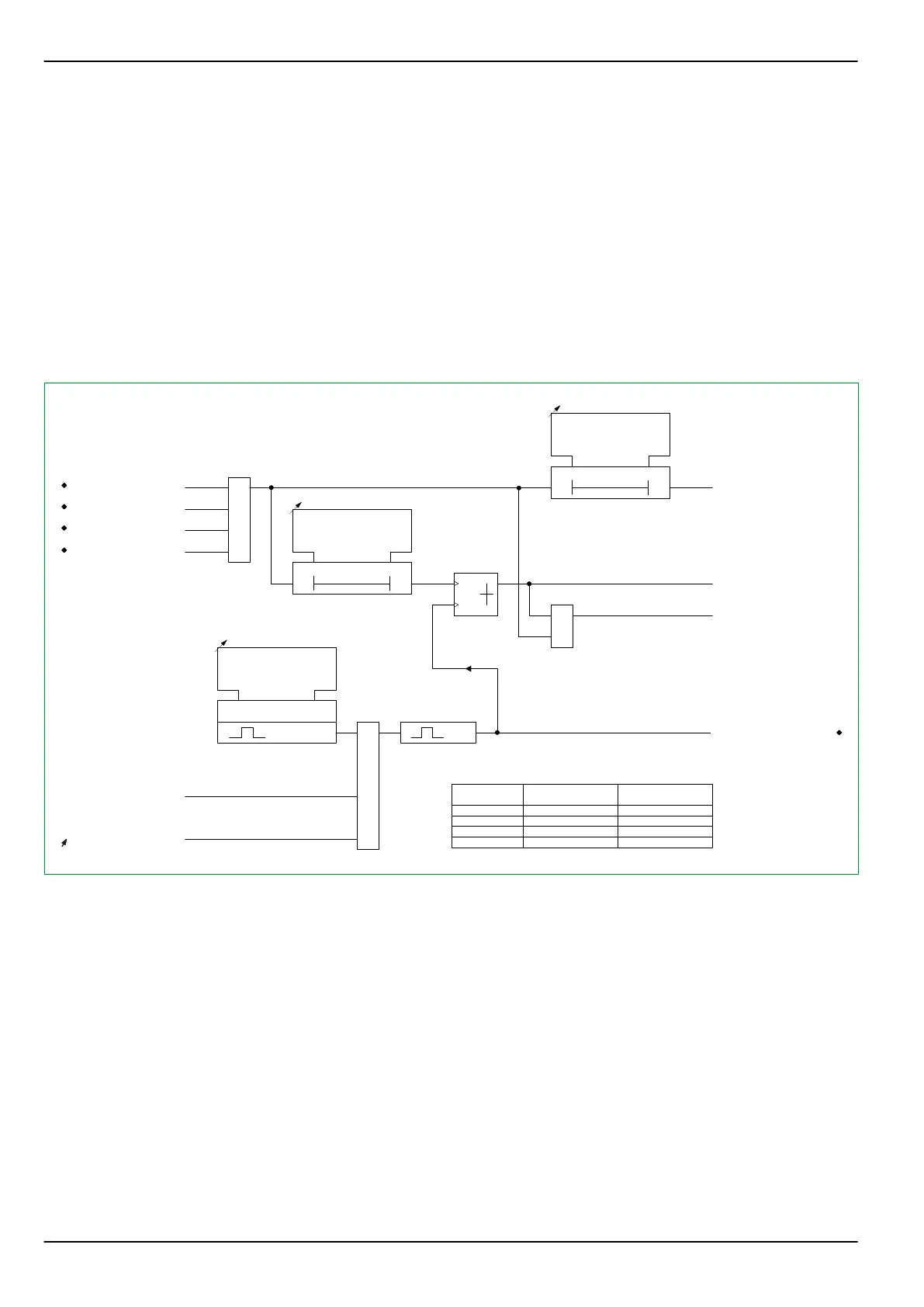
3.29.6 Multiple Signaling from the CTS Function
The signals issued by the CTS function (and/or measuring circuit monitoring, see
Section 3.30, (p. 3-202)) are combined into the MAIN: Meas. circ.I faulty
signal. A signal is simultaneously issued by the self-monitoring function.
64Z5304B
CTS:
End a faulty
460 471
CTS:
End b faulty
460 472
CTS:
End c faulty
460 473
CTS:
End d faulty
460 474
CTS:
Reset latch. EXT
[ 036 158 ]
CTS:
Reset latch. USER
[ 036 157 ]
1
0
1 100 ms
1: execute
0: don't execute
MAIN:
General reset USER
[ 003 002 ]
t 0
CTS:
t(Latch) PSx
[ * ]
1
1
1
S
R
t 0
CTS:
t(Alarm) PSx
[ * ]
CTS:
Operated (updating)
[ 036 099 ]
CTS:
Operated (latched)
[ 036 202 ]
CTS:
Idiff>(CTS)active
[ 036 203 ]
CTS:
Reset
Parameter
set 1
set 2
set 3
set 4
CTS:
t(Alarm) PSx
001 126
001 127
001 128
001 129
CTS:
t(Latch) PSx
001 130
001 131
001 132
001 133
1 500 ms
*
1: execute
≥1
≥1
≥1
460 450
Fig. 3-154: CTS overreaching signals
P634 3 Operation
3-200 P634/EN M/R-42-A // P634‑311‑653


 To Next Page