3.29.4 Signaling and Indication
Triggering of the CTS function is signaled by multiple signals as well as by single
signals referring to the respective ends. Beside the updated signals latched
signals are also available in order to achieve stable signaling behavior and a
permanent differential protection characteristic with reduced sensitivity when,
for instance, intermittent faults have occurred. The updated signal as well as the
stored signal are time-delayed in order to suppress any signaling caused by a
transient event. On the other hand, instantaneous signals are used to block or
restrain the differential protection functions as fast as possible. As soon as a CTS
condition is detected (CTS: Idiff>(CTS)active is present), the function will
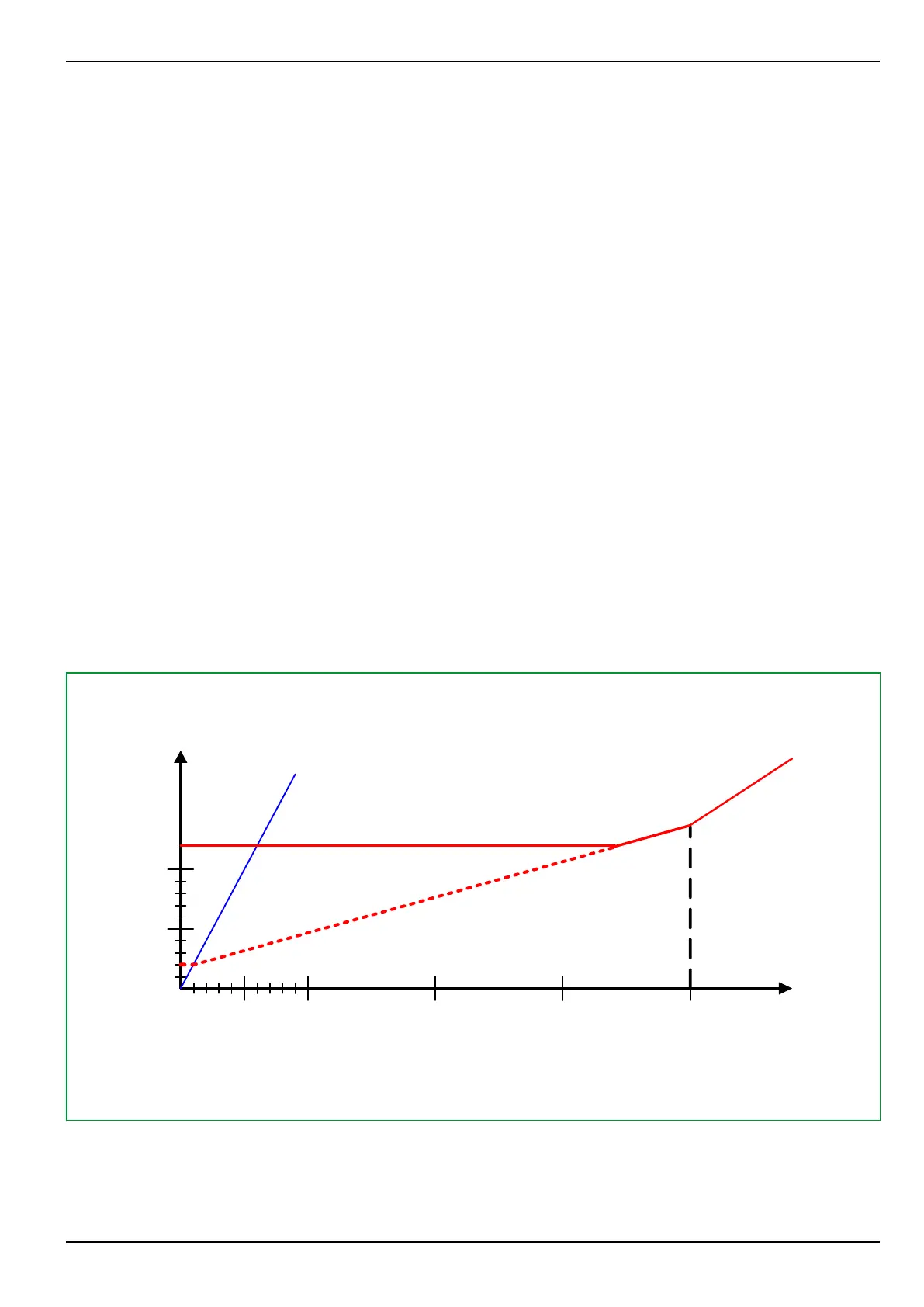
raise the differential protection low set threshold to the DIFF: Idiff>(CTS) PSx
setting; see Fig. 3-153, (p. 3-199).
The setting for this value determines the CTS operating mode:
●
Signaling only
DIFF: Idiff>(CTS) PSx = DIFF: Idiff> PSx. Differential protection
remains unrestricted, but there is a risk of unwanted tripping occurring
under load current.
●
Restricted operation
DIFF: Idiff>(CTS) PSx = maximum load current. This will permit the safe
differential protection behavior, even during CT failure. There will be no
unwanted trip under any load condition, but protection will remain
operational for internal faults with currents exceeding the load current.
●
Blocking
DIFF: Idiff>(CTS) PSx = DIFF: Idiff>> PSx. In practice differential
protection is blocked for all currents under normal operating conditions.
1 2 3
1
0
I
diff
I
R
Fault current characteristic
for single side infeed
I
diff
>
I
R,m2
m
1
m
2
I
diff
>(CTS)
64Z9004A
Fig. 3-153: Modification of the differential protection triggering characteristic with CTS active
When a CTS alarm signal is issued for one of the transformer ends (for example
CTS: Alarm end a), the associated ground differential protection function is
3 Operation
P634
P634/EN M/R-42-A // P634‑311‑653 3-199


 To Next Page