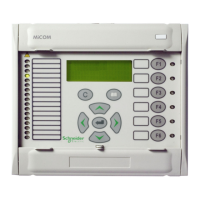
The P634 identifies the installed modules during startup. If a given binary I/O
module is not installed or has fewer binary signal inputs than the maximum
number possible at this slot, then the configuration addresses for the missing
binary signal inputs are automatically hidden in the menu tree.
When configuring binary inputs, one should keep in mind that the same function
can be assigned to several signal inputs. Thus one function can be activated from
several control points having different signal voltages.
In order to ensure that the device will recognize the input signals, the triggering
signals must persist for at least 30 ms. The operating mode for each binary
signal input can be defined.
The user can specify whether the presence (active ‘high’ mode) or absence
(active ‘low’ mode) of a voltage shall be interpreted as the logic “1” signal.
General Notes on the Configuration of Function Group “Binary Output” (OUTP)
The P634 has output relays for the output of binary signals. The number and
connection schemes for the available binary output relays are shown in the
terminal connection diagrams. The “DataModelExplorer” (available as a separate
ZIP archive file) gives information about the configuration options for all binary
outputs.
The P634 identifies the installed modules during startup. If a given binary I/O
module is not installed or has fewer output relays than the maximum number
possible at this slot, then the configuration addresses for the missing output
relays are automatically hidden in the menu tree.
The contact data for the all-or-nothing relays permits them to be used either as
command relays or as signal relays. It is important to note that the contact rating
of the binary I/O modules (X) varies (see Chapter “Technical Data”). One signal
can also be assigned simultaneously to several output relays for the purpose of
contact multiplication.
An operating mode can be defined for each output relay. Depending on the
selected operating mode, the output relay will operate in either an energize-on-
signal (ES) mode or a normally-energized (NE) mode and in either a latching or
non-latching mode. For output relays operating in latching mode, the operating
mode setting also determines when latching will be cancelled.
General Notes on the Configuration of the LED Indicators
The P634 has LED indicators for parallel display of binary signals. LED indicator
H 1 is not configurable. It is labeled “HEALTHY” and signals the operational
readiness of the protection unit (supply voltage present). LED indicators H 2 and
H 3 are not configurable either. H 2 is labeled “OUT OF SERVICE” and signals a
blocking or malfunction; H 3 is labeled “ALARM” and signals a warning alarm.
LED indicator H 17 indicates that the user is in the “EDIT MODE”. Section
“Configuration and Operating Mode of the LED Indicators (Function Group LED)”
in Chapter “Operation” describes the layout of the LED indicators and the factory
setting for LED indicator H 4.
An operating mode can be defined for each LED indicator. Depending on the set
operating mode, the LED indicator will operate in either energize-on-signal (ES)
mode (“open-circuit principle”) or normally-energized (NE) mode (“closed-circuit
principle”) and in either latching or non-latching mode. For LED indicators
operating in latching mode, the operating mode setting also determines when
latching will be cancelled.
With the multi-color LED indicators (H 4 – H 16 and H 18 - H 23) the colors red
and green can be independently assigned with functions. The third color amber
results as a mixture of red and green, i.e. when both functions assigned to the
LED indicator are simultaneously present.
P634
7 Settings
7-2 P634/EN M/R-42-A // P634‑311‑653


 To Next Page