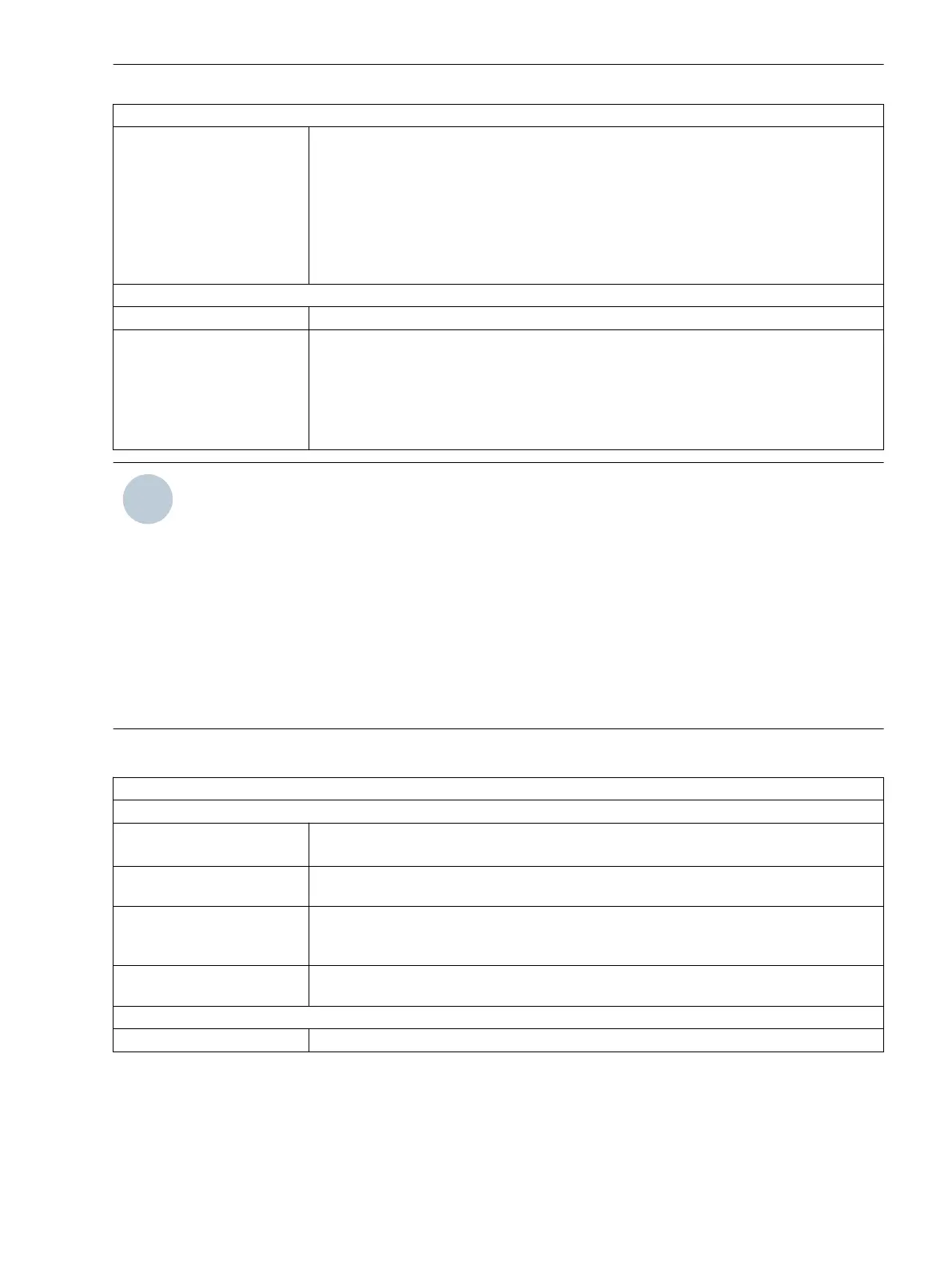
Parameter OPERRAT. MODE = 3-phase
Phase-Phase
Phase-Ground
If you have configured address 219 VT Con. 3ph S2 to V2an,V2bn,V2cn or
V2a2b,V2b2c,VGn, you can select whether a three-phase voltage function will evaluate
the phase-to-ground voltage or the phase-to-phase voltages.
When selecting phase-to-phase, these variables are derived from the phase-to-ground
voltages. The selection is, for example, important for single-pole faults. If the faulty
voltage drops to zero, the affected phase-to-ground voltage is thus zero, and the respec-
tive phase-to-phase voltages drop to the variable of a phase-to-ground voltage.
With phase-to-phase voltage connection, the parameter is hidden.
Parameter MEAS. QUANTITY = P forward or P reverse or Q forward or Q reverse or Power factor
Parameter POWER
Ia Va-n
Ib Vb-n
Ic Vc-n
It is determined which power measuring channel (current and voltage) is to be evaluated
by the function. The extent of the setting texts depends on the connection of the voltage
transformers (see address 213 VT Connect. 3ph). When selecting Vab, Vbc, VGnd,
the phase-to-ground voltages will be calculated if phase-to-ground is configured. If
phase-to-phase is configured, the connected phase-to-phase voltages are used and V
CA
is
calculated from V
AB
and V
BC
.
NOTE
With regard to the phase-selective pickup messages, a special behavior is observed in the three-phase
voltage protection with phase-to-phase variables, because the phase-selective pickup message "Flx01
Pickup Lx" is allocated to the respective measured-value channel "Lx".
Single-phase faults:
If, for example, voltage V
A
drops to such degree that voltages V
AB
and V
A
exceed their threshold values, the
device indicates pickups “Flx01 Pickup A” and “Flx01 Pickup C”, because the undershooting was detected in
the first and third measured-value channel.
Two-phase faults:
If, for example, voltage V
AB
drops to such degree that its threshold value is reached, the device then indi-
cates pickup "Flx01 Pickup A", because the undershooting was detected in the first measured-value
channel.
Table 2-25 Parameter in the Setting Dialog "Measurement Procedure", Mode of Operation 1-phase
Parameter OPERRAT. MODE = 1-phase
Parameter MEAS. QUANTITY = Current, Voltage or Voltage Side2
Parameter
MEAS. METHOD
Fundamental
Only the fundamental harmonic is evaluated, higher harmonics are suppressed. This is
the standard measurement procedure of the protection functions.
True RMS
The “True” RMS value is determined, i.e. higher harmonics are evaluated. This procedure
is applied, for example, if an overload protection element must be realized on the basis of
a current measurement, as the higher harmonics contribute to thermal heating.
Difference to the funda-
mental component
The setting Delta value activates the jump detection. For more information, see
Section 2.19 Flexible Protection Functions at Jump Detection.
Parameter MEAS. QUANTITY = Current
Parameter CURRENT
Functions
2.19 Flexible Protection Functions
SIPROTEC Compact, 7SC80, Manual 331
E50417-G1140-C486-A8, Edition 07.2017



 To Next Page