Chapter 5 Parameter Introductions
96
P2.06 Carrier frequency
Range: 1~16.0kHz[This value depends on the
inverter model]
Inverter Power ( kW)
S2R4GB
~3004GB/
35R5PB
35R5GB
/37R5PB
37R5GB/30
11PB~3011
GB/3015PB
3015GB/30
18PB~
3045G/305
5P
3055G/307
5P~3075G/
3093P
Carrier frequency
(KHz)
1.0~16.0
【6.0】
1.0~16.0
【8.0】
1.0~16.0
【6.0】
1.0~10.0
【6.0】
1.0~6.0
【3.0】
Note:
In order to achieve better control performance, the maximum frequency should not
be less than 36 times of the carrier frequency of the inverter.
In order to reduce noise, a higher carrier frequency can be set. If absolute silence is
not required during the inverter running, lower carrier frequency can be selected to
reduce the wear and tear of the inverter and intensity of radiation.
If carrier frequency is set larger than factory setting, the rated continuous working
current should be decreased.
P2.07 Jump frequency 1
Range: 0.00~Max frequency 【0.00Hz】
P2.08 Jump frequency 2
Range: 0.00~Max frequency 【0.00Hz】
P2.09 Jump frequency 3
Range: 0.00~Max frequency 【0.00Hz】
P2.10 Jump frequency bandwidth
Range: 0~15.00Hz【0.00Hz】
Note:
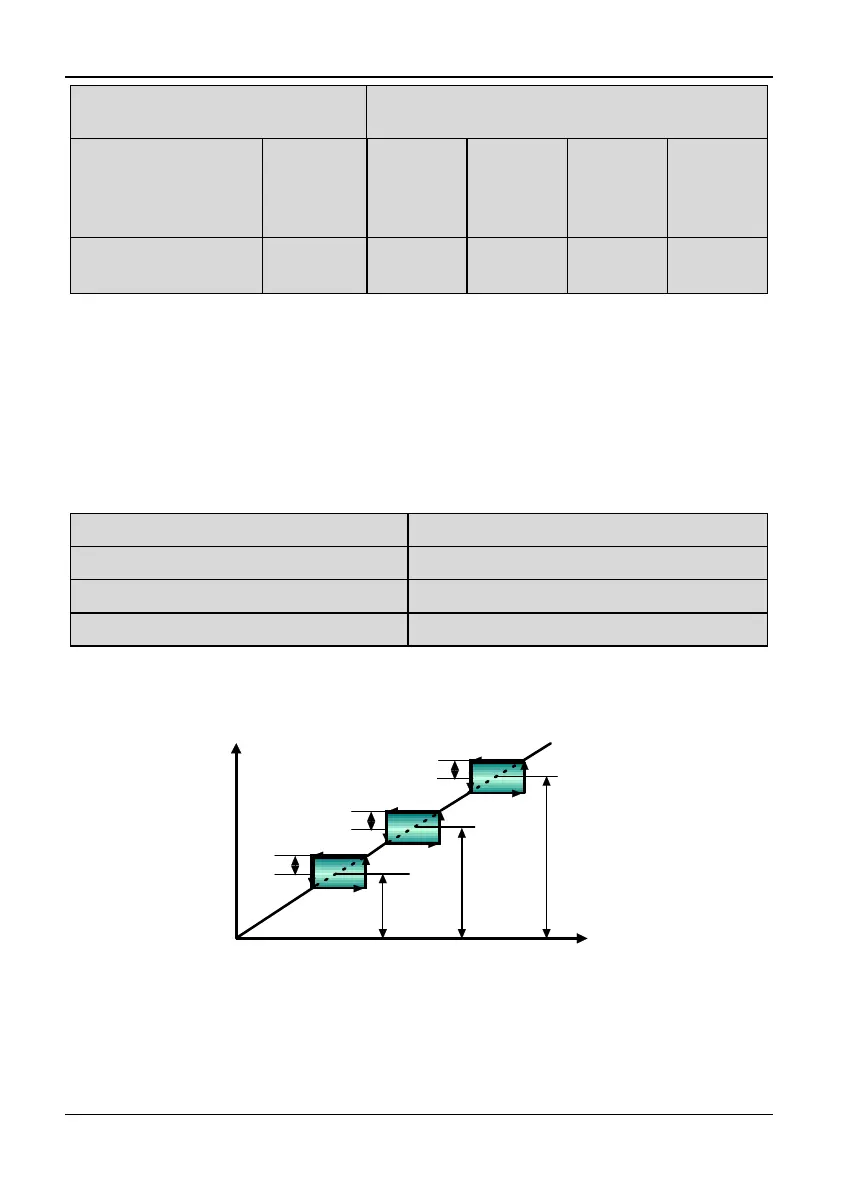
To avoid mechanical resonant, the inverter can skip round some running points,
which is called Jump frequency. As shown in Fig. 5-2-5.
Frequen cy set t in g sign al
Reference Freq.(Hz)
Jump
frequency 1
Jump
frequency 2
Jump
frequency 3
Jump
frequency
bandwidth
Jump frequency
ban dwidt h
Jump frequency
bandwidt h
Fig. 5-2-5 Jump Frequency
The inverter can set three jump frequency points, and the jump frequency
bandwidth can overlap or nesting. If overlapped, the range broadens. When all
three jump frequency set to 0.00 Hz, the jump function will be disabled.


 To Next Page