35
Scanner
®
2000 microEFM Section 2
1. Verify that the meter is properly installed in the ow line (per manufacturer’s instructions).
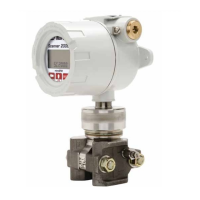
2. Bolt a ange-by-ange 5-valve manifold (as recommended by Cameron) to the Scanner 2000 MVT sen-
sor.
a. Locate the H and L markings on the integral MVT sensor body and position the MVT/manifold as-
sembly so that the upstream side of the ow line can easily be connected to the sensor’s “High” port
and the downstream side of the ow line can be connected to the sensor’s “Low” port. The Scanner
2000 enclosure can be rotated to face the desired direction.
b. Position the manifold so that all valves are accessible from the front of the instrument.
3. Connect the Scanner 2000 and manifold assembly to the differential pressure meter. Hardware require-
ments will vary, depending upon the installation conguration. However, minimally, an adapter is re-
quired that can span between the threaded pressure tap/orice ange connector and the non-threaded
manifold. This adapter can be a one-piece stabilizer (often preferred for added strength and stability) or a
short heavy wall pipe nipple attached to a futbol ange (available from Cameron). Use a suitable com-
pound or tape on all threaded process connections.
CAUTION Do not use Teon
®
tape on the threads of the union, adapter, or pipe plugs. Use of
Teon
®
tape will void the explosion-proof rating of the instrument.
4. Install the RTD assembly in the thermowell. Route the RTD assembly cable through the conduit opening
in the top of the Scanner 2000 to connect to the main circuit board. A wiring diagram for the RTD assem-
bly is provided in Figure 3.5, page 66. For hazardous areas, review Hazardous Area Installations, page 27.
5. Route any additional inputs/outputs or COM connections, etc. through the conduit opening in the top of
the Scanner 2000. For hazardous areas, review Hazardous Area Installations, page 27.
6. Perform a manifold leak test as described on page 55.
7. Verify the zero offset, if required (and other calibration points, if desired). See the ModWorX™ Pro Soft-
ware User Manual, Part No. 9A-30165025, for complete instructions. See also Zero Offset (Static Pres-
sure or Differential Pressure), page 56, Static Pressure Calibration and Verication, page 56, and Differential
Pressure Calibration and Verication, page 57.
CAUTION Do not put the Scanner into operation until the valves are positioned properly so that
pressure is supplied to both sides of the MVT. For instructions on proper valve positions,
see Placing the Scanner into Operation, page 58.
Installation Procedure—Remote Mount to Orice Meter or Cone Meter
A Scanner 2000 can be mounted remotely and connected to an orice meter or cone meter with tubing for gas
measurement. The setup of the meter run and plumbing congurations can vary widely, depending upon the
challenges existing on location. Figure 2.6 shows a typical remote-mount installation.
WARNING HAZARDOUS AREA USE. The Scanner 2000 is certied for hazardous area use only when
installed in accordance with applicable standards and local wiring practices. Carefully
review Hazardous Area Installations, page 27, to determine specic installation require-
ments (cable glands, conduit seals, signal cable, RTD, etc.).


 To Next Page