Overview
1. Overview
1.1 Introduction
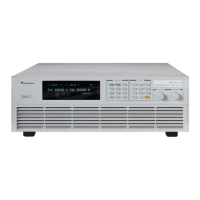
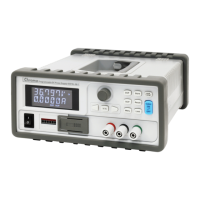
Chroma 62000H Series Programmable DC Power Supplies with Solar Array Simulation are
high power density power supplies that provide stable DC output and accurate measurement
of voltage and current.
62000H Series DC Power Supplies with Solar Array Simulation have the following features:
(1) The output can simulate the I-V curve of a solar panel module in the Programming Mode.
(2) Voltage mode with two control loops to provide a stable, quick response output.
(3) The ability to set the slew rates of the output voltage and current.
(4) High power density output; the maximum output power can be as high as 15kW in a unit
under 3U in height.
(5) 16-bit ADC/16-bit DAC to provide excellent resolution.
(6) Lower transient spike and transient response time to insure the unit under test receives a
stable output and protection under load variations.
(7) Editing mode (Programming Mode) for output waveforms to provide multiple output
voltage and current combinations in real time for extended time period tests.
(8) Rotary knob and keyboard controls on the front panel to set the output voltage and
current.
(9) VFD panel: a high brightness, wide viewing angle interface for monitoring and setting
functions.
(10) Remote control via GPIB/Ethernet (option), USB, RS-232/RS-485, or Analog
Programmable (APG) interface.
1.2 System Functions
1.2.1 Operating Modes
(1) Local operation using the keyboard and rotary knob on the front panel.
(2) Remote operation using a GPIB/Ethernet (option), USB or RS-232/RS-485 interface.
(3) Through the APG input to control the output using analog signals.
(4) The setting and editing of I-V curves is provided by the Solar Array Simulation Soft Panel.
1.2.2 Protection
(1) Protection is provided for voltage phase loss, input over-voltage or under-voltage, output
over-voltage, over-current, over-power, over-temperature, fan fail, CV/CC foldback, etc.
(2) Fan speed is controlled by the internal temperature of the power supply.



 To Next Page