C
4
(g.25/D)
(Radiator drain pipe
38.16)
1
2 2
1
(g.26/D)
3
3
Replacing the coolant
To replace the coolant correctly:
1. Place the machine on a at surface.
2. Switch off the engine and remove the ignition key.
Place a “maintenance work in progress” sign in the cab.
3. Open and fasten the bonnet.
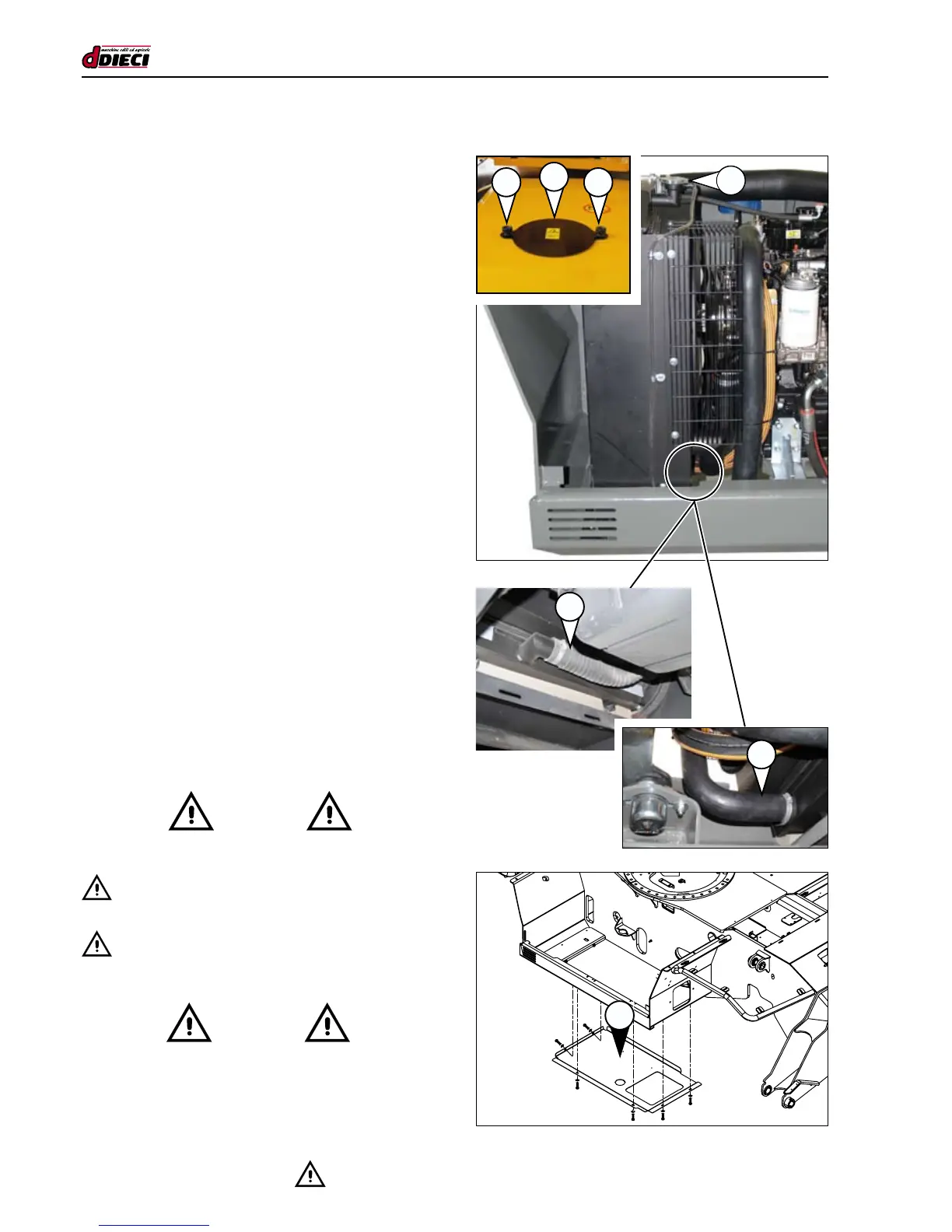
4. Unscrew the screws (g.26/D) to remove the bottom part
of the engine compartment (g.26/D Pos.“1”).
5. Place a suitably sized container below the radiator to
collect any coolant that may leak during the replacement
procedure.
6. Remove the lid on the bonnet (fig.25/D Pos.“1”) by un-
screwing the screws (g.25/D Pos.“2”) and remove the
ller cap (g.25/D Pos.“4”) to speed up the operation.
7. Remove the radiator hose (g.25/D Pos.“3”) to allow the
radiator water to ow out.
8. Allow the cooling circuit to empty completely.
9. Check the condition of the radiator hoses and their fit-
tings. Replace if necessary.
10. Clean the radiator by pouring clean water through the l-
ler cap (g.25/D Pos.“4”) and allow the water to drain out
through the radiator hose hole (g.25/D Pos “3”).
If necessary, add a detergent to the clean water.
11. When clean, close the drain hole by reinserting the ra-
diator sleeve (g.25/D Pos.“3”).
12. Fill the cooling system through the filler cap (fig.25/D
Pos.“4”) up to the level (3 cm below the radiator cap)
using the coolant prepared beforehand.
13. Close the cap (g.25/D Pos.“4”) and switch on the engine.
Allow the engine to idle for a few minutes.
14. Check that there are no leaks, check the level and top up
with more coolant if necessary.
15. When you have finished, re-close the lid (fig.25/D
Pos.“1”) with the screws (g.25/D Pos.“2”).
- CAUTION -
Use demineralised water to ll the cooling system.
Hard water causes scale and reduces system lifetime.
- CAUTION:
Wear appropriate protective clothing during these procedures.
- CAUTION:
Exhausted coolant is a potential danger to the environment
and must be disposed of appropriately.
- CAUTION -
The radiator must always be filled with a solution of
distilled water and antifreeze to avoid corrosion and to
prevent the water from freezing in the system.
The mixture percentages are indicated on the antifreeze
container.


 To Next Page