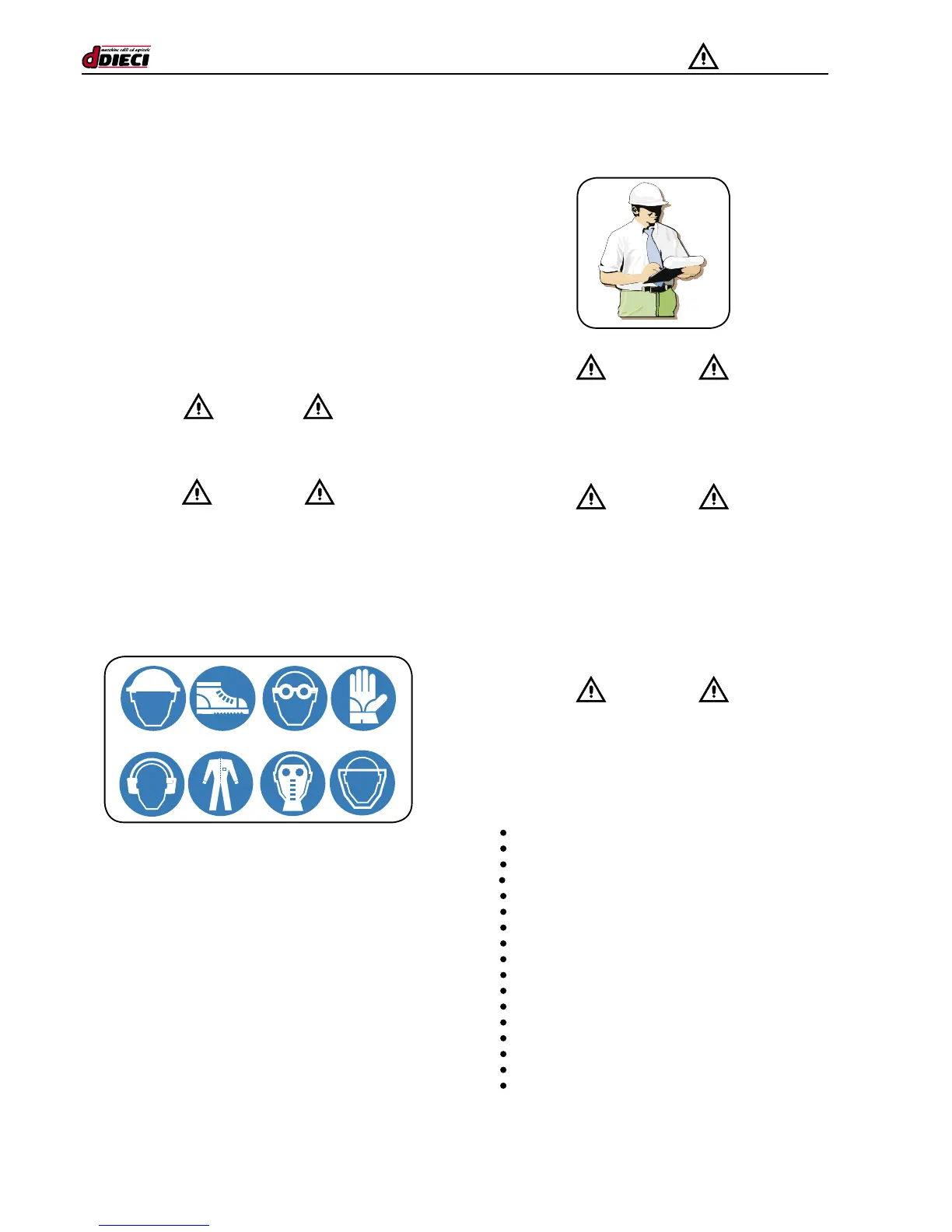
PROTECTIVE CLOTHING
- Always wear garments that are appropriate for the job
you have to accomplish. Do not wear loose clothing, ties,
chains, belts or other accessories that may become tan-
gled in the control levers or other parts of the machine.
- Do not wear jewellery or metallic accessories that could
cause injury if they become entangled or if the wearer is
subjected to electric current.
- Tie back any long hair protruding from your safety helmet
to ensure it does not become tangled in the machinery.
- The operator must wear suitable protective clothing to
provide adequate accident prevention depending on the
type of work or site.
- DANGER -
Before starting to use the machine, the operator must ask
the safety or site manager about possible risks and the type
of protective clothing to wear.
- CAUTION -
The operator must always have the following:
Safety helmet;•
Safety shoes;•
Safety goggles or face shield;•
Safety gloves;•
Ear defenders;•
Reective clothing;•
Waterproof clothing;•
Respirator or respiratory lter;•
- There are various types of safety garments of all sizes
available on the market. Always use the most appro-
priate model for the type of application and ensure the
garments t properly.
- Safety clothing must be considered personal; do not
wear other people's safety clothing.
- Safety clothing must always be complete and in good
condition. A ruined garment no longer guarantees ade-
quate protection. Do not wear garments that are worn;
replace with new garments before you start working.
- Prolonged exposure to loud noise can damage your he-
aring or may cause loss of hearing. Always protect your
hearing by wearing ear defenders or earplugs to protect
yourself from excessive and tiresome noise.
- Do not listen to the radio or music through headphones
to while using the machine. The operator must always
pay the utmost attention.
INSPECTING THE MACHINE
- CAUTION -
Inspect the machine every day or every shift.
Carefully check the machine before resuming work.
- Ensure the tyres are suitable for the type of terrain.
There are tyres for working on sand, earth, farmland, snow,
etc. Consult your agent or dealer for more information.
- CAUTION -
If you discover any malfunctions (abnormal noise, vibra-
tions, odour, instrument errors, smoke, oil leaks, etc.) or
if the machine does not comply with safety regulations,
stop using the machine and immediately report your
concern to the person in charge.
- IT IS FORBIDDEN for the driver to carry out any repairs
or adjustments unless he or she has been specifically
trained to do so. The driver must keep the machine in
perfect working condition if entrusted to do so.
- CAUTION -
Before starting work, ensure the machine is fully effi-
cient to guarantee maximum efciency and compliance
with all safety regulations.
- To carry out the checks listed below, consult the chapter
about maintenance in this manual.
- Carry out the functional checks and inspections listed below.
Parking brake efciency.
Engine oil level (check and top up if necessary).
Hydraulic oil level (check and top up if necessary).
Clogged air lter indicator (check and clean if necessary).
Tyre condition and pressure (check).
Fuel level.
Signalling and warning devices (check).
Steering efciency.
Service brake efciency.
Nuts and bolt torque.
Lights.
Direction indicators.
Hazard warning lights.
Switches.
Pilot lamps.
Windshield wipers.
Reversing alarm.
If the machine is not used for a long time, it must be che-
cked more thoroughly than usual.


 To Next Page