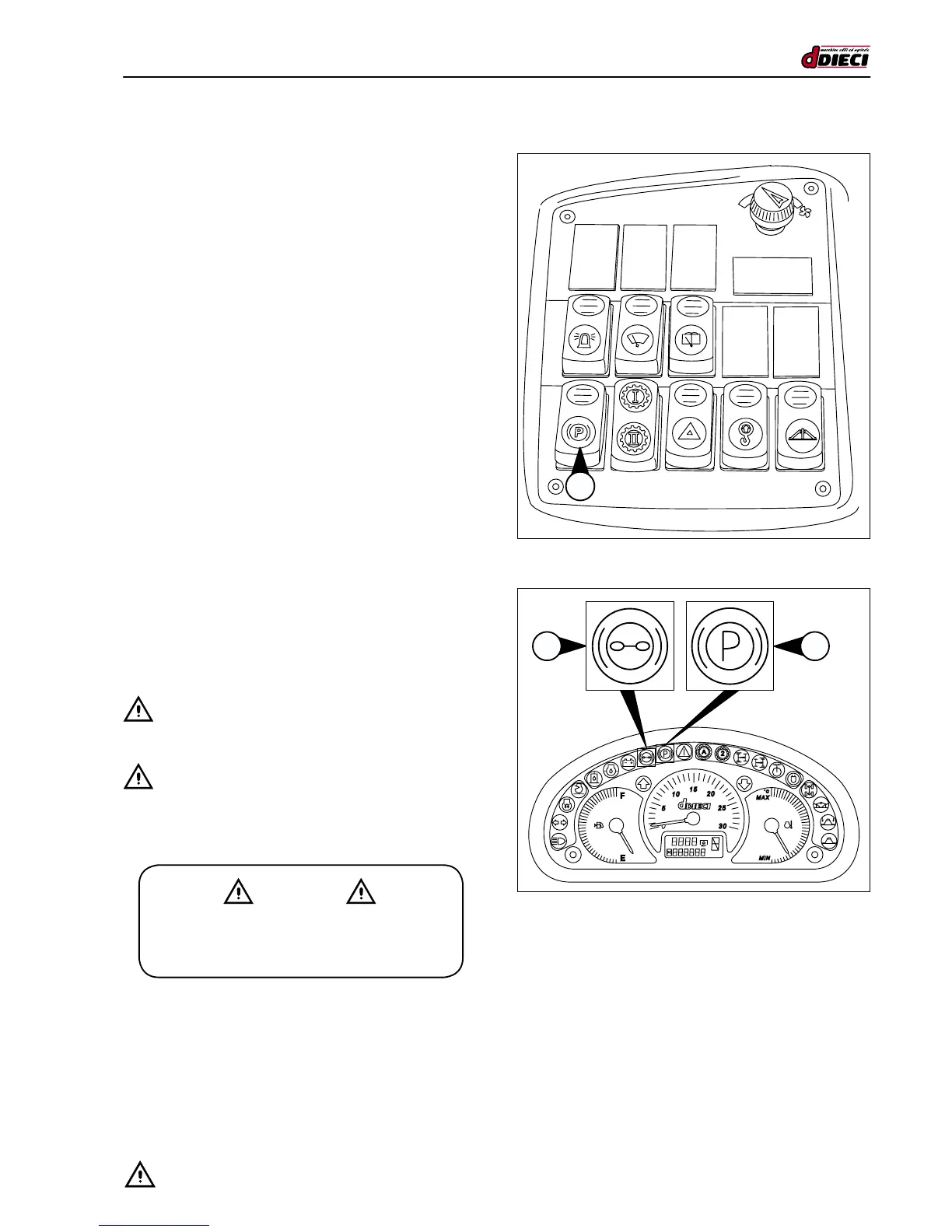
A
2
(g.28/C)
1
(g.29/C)
PARKING BRAKE
The parking brake must be engaged every time you leave
the machine (whether the engine is switched on or off),
during temporary stops, every time the machine is used at
a standstill (even when the stabilisers are lowered and the
wheels are off the ground). The parking brake is engaged
automatically when the engine is stopped.
Press switch “A” (fig.28/C) to engage the parking brake.
The pilot lights on the switch and in the instrument cluster
(g.29/C Pos.“1”) light up to indicate that the brake is enga-
ged. When the parking brake is engaged the machine can-
not move, the hydrostatic transmission is disabled.
To check the efciency of the parking brake, proceed as follows:
1. Get in the cab. Fasten your seat belt.
2. Start the engine.
3. Park the machine on at and dry ground.
4. Engage the parking brake (g.28/C Pos.“A”).
5. Raise the tools until they are in the correct transfer position.
6. Engage slow gear.
7. Engage the forward gear switch.
8. If the machine does not move, press the accelerator to
gradually increase the engine speed to 1,500 r.p.m.
The machine must not move.
9. The test should not last for more than 20 seconds.
10. If the machine moves during the test, the brake must be
checked at a DIECI service centre.
- CAUTION:
If there is a parking brake malfunction, do not use the machine.
- CAUTION:
Unauthorised modications to the rear axle ratio, to machine
weight, that is wheel and tyre dimensions, may compromise
parking brake efciency.
- CAUTION -
Before checking the efciency of the parking
brake, ensure nobody is anywhere near the
machine.
If pilot light “2” (g.29/C) lights up, consult the “Maintenance”
chapter in this manual.


 To Next Page