VIsualEyes 515/525 - Additional Information Page 104
Summary View:
Detailed, individual cycles: Detailed view will draw each cycle individually and fit a line to each cycle
Concise combined cycles: Concise will show every cycle overlapped and a single fitted line is drawn
through the concise view.
Keep aspect ratio: This allows the nystagmus to be displayed in a non-compressed form, allowing for easy
recognition of the slow phase velocities of nystagmus. Disabling this feature will cause the nystagmus to
appear more compressed.
Display Interval: Set the desired length of time (in seconds) to display data in the test window. This feature
only becomes available when “Keep aspect ratio” is disabled.
Invert chair signal: Enabling this feature sets the eye trace to overlap the stimulus trace, providing a
different view for comparing results. By default the setting is disabled.
Figure 8.4.10 VOR Suppression subtest settings
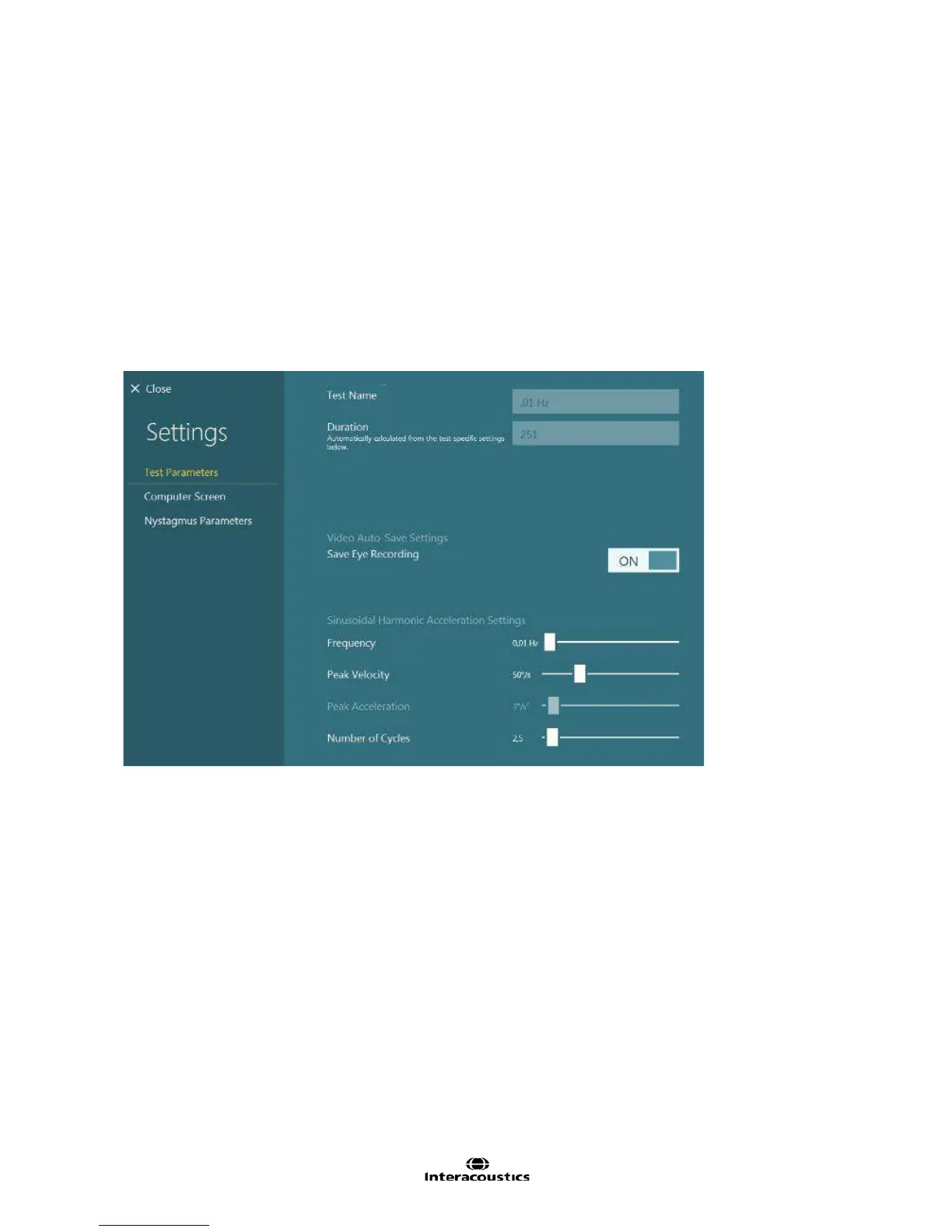
Test Name: Name of subtest
Duration: Define how long the eye movement is to be recorded and analyzed (in seconds). This value is
calculated based on the Frequency, Peak Velocity, and Number of Cycles.
Fixation light: Determines when the fixation light in the goggles is displayed. Manual (default) will leave the
operator to determine when the fixation light should be displayed. Timed will have the fixation light come on
automatically at the designated time.
Save Eye Recording: Choice to save eye video recordings.
Target Direction: Defines direction of target movement.
Extend end of Recording: If enabled the test will return the target back to center for two seconds. Not
recommended if the tests are run automatically.
Sinusoidal Harmonic Acceleration Settings:
Frequency: Define the frequency (Hz) of Stimulus (Chair motion side to side). The frequencies available
include 0.01 Hz to 0.32 Hz with increments of 0.01 Hz.
Peak Velocity: Define the peak velocity (in dps) the chair will rotate. Range of velocities is 1 to 200 degrees
per second.
Peak Acceleration: The maximum rate at which the chair can accelerate (in m/s
2
). This is automatically
calculated based on the sinusoidal harmonic acceleration settings.






 To Next Page