VIsualEyes 515/525 - Additional Information Page 28
3.5 Caloric testing
The caloric irrigation test acquires eye movement data during direct stimulation of the vestibular end organ
using an air or water irrigator to provide a temperature controlled stimulus. Recorded data is analyzed for
slow phase velocity and frequency of nystagmus beating and is displayed in various standard diagrams.
Caloric testing is available in both VisualEyes 515 and VisualEyes 525 software.
Please note that Caloric testing is contraindicated in persons exhibiting the following:
• History of hypertension (uncontrolled, acute or de-compensated phase)
• History of cardiac problems (arrhythmias especially bradycardia or Stokes-Adams attack; acute or de-
compensated phase) e.g. if someone has unstable angina, a recent myocardial infarction (within last 3-6
months) or is undergoing cardiac investigations
• Psychotic/neurotic disorders (acute or de-compensated phase)
• Epilepsy (acute or de-compensated phase)
• Eye surgery (within the previous 3 months)
• Ear surgery (within the previous 6 months)
• Perforated eardrum (water stimulation not allowed, air stimulation may be tolerated)
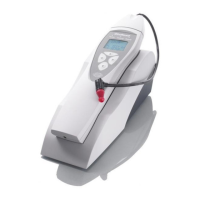
The caloric test will connect with the Air Fx air caloric irrigator or Aqua Stim water caloric irrigator based on
the test configuration. If the clinic uses a third party caloric irrigator, the test will have to be configured for a
manual irrigator setup where the operator runs the irrigator outside of software control. In either case the
caloric irrigator should be turned on prior to starting the test.
The default caloric test will start with the right warm subtest. The connected irrigator should begin to warm up
to the specific temperature as defined in the test settings. If using a third party irrigator, turn on the irrigator
and have it reach the warm temperature setting. When the irrigator is ready to dispense the warm water or
air, the Start button will become available.
When the test is ready to begin, use the button on the Air Fx or Aqua Stim handle to begin the irrigation and
start recording in the software. If using a third party irrigator, start the test using the RF Remote or foot pedal
then begin irrigation. As the irrigation proceeds, the software will record the patient’s eye movements. As the
nystagmus beats are detected, the software will calculate the slow phase velocity for the beats and display
the velocity in the Pod View graph on the right side of the screen. The average slow phase velocity (a.SPV)
will be calculated based on the peak response window settings (by default 10 seconds). As with nystagmus
tests, the software will display triangles on the waveform indicating left beating or right beating nystagmus.
If the irrigation needs to be suddenly aborted, remove the speculum or silicone tube from the ear and direct
stimulus flow elsewhere. The irrigator stimulus flow will continue until the pre-selected irrigation time has
elapsed, at which time an indicator tone will sound and the irrigation will stop. Alternatively, press and hold
the irrigator button for three seconds to abort the irrigation. A message will be displayed on the computer
test screen asking “Are you sure you want to stop?”. Click or touch yes to stop the recording. Click or touch
no to continue recording.
After the irrigation has completed, remove the irrigator handle from the patient’s side and have the patient
begin alerting tasks to stay focused during the test and provide a stronger nystagmus response. As the
patient continues alerting tasks, the patient’s a.SPV will rise. Once the a.SPV begins to drop by 10% of the
maximum value, the fixation light will come on inside the goggle. If the patient’s maximum a.SPV value is too
low (such as with cool air calorics), the software may not detect the drop in the response, so the operator
must watch the Pod View and intercede with activating the fixation light (using the Fixation button on the RF
Remote or the Fixation button on the screen). The fixation light will turn off after 10 seconds if activated
automatically, otherwise the operator must turn off the fixation light manually after 10 seconds. This will allow
the software to calculate the fixation index value. After the fixation light is turned off, the remaining
nystagmus will still be tracked and recorded for post-fixation information.
When the test is completed, the software will either color the nystagmus slow phase portions of the
waveform in green or leave the triangles depending on the System Default Settings. The peak response
window will be displayed in the Pod View with a small dashed box in light blue color.






 To Next Page