2. Thread the breakaway cable through the guide welded on the side of the towing bar.
3.
Loop the end of the cable round the towing vehicle hitch and secure with the spring clip.
12.2.3 Parking the machine
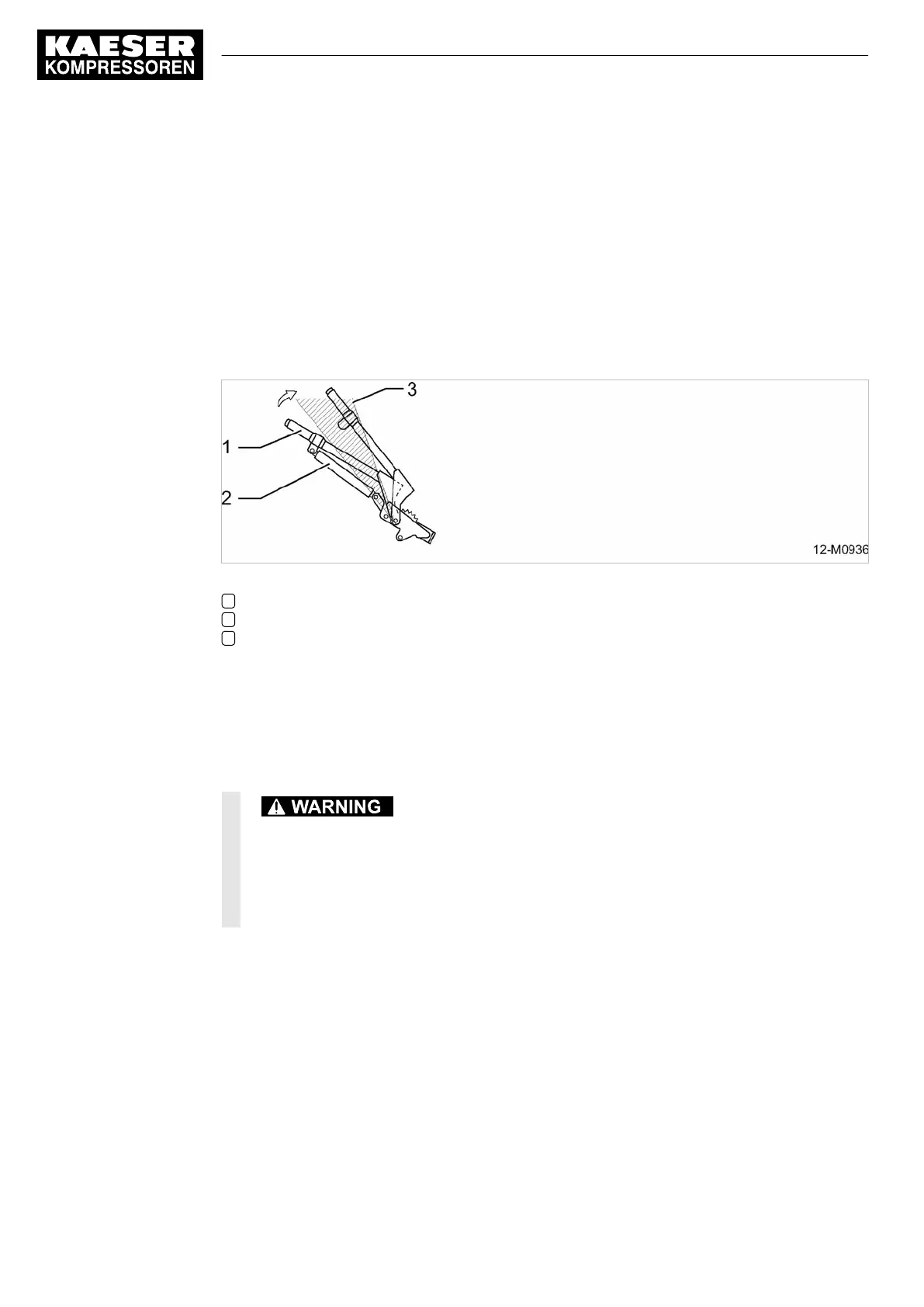
Towing devices with parking brake
The parking brake is not a running brake and is used only to lock the wheels when the machine is
positioned. The gas spring automatically increases parking brake force if the machine rolls back‐
wards or when parked on a slope.
Fig. 81 Actuating the parking brake with gas spring assistance
1 Parking brake lever
2 Gas spring
3 Dead point zone
➤ Always engage the parking brake when parking the machine.
12.2.3.1 Option rb/rm/rr
Parking a machine with an adjustable-height chassis
When parking on a slope, securely chock the machine before uncoupling.
Machine without parking brake.
Serious injury or death can result from an unsecured machine rolling away.
➤ Securely chock the machine before uncoupling.
➤ As a general rule, the machine should always be blocked with chocks when it is not be‐
ing moved.
1. Use a coupled towing vehicle to move the machine into position.
2. Place chocks under the wheels.
3. Loosen the lighting and signalling system.
4. Throw the clamping lever to loosen the support.
5. Manually lower the support.
6. Throw the clamping lever to re-secure the support.
The support must be secured.
7. Pull up and lift the coupling release lever.
8. Position the towing mechanism laterally next to the towing device of the towing vehicle.
9. Remove the machine from the towing vehicle.
12 Decommissioning, Storage and Transport
12.2 Transport
226
Operator Manual Screw Compressor
M27
No.: 9_9548 05 USE
Option rb/rm/rs, rc/ro/rr,
rg/rp/rr, rc/ro/rs


 To Next Page