LDI Intellectual Property.
Not for secondary distribution or replication, in part or entirety.
DIGISONDE-4D
SYSTEM MANUAL
VERSION 1.2.11
1-4 SECTION 1 - GENERAL SYSTEM DESCRIPTION
DIGISONDE
®
FAMILY OF IONOSPHERIC SOUNDERS
1:2. The Digisonde
®
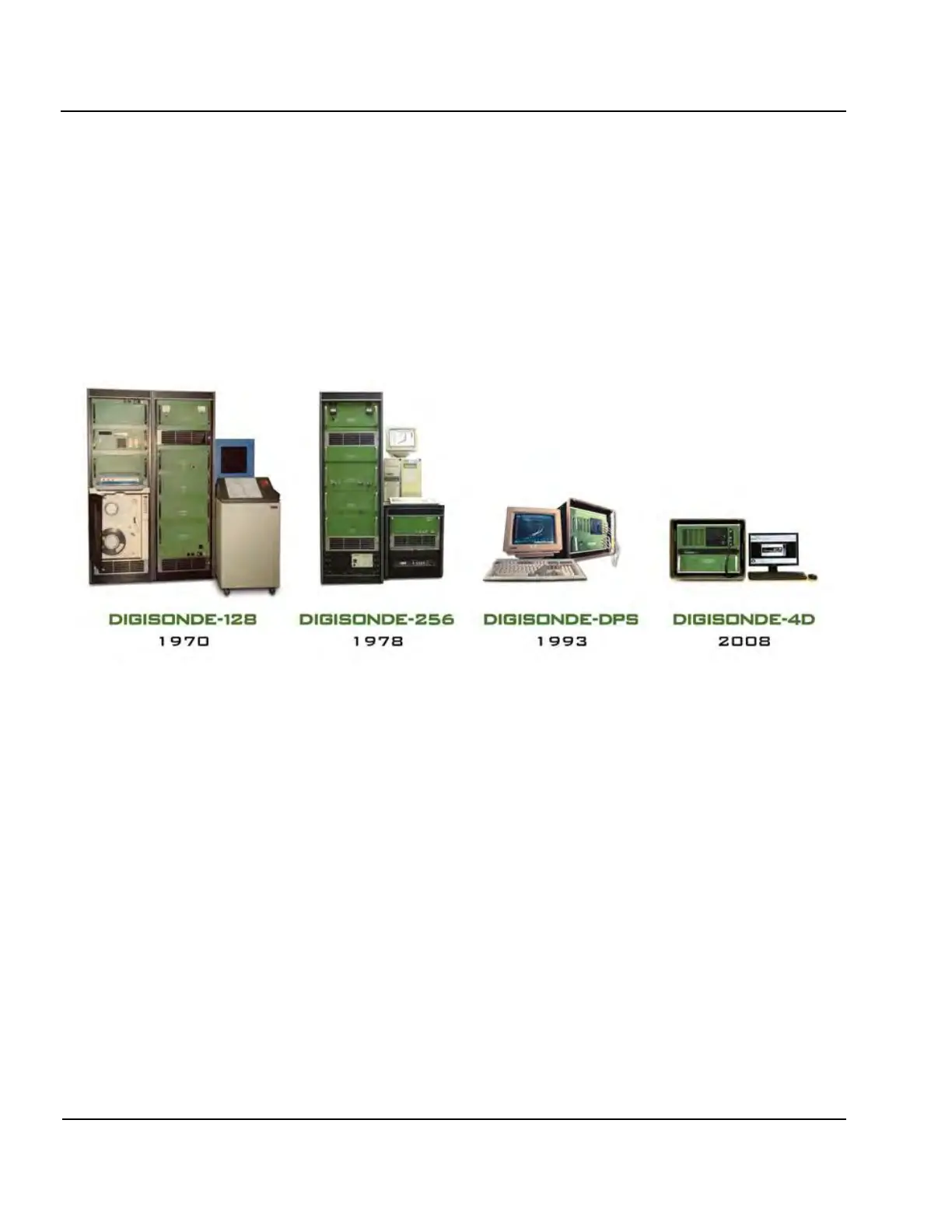
Portable Sounder 4D, sometimes referred to as DPS4D or simply Digisonde-4D is the
latest digital ionosonde that was developed during 2004-2008 (Figure 1-1). While preserving the basic princi-
ples of the Digisonde
®
family – the Digisonde-128, the Digisonde-256, the Digisonde
®
Portable Sounder DPS1,
and the DPS4 – the Digisonde-
4D model introduces a number of important hardware and software changes
that implement the latest capabilities of new digital radio frequency (RF) circuitry and embedded computers.
The “D” in the new model refers to the digital transmitters and receivers in the Digisonde-4D, which uses digi-
tal up- and down-converter IC chips that implement the classic functions of radio transmitters and receivers by
numeric techniques. It also uses new software solutions for data acquisition, hardware control, user command-
ing, and data processing.
Figure 1-2: Evolution of the Digisonde
®
GENERAL DESCRIPTION
1:3. Vertical radio sounding makes use of the fact that radio waves are reflected in the ionosphere at the
height where the local cutoff frequency equals the frequency of the radio wave. The original analog ionosondes
used for ionospheric sounding since Breit and Tuve described the concept in 1926 started to be replaced by dig-
ital instruments in the 1970s. Modern digital ionosondes are highly flexible high frequency (HF) radar systems
tasked to reliably describe the status of the ionospheric density distribution on a continuous basis. Robust au-
tomated operation is a sine qua non for the monitoring function of the ionosonde, and measuring flexibility and
precision are required for research applications.
1:4. Unlike incoherent scatter radar systems, ionosondes must be built at low cost and easy to install to
make operations at many sites around the world feasible. As for the previous DPS models, the Digisonde-4D
uses one simple crossed delta antenna for transmission, and an array of four small crossed loops for reception.
The integrated transceiver package of Digisonde-4D is shown in Figure 1-1, and one of the four crossed mag-
netic loop receive antennas in Figure 1-3.



 To Next Page