LDI Intellectual Property.
Not for secondary distribution or replication, in part or entirety.
DIGISONDE-4D
SYSTEM MANUAL
VERSION 1.2.11
1-36 SECTION 1 - GENERAL SYSTEM DESCRIPTION
Digital Beamforming (Aperture Resolution Technique)
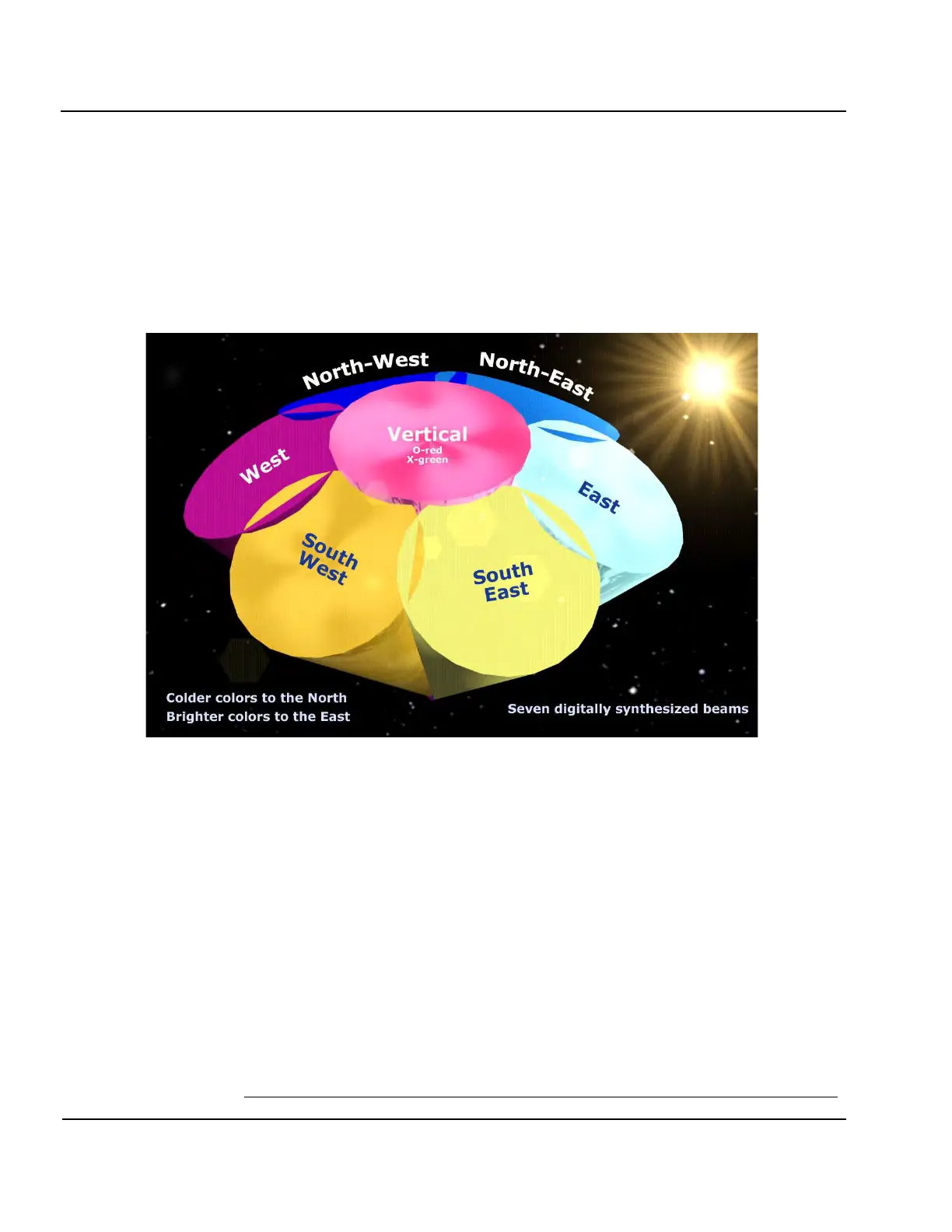
1:76. Digital beamforming is done by taking four complex amplitudes observed in a particular Doppler line
of the spectrum on four antennas and forming seven beams shown in Figure 1-23, one overhead (0° zenith an-
gle) and six oblique beams (the nominal 30° zenith angle can be changed by the operator) centered at North and
South directions and each 60° in between. All seven beams are formed using the same four complex samples,
at one reflection height at a time.
Figure 1-23: Seven Digitally Synthesized Beams for the Angle of Arrival Measurement in Ionogram
Mode
1:77. Oblique beams are formed by phase shifting the four complex amplitudes to compensate for the addi-
tional path length in the direction of each selected beam. If a signal has actually arrived from near the centre of
one of the beams formed, then after the phase shifting, all four signals can be summed coherently, since they
now have nearly the same phase, so that the beam amplitude of the sum is roughly four times each individual
amplitude. The farther the true beam direction is away from a given beam centre the farther the phase of the
four signals drift apart and the smaller the summed amplitude. However, in the DPS system the beams are so
wide that even at the higher frequencies the signal azimuth may deviate more than 30° from the beam centers
and the four amplitudes will still sum constructively [Murali, 1993].
1:78. The technique for finding the angle of arrival is then simply to compare the amplitude of the signal on
each beam and declare the direction as the beam centre of the strongest beam. The accuracy of this technique is
limited to 30° in azimuth and 15° in elevation angle (the six azimuth beams are separated by 60° and the
oblique beams are normally set 30° away from the vertical beam); as opposed to the Drift angle of arrival tech-
nique described in the next section which obtains accuracies approaching 1°. The fundamental principle of this
technique is that there is no direction which can create a larger amplitude in a given beam than the direction of



 To Next Page