LDI Intellectual Property.
Not for secondary distribution or replication, in part or entirety.
DIGISONDE-4D
SYSTEM MANUAL
VERSION 1.2.11
1-34 SECTION 1 - GENERAL SYSTEM DESCRIPTION
Angle of Arrival Measurement Techniques
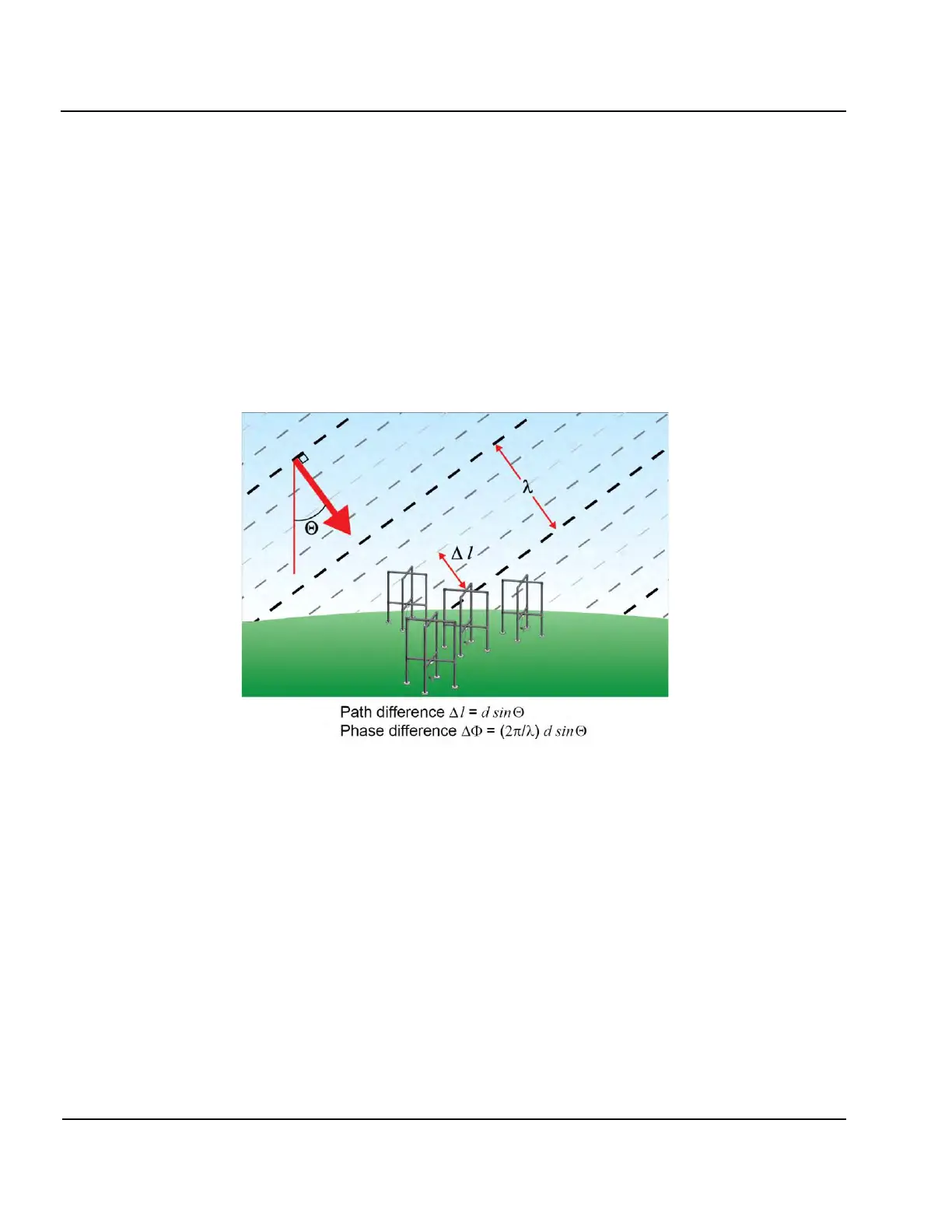
1:72. Another new development in the 1970’s was the coherent multiple receiver array [Bibl and Reinisch,
1978] which allows angle of arrival (incidence angle) to be deduced from phase differences between antennas
by standard interferometer techniques. Given a known operating frequency, and known antenna spacing, by
measuring the phase or phase difference on a number of antennas, the angle of arrival of a plane wave can be
deduced. This interferometry solution is invalid, however, if there are multiple sources contributing to the re-
ceived signal (i.e., the received wave therefore does not have a planar phase front). This problem can be over-
come in over 90% of the cases as was first shown with the Digisonde-256 [Reinisch et al., 1987] by first isolat-
ing or discriminating the multiple sources in range, then in the Doppler domain (i.e., isolating a plane wave-
front) before applying the interferometry relationships.
Figure 1-21: Angle of Arrival Interferometry
1:73. The Digisonde-4D system uses two distinct techniques for determining the angle of arrival of signals
received on the four antenna receiver array,
a. An aperture resolution technique using digital beamforming, in which four antennas are used
to form seven beams and then select the beam with the largest amplitude as the best representa-
tion of the echo arrival angle; and
b. A super-resolution technique, in which signal phases in antenna triplet combinations are used
to restore the angle direction to the reflecting source in the ionosphere.



 To Next Page