LDI Intellectual Property.
Not for secondary distribution or replication, in part or entirety.
DIGISONDE-4D
SYSTEM MANUAL
VERSION 1.2.11
SECTION 1 - GENERAL SYSTEM DESCRIPTION 1-31
1:64. Except for the FM/CW chirp sounder which operates well on transmitter power levels of 10 to 100 W
(peak power) the above techniques and cited references typically employ a 2 to 30 kW peak power pulse trans-
mitter. This power is needed to get sufficient signal strength to overcome an atmospheric noise environment
which is typically 20 to 50 dB (CCIR Noise Tables) above thermal noise (defined as kTB, the theoretical mini-
mum noise due to thermal motion, where k = Boltzman’s constant, T = temperature in K, and B = system
bandwidth in Hz). More importantly, however, since ionogram measurements require scanning of the entire
propagating band of frequencies in the 0.5 to 20 MHz RF band (up to 45 MHz for oblique measurements), the
sounder receiver will encounter broadcast stations, ground-to-air communications channels, HF radars, ship-to-
shore radio channels and several very active radio amateur bands which can add as much as 60 dB more back-
ground interference. Therefore, the sounder signal must be strong enough to be detectable in the presence of
these large interfering signals.
1:65. To make matters worse, a pulse sounder signal must have a broad bandwidth to provide the capability
to accurately measure the reflection height, therefore the receiver must have a wide bandwidth, which means
more unwanted noise is received along with the signal. The noise is distributed quite evenly over bandwidth
(i.e., white), while interfering signals occur almost randomly (except for predictably larger probabilities in the
broadcast bands and amateur radio bands) over the bandwidth. Thus a wider-bandwidth receiver receives pro-
portionally more uniformly distributed noise and the probability of receiving a strong interfering signal also
goes up proportionally with increased bandwidth.
1:66. The 33 s wide chips of the DPS transmitter pulses imply a transmission bandwidth of 30 kHz requir-
ing a receiver bandwidth of at least 30 kHz. This large bandwidth makes the receiver susceptible to a variety of
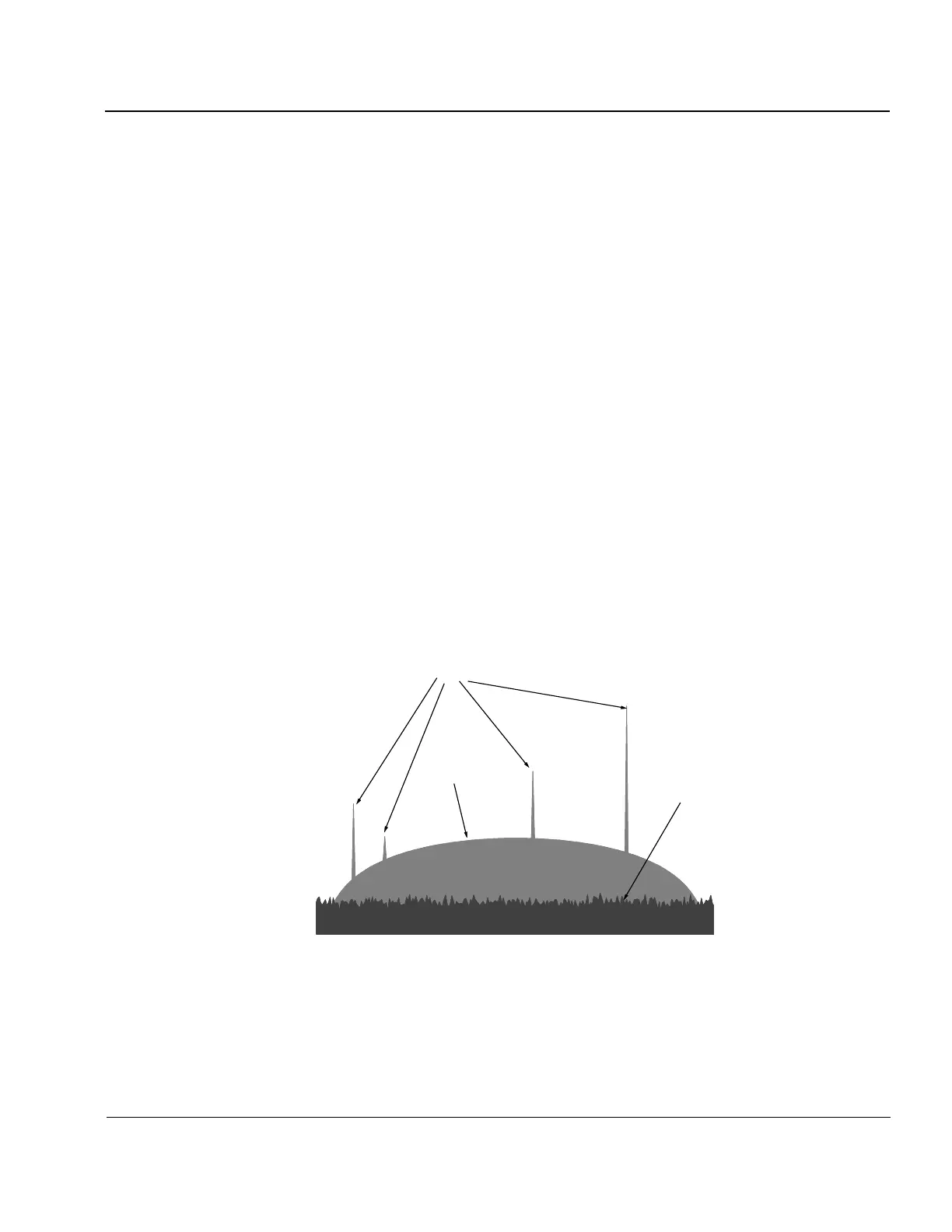
“contaminating” radio emissions that are received together with the signal. Figure 1-18 illustrates the typical
situation when a wideband signal is mixed with two types of radio contamination, wideband background noise
and narrow-band interferers.
Noise
Signal
Interferers
Frequency
Amplitude
Figure 1-18: Wideband Received Signal Spectrum Contaminated by Interferences and Background
Noise.
1:67. Effective methods for mitigating the background noise exist such as signal integration/accumulation,
inter-pulse phase switching, pulse modulation, or increased transmission power, but removing narrow-band in-



 To Next Page