LDI Intellectual Property.
Not for secondary distribution or replication, in part or entirety.
DIGISONDE-4D
SYSTEM MANUAL
VERSION 1.2.11
3-6 SECTION 3 - OPERATING INSTRUCTIONS
CHAPTER 1
PROGRAMMING DIGISONDE
®
MEASUREMENTS
PROGRAMS, SCHEDULES, AND SCHEDULE START TIMES
3:1. The Digisonde
®
is a configurable scientific instrument that offers a variety of measurement modes and
corresponding data products. The basis of all its operations is a measurement program, or simply program, a set
of operational parameters that define one logically complete set of measurements performed by the Digisonde
®
.
For example, a Digisonde
®
program can define an ionogram measurement. Digisonde-4D keeps up to 128 ac-
tive program definitions in its memory.
3:2. A measurement program can be started manually by a keyboard/mouse command or, during autono-
mous operations, triggered by the system software in accordance with the current schedule, a repetitive se-
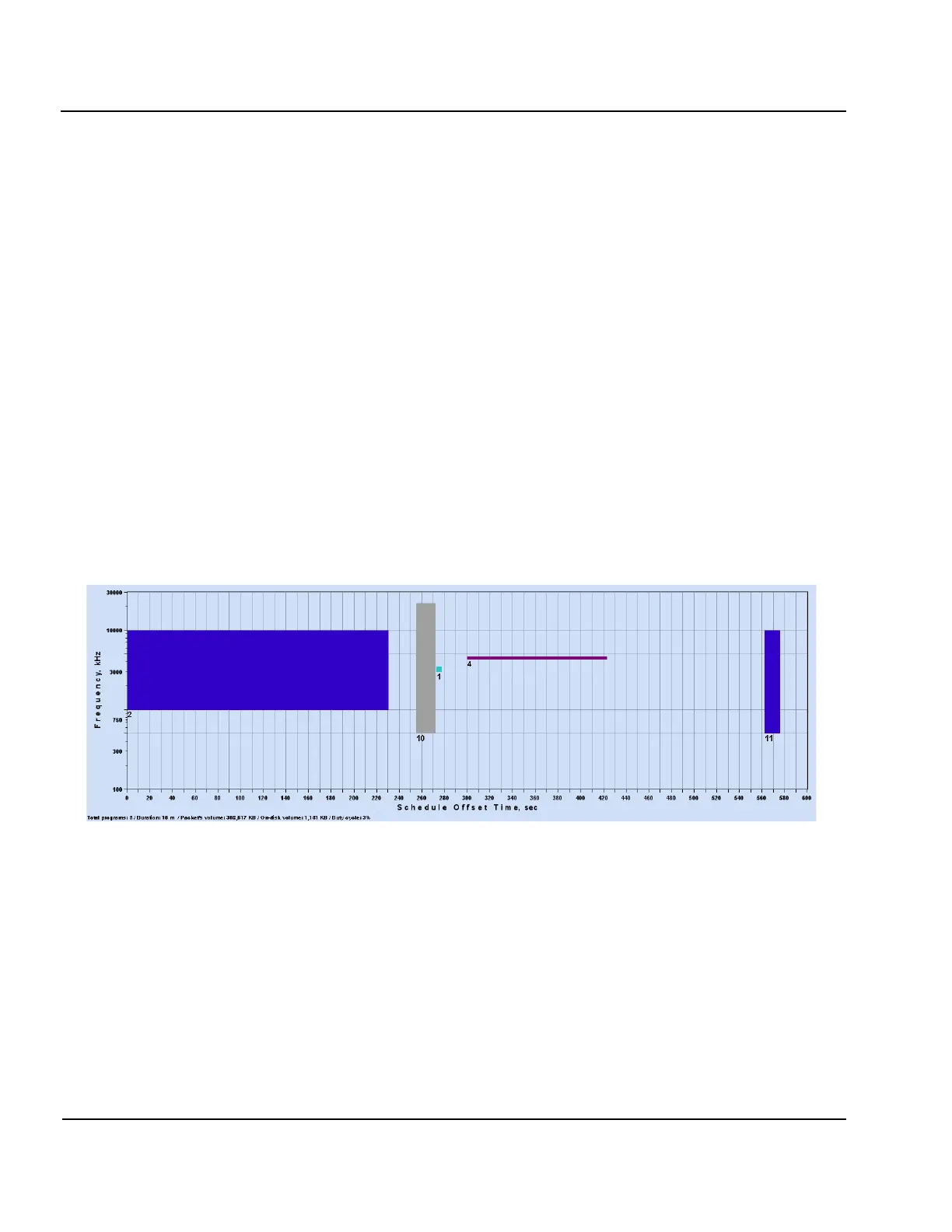
quence of measurement programs (Figure 3-1). For example, a Digisonde
®
schedule can instruct Digisonde
®
to
make ionogram measurements every 10 minutes. When a schedule is running, its measurement programs are
started automatically in an endless loop. Digisonde-4D stores up to 128 active schedule definitions in its
memory.
Figure 3-1: Digisonde
®
Example of a 10 minute schedule
3:3. A measurement schedule can be started manually by a keyboard/mouse command or, during autono-
mous operations, triggered by the system software using the concept of Schedule Start Time (SST). One SST
consists of (1) schedule number and (2) UT timestamp when the schedule shall be started. A SST Task is re-
sponsible for starting the Schedule Task at requested times. The SST Task periodically checks an SST Queue
holding individual SSTs. When the system clock matches the earliest SST in the queue, The SST Task invokes
the Schedule Task and removes expired SST from the queue. As an example, Schedule Start Time rules can be
used to determine when the day and night schedules start.
3:4. The SST Queue has to be replenished with new SSTs that are usually calculated automatically in ac-
cordance with the top-level definition of the measurement planning. For example, such planning can have two



 To Next Page