LDI Intellectual Property.
Not for secondary distribution or replication, in part or entirety.
DIGISONDE-4D
SYSTEM MANUAL
VERSION 1.2.11
SECTION 1 - GENERAL SYSTEM DESCRIPTION 1-15
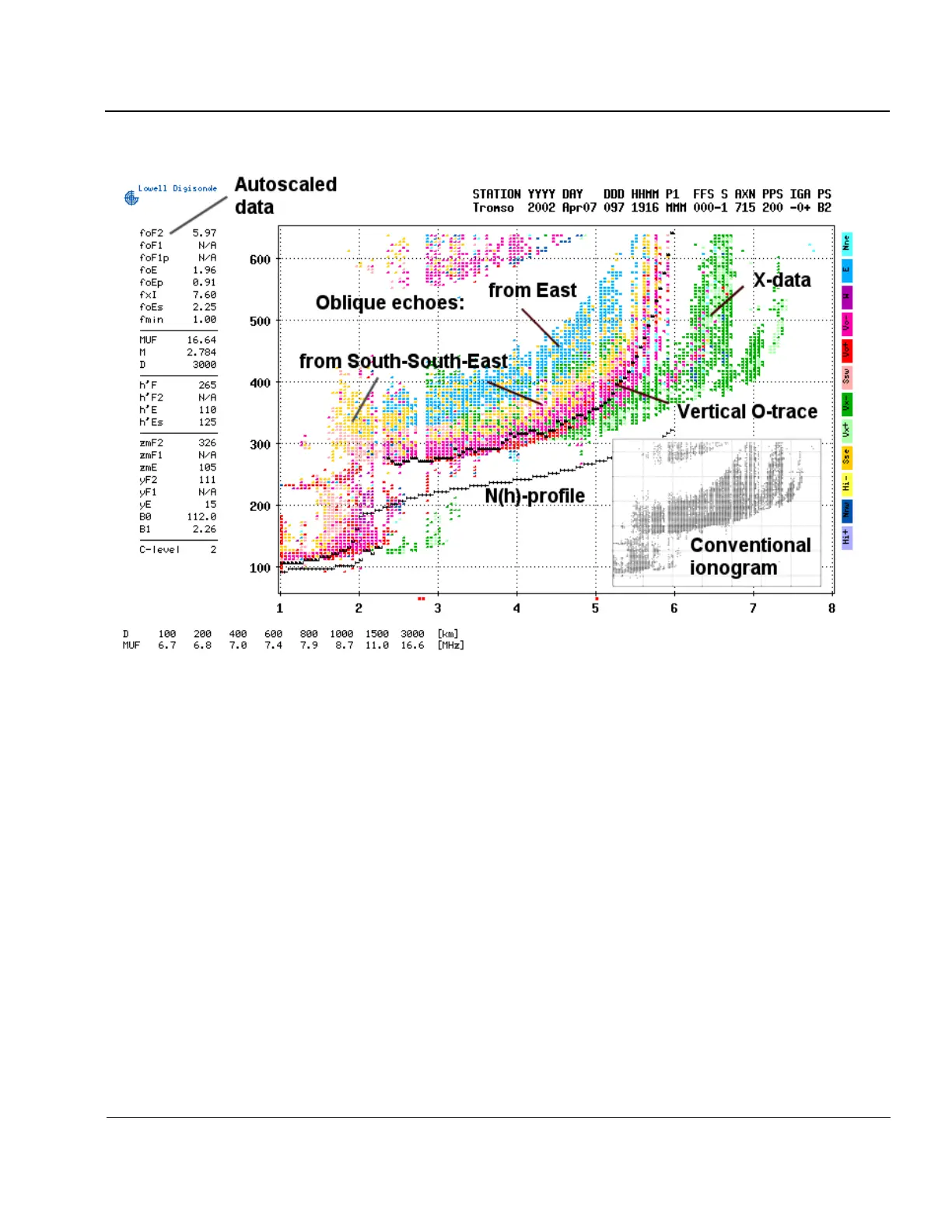
Figure 1-8: Six-Dimensional Ionogram
1:27. Figure 1-8 is a six-dimensional display, with sounding frequency as the abscissa, virtual reflection
height (simple conversion of time delay to range assuming propagation at 3x10
8
m/sec) as the ordinate, signal
amplitude as the dot size, and echo status (polarization, Doppler shift, and angle of arrival) mapped into 12
available distinct colors. The wave polarizations are shown as two different color groups (the green scale, “neu-
tral” colors showing extraordinary polarization, the red scale, “demanding attention” colors showing ordinary
polarization. The angle of arrival is shown by different colors (using the “warm” scale for South and the “cold”
scale for North), and the Doppler shift is indicated by the color shades. For comparison, the insert in Figure 1-8
shows a conventional, three-dimensional ionogram with the signal amplitude shown as intensity. The left side
of Figure 1-8 shows a table of ionospheric characteristics scaled automatically by the ARTIST software.
Coherent Pulse Integration in Time Domain
1:28. Historically, first improvement in sounding technique was the coherent integration of several pulses
transmitted at the same frequency. Two signals are coherent if, having a phase and amplitude, they are able to
be added together (e.g., one radar pulse echo received from a target added to the next pulse echo received from
the same target, thousandths of a second later). Two extreme cases of coherent summation may result a sum of
zero (if the two signals are exactly out of phase with each other) or double the amplitude (if they are exactly in
phase). Coherent integration of N signals can provide a factor of N improvement in power. This technique was
first used in the Digisonde-128 [Bibl and Reinisch, 1975] and further expanded to the case of moving reflectors
by employing Doppler integration as further discussed below in Paragraph 1:49 et seq.



 To Next Page