11. Commissioning
MiR1350 User Guide (en) 05/2022 - v.1.2 ©Copyright 2021-2022: Mobile Industrial Robots A/S. 187
Optimizing the timeout and deviation of paths is useful in situations
where you want to configure how strictly the robot should follow the
path it has planned. Making the robot follow the exact path it has
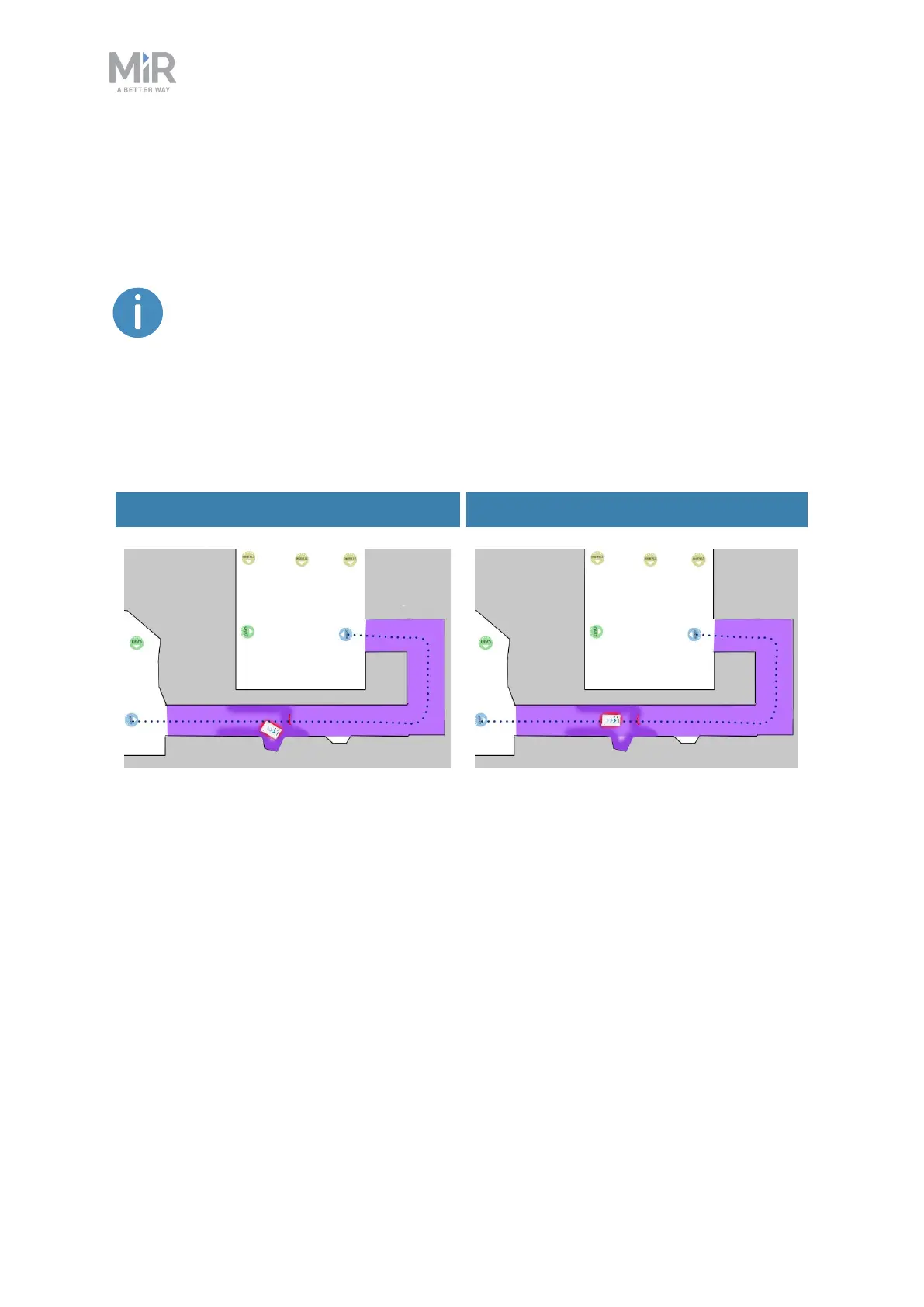
planned with little or no deviation is known as Line-following mode.
This can be useful, for example, in narrow corridors where there isn't
enough space for the robot to go around dynamic obstacles—see
Figure 11.26.
For more information on Line-following, see the guide How to set up
Line-following mode.
Line-following disabled Line-following enabled
Figure 11.26. Example of where the robot might benefit from using a Line-following configuration.
When there isn't enough space for the robot to go around an obstacle, it will often spend more
time trying to maneuver around the obstacle and correct its trajectory afterward than it would
have just waiting for the obstacle to move out of the way.
Maximum allowed speed defines the overall speed limit of the robot. The
maximum allowed speed will never be exceeded no matter what is stated in a
mission or Speed zone. This setting can be useful if, for example, the robot
transports motion sensitive objects or if the work environment in other ways
requires the robot to always stay below a certain speed threshold.


 To Next Page