Before loading the wash elements into the designated wash baskets, it is necessary to
eliminate any coarse residue resulting from previous activities, through the appropriate
wash, treatment, and rinse phases.
The load must be properly placed to prevent wash elements from overlapping as well as
the formation of “grey areas”; all areas of the wash load must be reached by the spray arm
and/or injectors’ water in the wash and rinse phases.
The open side of the container must face downward so that the load elements are correctly
washed and dried at the end of the cycle.
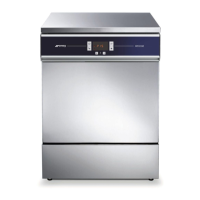
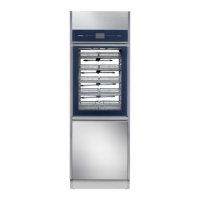
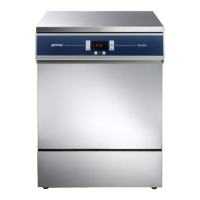
The machine is supplied without washing carts.
Please refer to the washing cart manuals for instructions on proper use.
The operator must avoid direct contact with the dirty load.
Use extreme caution by wearing all personal protective equipment both before and after
the treatment.
Before processing glassware or other objects in the instrument washer, check the
manufacturer instructions to verify that they are approved for automatic treatment in
the thermal disinfector and check the compatible maximum washing temperature.
Stainless steel instruments cannot be immersed in physiological solutions of sodium chloride because
prolonged contact produces deep corrosions and surface cracks due to stress.
Avoid overloading wash baskets. Slags, skin disinfectant residue, physiological solutions, etc. must not go
inside the treatment containers, which must be kept closed in order to prevent further desiccation.
Where possible, it is recommended to start a dry process.
In case of treatment with a liquid, the instruments should be immersed in a combined solution of non-
protein-fixing disinfectant and detergent. On the other hand, aldehyde-based disinfectants have a fixing
effect. Please regard the manufacturer’s indications carefully for solution concentration, action time, and
the addition of any adjuvant detergents.
For both methods, given the corrosion risk it is necessary to avoid long intervals between the preliminary
treatment and the one in the instrument washer.
In order to obtain an effective cleaning, joint instruments (scissors, pliers, forceps) must be open to
minimize surface overlap.. The instrument supports used, such as baskets, racks, securing devices, are
designed to prevent grey areas during the cleaning and sanitizing phase.
Instruments that can be disassembled must be placed according to the manufacturer’s indications. It is
necessary to avoid overlap.
Microsurgical instruments must be placed on special racks or the appropriate securing devices.
Residue on dental instruments, such as material for fillings or acid substances used to remove cement,
must be eliminated immediately after use to prevent the risk of hardening and/or corrosion.
Surgical motor systems must be disassembled immediately after use, following the manufacturer’s
indications.



 To Next Page