CHAPTER 11 Technical Information
Sysmex XE-5000 Instructions for Use 11-23
Revised April 2007 EU
1. Blood is aspirated from the manual aspiration pipette to
the sample rotor valve.
2. 18 µL of blood, measured by the sample rotor valve, is
diluted with 0.882 mL of STROMATOLYSER-NR (L) lyse
reagent, and then sent to the reaction chamber as the
diluted sample.
At the same time, 18 µL of STROMATOLYSER-NR (S)
dye solution is added to dilute the sample to a ratio of
1:51. After reacting for about 7 seconds in this condition,
the red blood cells are hemolyzed and the white blood
cells and nucleated red blood cells are stained.
3. The sheath injector piston sends 40 µL of diluted sample
to the optical detector block.
4. In the optical detector block, the sample is analyzed via
flow cytometry method utilizing a semiconductor laser.
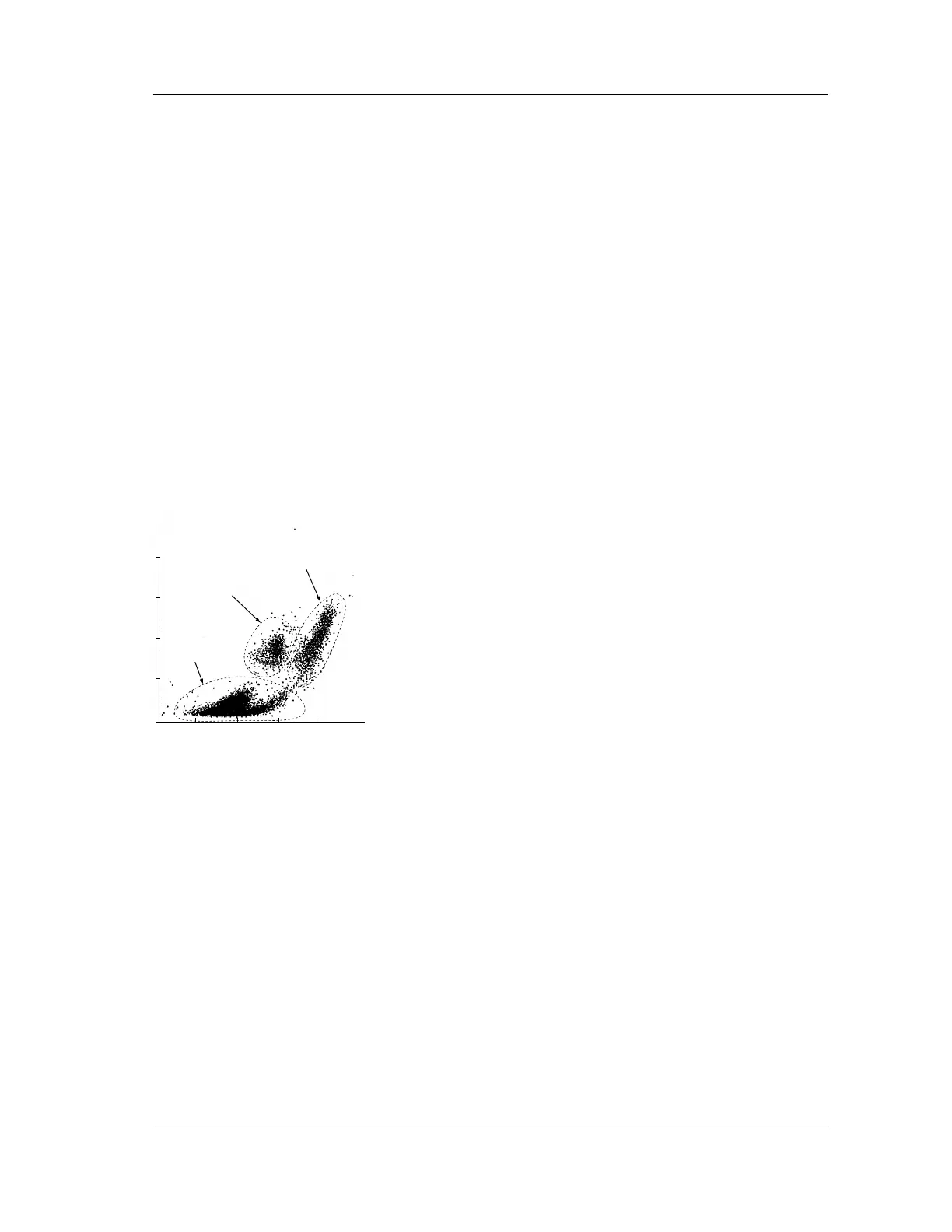
7. NRBC scattergram
Through fluorescence flow cytometry method utilizing a
semiconductor laser, a two-dimensional distribution of the
forward scattered light and lateral fluorescent light is
displayed as a scattergram.
The X-axis of the scattergram represents the intensity of the
lateral fluorescent light and the Y-axis the intensity of the
forward scattered light.
After scattergram analysis, the classified groups of red blood
cell ghosts, white blood cells and nucleated red blood cells
are displayed.
NRBC
Nucleated red blood cells
RBC ghosts
White blood cells


 To Next Page