Commands
7-41
feature primarily is designed to overcome some
of the system-design RF interference
issues in reading IAG tags at locations having a dense population of readers and tags.
All readers on the bus require the same enabled tag protocols for synchronization to
work. Entering increasing values to all readers on the bus is required so that should a
break occur in the bus that is connecting all the readers, the next reader will take over
as master for the rest of the readers that are connected, and the system may work rea-
sonably well until the cabling is fixed. Do not
set the synchronization times too short,
as IAG tags are battery powered and their useful life can be diminished if the typical
traffic flow is slow moving, and the tag is activated continuously in the reader pattern.
Command #582 displays the synchronization output time.
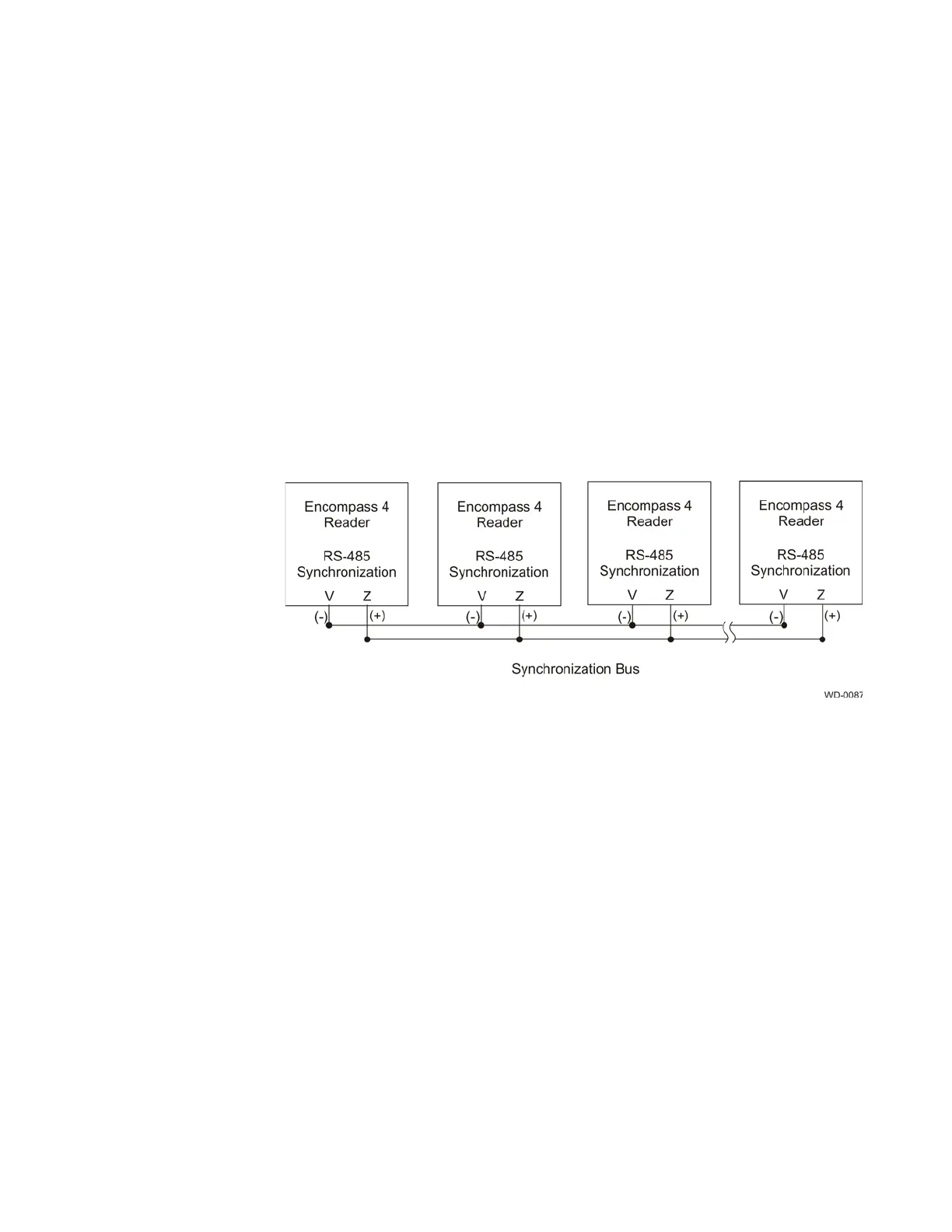
The synchronization bus is wired by connecting all of the
readers’ “V” (RS–485 syn-
chronization minus) pins together and all of the
readers’ “Z” (RS–485 synchronization
plus) pins together (Figure 7-1).
Figure 7-1 Example of Synchronization Bus Wiring
#649NN Set Synchronization Hold Off Time
Command #649NN sets the time in milliseconds that the reader will hold off after get-
ting (or sending if it is the master on the bus) the
synchronization pulse before it starts
to run its IAG tag sequence. This command is used in close combination with com-
mand #648NN. Command #649NN is applicable on
ly if a value other than #64800 is
entered for #648NN and is used only when the IAG tag protocol is enabled. Entering a
value of #64900 (factory default) disables this feature. Entering a value between
#64901 and #6490A (hex value of 10 decimal) causes the reader to hold off starting its
tag protocol transaction for the time set between 1 and 10 milliseconds. This feature is
used to lessen the possibility of a reader reading an IAG tag that is activated by
another reader in the site. Because IAG tags are battery powered active transmitters,
their read zones can be much harder to control than for beam-powered passive tags.
The pattern also will vary greatly among tags depending on the condition of the indi-
vidual tag battery. If this feature is used, e
ach reader on the bus needs a value of
between #64901 and #6490A entered for the feature to work. As with the #648NN
command, the reader’s physical location on the bus is not critical, but TransCore rec-
ommends that the reader numbering follow a logica
l sequence. Using this command,


 To Next Page