EasyManua.ls Logo

Triumph Trident T160 - F6 FLUSHING THE HYDRAULIC SYSTEM; F7 BLEEDING THE SYSTEM (GENERAL)

Triumph Trident T160
198 pages
Print Icon
To Next Page IconTo Next Page
To Previous Page IconTo Previous Page
Loading...
BRAKES,
WHEELS
AND
TIRES
SECTION
F6
FLUSHING
THE
HYDRAULIC
SYSTEM
F
The capacity of
the
reservoir
is such
that,
even
when
the
brake pads ·are
excessively
worn,
there
is
sufficient fluid retained
In
the reservoir to allow the
brake
to
be
operated,
so
that,
under
normal
conditions,
the
fluid
should
not
require
replenish-
ment.
However,
If
the
hydraulic
system
has
been
contaminated
by
foreign
matter,
or
other
flUids,
It
should
be flushed
out
and refilled
with
new
fluid.
The
system
should
be flushed
out,
In
any
case;
once
every
th
ree
years.
Pump all
the
fluid
out
of
the
system,
by
opening
the
bleed
screw,
and
operating
the
front
brake
lever
a
few
times,
after
connecting
a
pipe
to
the
bleed
sc"rew,
In
order
to collect
the
fluid In a container.
Fill
the
master
cylinder
reservoir
with
meth'ylated
spirits,
and
pump
out
through
the
bleed
screw,
In
a
manner
similar
to
that
previously
described.
Having
ensured
that
all
the
methylated
spirit
has
passed
through
the
bleed
screw,
replenish
the
master cylinder
r~servolr
with the specified grade
of
brake
fluid. The capacity
is
approximately
60
em'
for
the
front
brake, and 80 em] for
the
rear
brake,
a.nd
the
speCial fluid
to
be
used
must
conform
with
DOT 3, Federal
Motor
Vehicle
Standards
116 (for
U.S.A.). Lockheed Braking Fluid
to
specification
329
should
be used in
other
parts
of
the
world.
Finally,
"bleed"
the
brake,
as described in
Section
F7.
IMPORTANT
NOTE.
If
the
system
has
been
contaminated
by a minerai
oil,
all
rubber
parts, including flexible hoses,
must
be replaced.
SECTION
F7
BLEEDING
THE
SYSTEM
(GENERAL)
Remove
the
cap and
diaphragm
from
the
reservoir
and
flll
with
the
correct
hydraulic
fluid
(see
Fig.
F3)
..
Throughout
the
whole
operation,
maintain
the
fluid level
at
not
less
than
t full,
to
avoid any
risk
of
Introduction
of
air
at
this
point.
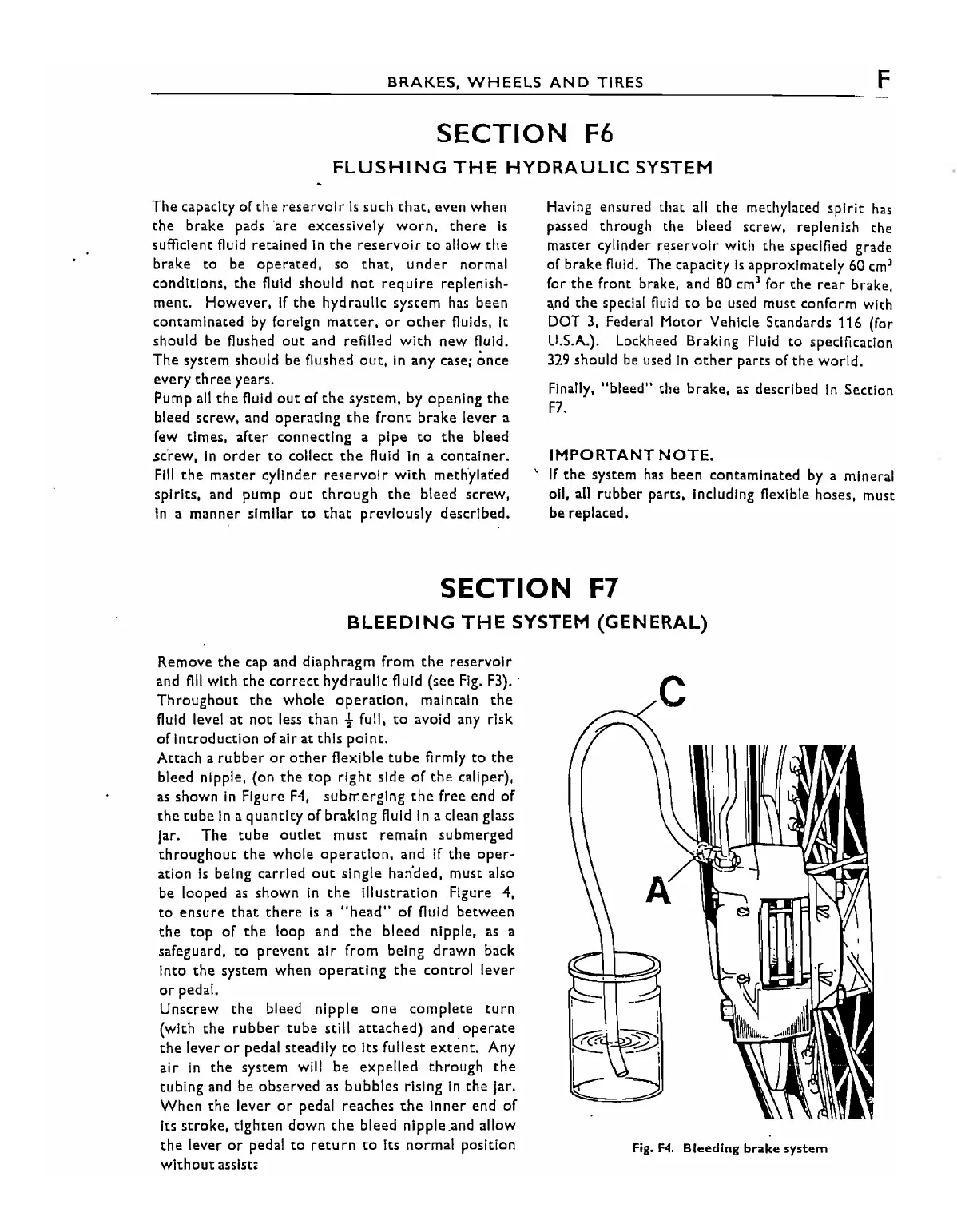
Attach
a
rubber
or
other
flexible
tube
firmly
to
the
bleed nipple, (on
the
top
right
side
of
the
caliper),
as
shown
In
Figure
F4,
subrr.erging
the
free
end
of
the
tube
In
a
quantity
of
braking
fluid
In
a clean glass
Jar.
The
tube
outlet
must
remain
submerged
throughout
the
whole
operation,
and
if
the
oper-
ation
Is
being
carried
out
single
han'ded,
must
also
be
looped
as
shown
in
the
illustration
Figure 4,
to ensure
that
there
Is
a IOhead"
of
fluid between
the
top
of
the
loop
and
the
bleed
nipple,
as
a
safeguard,
to
prevent
air
from
being
drawn
back
into
the
system
when
operating
the
control
lever
or
pedal.
Unscrew
the
bleed
nipple
one
complete
turn
(With
the
rubber
tube
stili
attached)
and
operate
the
lever
or
pedal
steadily
to
Its
fullest
extent.
Any
air
in
the
system
will
be
expelled
through
the
tubing
and be
observed
as
bubbles
rising
In
the
jar.
When
the
lever
or
pedal
reaches
the
Inner
end
of
Its
stroke,
tighten
down
the
bleed
nipple.and
allow
the
lever
or
pedal
to
reeu
rn
to
Its normal
position
without
assistance.
c
Fig.
F4.
Bleeding
brake
system
FS
ClassicBike.biz

Table of Contents