H
ELECTRICAL
SYSTEM
SECTION
/-l4
SPARKING
PLUGS
It
is
recommended
that
the sparking
plugs
be
inspected,
cleaned and
tested
every
3,000
miles
(11,800 krn,) and
new
ones
fitted
every
12,000
miles
(20,000
km,),
To
remove
the sparking plugs, a
box
spanner
('3/'6 in,
(19,5
mm,) across flats)
should
be
used, end
if
any
difficulty
is encountered, a
small
amount
of
penetrating
oil (see
lubrica-
tion
chart
Section
A2)
should
be placed
at
the
base
of
the
sparking plug and
time
allowed
for
penetration,
When
removing
the
sparking
plugs
identify
each plug
with
the
cylinder
from
which
it
was
removed so
that
any
faults
revealed
on
examination can be
traced
back
to
the
cylinder
concerned,
Examine all plugs
for
signs
of
oil
fouling,
This
will
be
indicated
by a
wet,
shiny,
black
deposit
on
the
central
insulator,
This
is
caused
by
excessive oil in the
combustion
chamber
during
combustion
and
indicates
that
the
piston
rings
or
cylinder bores are
worn,
Next
examine
the
plugs
for
signs
of
petrol
(gasoline) fouling, This
is
indicated
by
a dry,
sooty,
black
deposit
which
is
usually
caused
by
over-rich
carburation,
although
ignition
system
defects such
as
a
discharged
battery,
faulty
contact
breaker, coil
or
capacitor
defects,
or
a broken
or
worn
out
cable
may
be
additional
causes, To
rectify
this
type
of
fault
the
above
mentioned
items
should
be
checked
with
special
attention
given
to
carburation
system,
Over-heating
of
the sparking plug electrodes
is
indicated
by
severely eroded electrodes and a
white
burned
or
blistered insulator,
This
type
of
fault
is usually caused
by
w,eak carburation,
although
plugs
which
have been
operating
whilst
not
being
screwed
down
sufficiently
can easily
become
over-heated
due
to
heat
that
is
normally
dissipated
through
to
the
cylinder
head
not
having an
adequate
conducting
path, Over-heating
is
normally
symptomised
by pre-ignition,
short
plug
life,
and
"pinking"
which
can
ultimately
result in
piston
crown
failure, Unnecessary
damage
H8
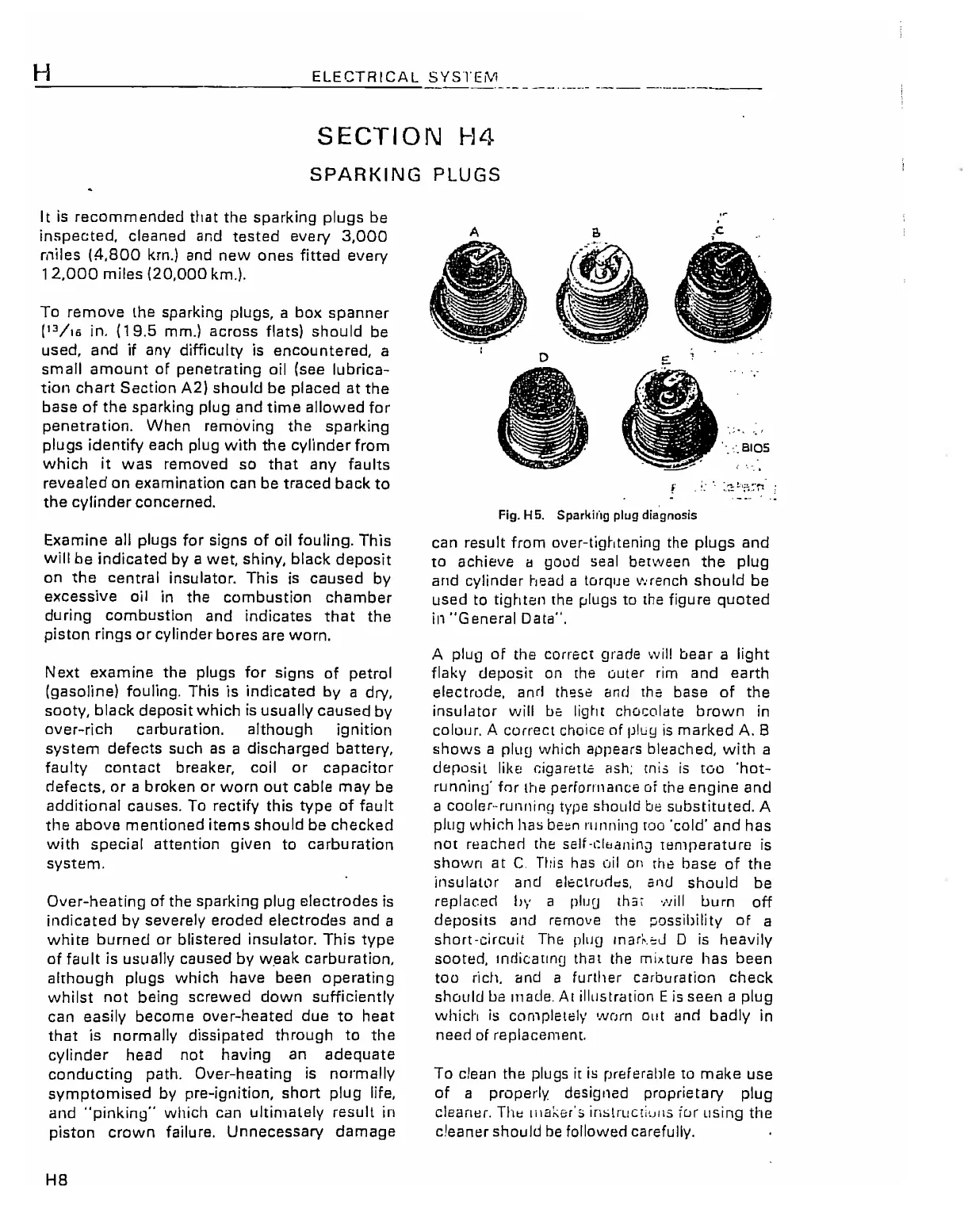
A
o
.
~
; ,,
··.··.8105
....•
f
Fig. H5.
SparkiJ'lg
plug diagnosis
can result
from
over-tightening the plugs and
to
achieve a good seal between
the
plug
and cylinder head a torque
~,rench
should
be
used to
tighten
the plugs to the figure
quoted
in
"General
Data".
A plug
of
the correct grade will
bear
a
light
flaky
deposit
on
the outer rim and
earth
electrode, and these and the base
of
the
insulator
will
be
ligllt
chocolate
brown
in
colour. A correct choice
of
plu~
is
marked
A. B
shows
a plug which appears bleached,
with
a
deposit like c.igaretle
ash;
enis
is
too
'hot-
running'
for
the performance of the engine and
a
cooler··runnin~
type should
be
substituted. A
plug
which
has been nllming too 'cold' and has
not
reached the self·c1eaning
temperature
is
shown
at
C Tilis
has
oil
on
the base
of
the
insulator
and electrudds, and
should
be
replaced hI' a plug thor will
burn
off
deposits and remove the possibility
of
a
short·circuit
The plug
/nar'."J
0 is
heavily
sooted, Indicating that the mixture has been
too
rich. and a further carburation
check
should be made. At illustration E
is
seen a plug
which
is completely worn
alit
and
badly
in
need
of
replacement.
To clean the plugs it
is
preferable 10
make
use
of
a properly designed proprietary
plug
cleaner.
Tilt::
11
laker's
in~trucri~j1l5
fur
llsing the
cleaner
should
be
followed carefully.








 To Next Page