EasyManua.ls Logo

Triumph Trident T160 - Removing the Oil Seal from the Fork Leg; Replacing the Oil Seal

Triumph Trident T160
198 pages
Print Icon
To Next Page IconTo Next Page
To Previous Page IconTo Previous Page
Loading...
TELESCOPIC
FORKS
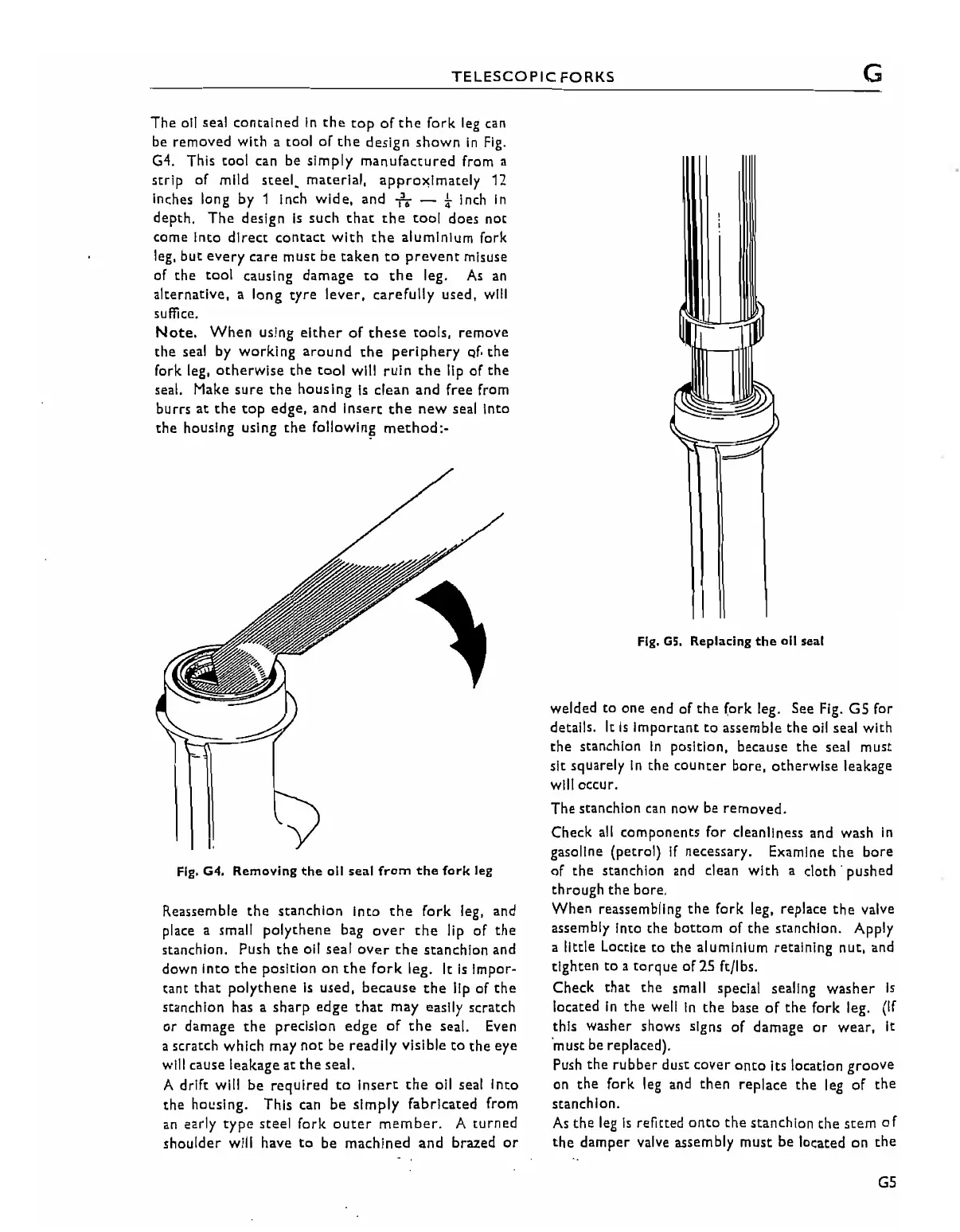
The
oil seal
contained
in
the
top
of
the
fork leg
can
be
removed
with
a tool
of
the
design shown
in
Fig.
G4. This
tool
can be
simply
manufactured
from a
strip
of
mild
steel,
material,
approximately
12
Inches long by 1 Inch
wide,
and
+.-
-
~
Inch
in
depth.
The
design
is
such
that
the
tool
does
not
come
Into
direct
contact
with
the
aluminium
fork
leg, but
every
care must
be
taken
to
prevent
misuse
of
the
tool
causing
damage
to
the
leg.
As
an
alternative, a
long
tyre
lever,
carefully
used, will
suffice.
Note.
When
using either
of
these
tools, remove
the
seal by
working
around
the
periphery
Qf.
the
fork leg,
otherwise
the
tool
will
ruin
the
lip
of
the
seal. Make
sure
the
housing
Is
clean
and free from
burrs
at
the
top
edge, and
Insert
the
new
seal Into
the
housing using
the
followln~
method:-
G
I.
Fig. G4.
Removing
the
all
seal
from
the
fork
leg
Reassemble
the
stanchion
Into
the
fork
leg, and
place a small
polythene
bag
over
the
lip
of
the
stanchion. Push
the
all
seal
over
the
stanchion
and
down
Into
the
position
on
the
fork
leg. It
is
Impor-
tant
that
polythene
Is
used,
because
the
lip of
the
stanchion has a
sharp
edge
that
may
easily scratch
or
damage
the
precision
edge
of
the
seal. Even
a scratch which may
not
be
readily
visible
to
the
eye
will cause leakage
at
the
seal.
A drift will
be
required
to
Insert
the
oil seal
into
the
hocslng. This can
be
simply
fabricated
from
an
early
type
steel
fork
outer
member.
A turned
shoulder
will have
to
be
machined
and
brazed
or
Fig.
G5.
Replacing
the
all
seal
welded
to
one
end
of
the
fork ieg. See
Fig.
G5
for
details. It
Is
Important
to
assemble
the
oil seal with
the stanchion
In
position, because the
seal
must
sit squarely
In
the
counter
bore,
otherwise
leakage
will occur.
The stanchion
can
noW
be
removed.
Check
all
components
for
cleanliness and wash
In
gasoline (petrol)
If
necessary. Examine
the
bore
of
the
stanchion and clean
with
a
cloth'
pushed
through
the
bore.
When
reassembling
the
fork leg, replace
the
valve
assembly into the
bottom
of
the
stanchion. Apply
a little Loctlte
to
the aluminium retaining nut, and
tighten
to
a
torque
of25
ft/lbs.
Check
that
the
small special sealing
washer
is
located
In
the
well
In
the
base
of
the
fork
leg. (If
this washer
shows signs
of
damage
or
wear,
It
'm
ust be replaced).
Push
the
rubber dust
cover
onto
its location
groove
on
the
fork leg and
then
replace
the
leg
of
the
stanchion.
As
the
leg
Is
refitted
onto
the
stanchion
the
stem
of
the
damper
valve assembly must be located
on
the
GS
ClassicBike.biz

Table of Contents

Related product manuals