EasyManua.ls Logo

Triumph Trident T160 - G1 STEERING HEAD ADJUSTMENT; G2 DISMANTLING AND REASSEMBLING THE FORK LEGS

Triumph Trident T160
198 pages
Print Icon
To Next Page IconTo Next Page
To Previous Page IconTo Previous Page
Loading...
TELESCOPIC
FORKS
DESCRIPTION
G
The front fork
15
of
the
telescopic
type,
using high
grade steel tube stanchions.
They
are
hard
chrof(l~
lum plated,
and
then ground
to
an
extremely
fine
surface.
The alloy sliding
members
are
precision
bored
and
provide
the
bearing for
the
stanchion.
The
main
springs are enclosed within the stanchion,
and
locate on
the
damper
tube.
An oil
seal
is
contained
in
the
top
lip
of
each
sliding
member. and
is
protected
by
a
rubber
dust
cover.
Oil
Is
contained In
each
sliding
member,
and
serves
the
dual
purpose
of
damping
and
lubrication.
It
15
added by removal
of
the
stanchion
cap nuts,
and drained
at
the
plugs
provided.
Damping
of
the
telescopic
action
is
achieved by
the
use
ora
damper valve In conjunction
with
a series
of
bleed holes and slots
in
the
damper
tube.
SECTION
GI
STEERING
HEAD
ADJUSTMENT
It
15
most
important
that
the
steering
head bearings
are always
correctly
adjusted.
Stand astride
the
motor
cyeie and place
the
finger
tips
of
the
left hand
on
the
Joint
between
the
steering column and
the
top
bearing
cover.
Apply
the
front
brake
and rock
the
machine
backwards
and forwards, when any play will
be
felt
immediately
by
the
left hand.
To adjust
the
bearings,
support
the
crankcase
on
a
box
50
that
the
front
wheel
is
clear
of
the
ground,
and slacken
the
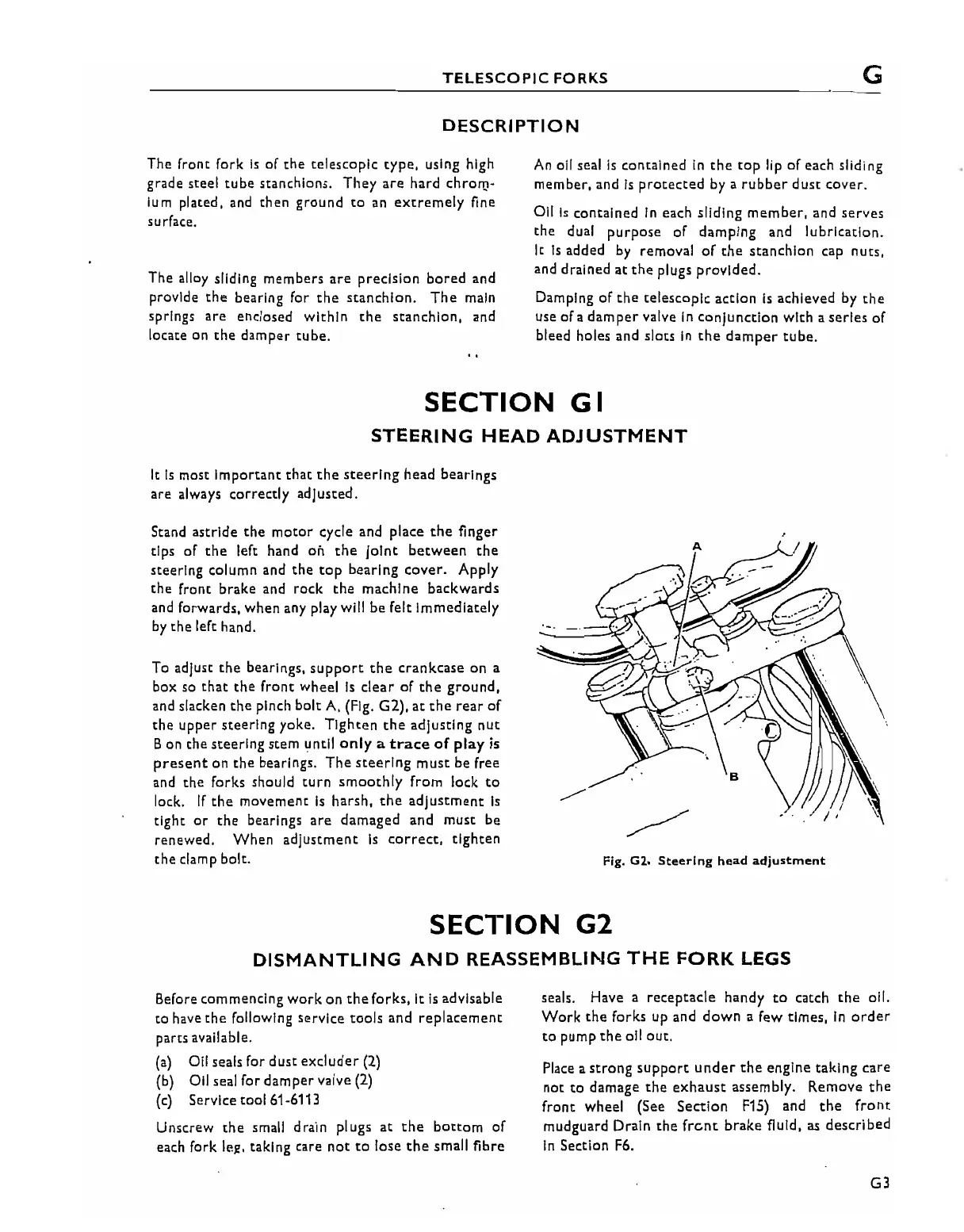
pinch bolt
A,
(Fig. G2J,
at
the
rear
of
the
upper
steering
yoke.
Tighten
the
adjusting
nut
Bon the
steering
stem
until
only
a
trace
of
play
is
present
on
the
bearings.
The
steering
must
be free
and
the
forks should
turn
smoothly
from lock
to
lock.
If
the
movement
is
harsh,
the
adjustment
Is
tight
or
the
bearings
are
damaged
and
must
be
renewed.
When
adjustment
15
correct,
tighten
the
clamp bolt. Fig.
Gl.
Steering
head
adjustment
SECTION
G2
DISMANTLING
AND
REASSEMBLING
THE
FORK
LEGS
Before commencing
work
on
the
forks,
It
is
advisable
to
have
the
follOWing
service
tools
and
replacement
parts available.
(aJ
Oil seals for
dust
excluder
(2)
(b) Oil seal for
damper
valve
(2)
(cJ
Service tool 61-6113
Unscrew
the
small drain plugs
at
the
bottom
of
each fork
le~,
taking care
not
to
lose
the
small fibre
seals. Have a
receptacle
handy
to
catch
the
oil.
Work
the
forks up and
down
a few times,
in
order
to
pump
the
oil
OUt.
Place a
strong
support
under
the
engine
taking
care
not
to
damage
the
exhaust
assembly. Remove
the
front
wheel (See
Section
F15)
and
the
front
mudguard Drain
the
frcnc
brake
fiuld,
as
described
In
Section
F6.
G3
ClassicBike.biz

Table of Contents

Related product manuals