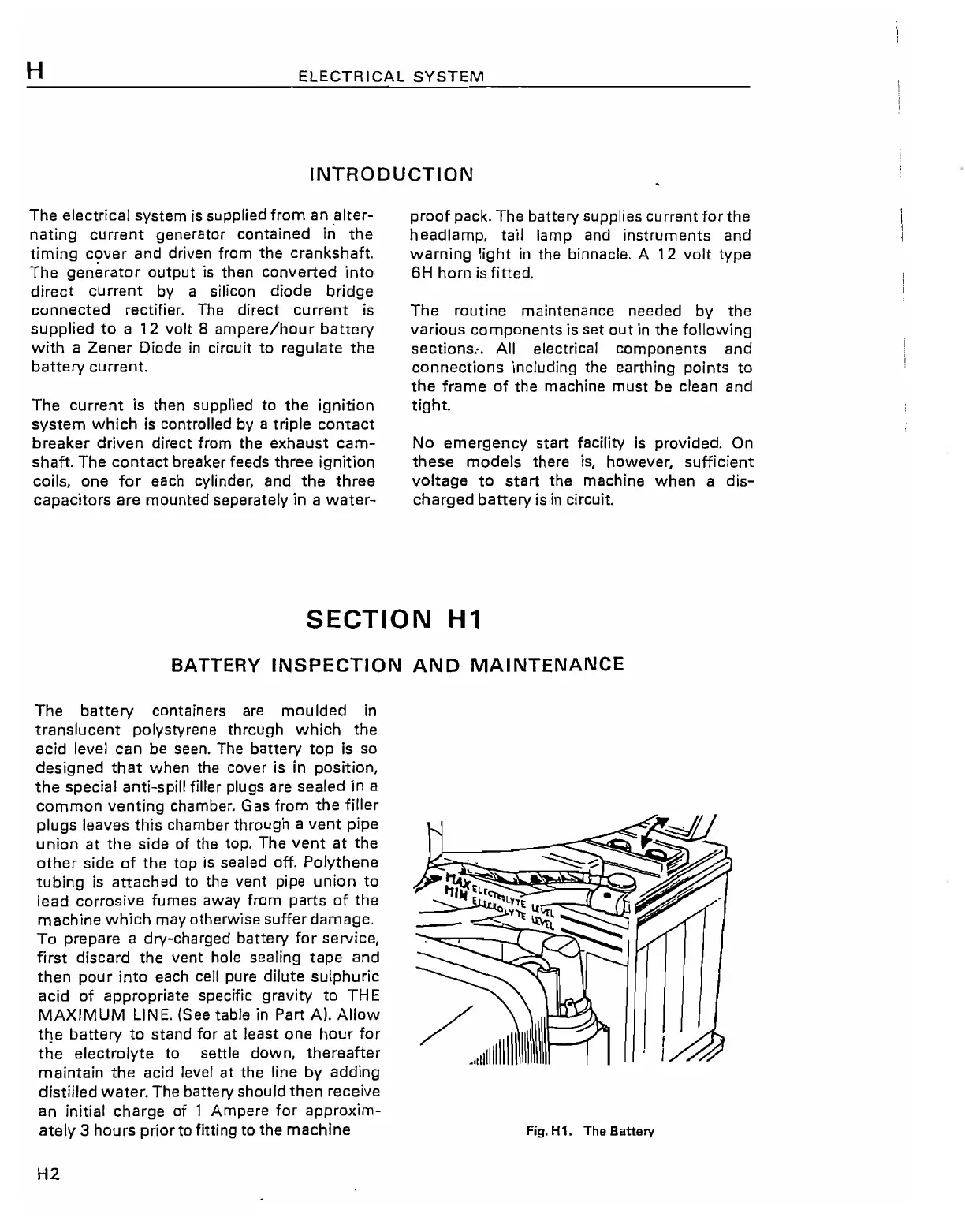
H
ELECTRICAL
SYSTEM
INTRODUCTION
The
electrical
system is supplied
from
an
alter-
nating
current
generator contained in
the
timing
cover
and driven from
the
crankshaft.
The
generator
output is then
converted
into
direct
current
by a silicon
diode
bridge
connected
rectifier. The
direct
current
is
supplied
to
a
12
volt
8
ampere/hour
battery
with
a
Zener
Oiode
in
circuit
to
regulate
the
battery
current.
The
current
is then supplied to
the
ignition
system
which
is controlled by a
triple
contact
breaker
driven
direct from the
exhaust
cam-
shaft. The
contact
breaker feeds
three
ignition
coils, one
for
each cylinder, and
the
three
capacitors
are mounted seperately in a
water-
proof
pack. The battery supplies current
for
the
headlamp,
tail lamp and
instruments
and
warning
light
in
the binnacle. A
12
volt
type
6H
horn
is fitted.
The routine maintenance needed
by
the
various
components
is set
out
in
the
following
sections
...
All
electrical components and
connections
including the earthing points
to
the
frame
of
the
machine
must
be clean and
tight.
No
emergency
start facility is provided. On
these
models
there is, however,
sufficient
voltage
to
start
the
machine
when
a
dis-
charged
battery
is in circuit.
SECTION
H1
BATTERY
INSPECTION
AND
MAINTENANCE
The
battery
containers are
moulded
in
translucent
polystyrene through
which
the
acid level can be seen. The
battery
top
is so
designed
that
when the cover is in position,
the
special anti-spill filler plugs are sealed
in
a
common
venting
chamber. Gas
from
the
filler
plugs
leaves
this
chamber through a
vent
pipe
union
at
the
side
of
the top. The
vent
at the
other
side
of
the top
is
sealed off. Polythene
tubing
is
attached
to the
vent
pipe
union
to
lead corrosive fumes away from
parts
of
the
machine
which
may otherwise
suffer
damage.
To
prepare a dry-charged battery
for
service,
first
discard
the
vent hole sealing
tape
and
then
pour
into
each cell pure dilute
sulphuric
acid
of
appropriate specific
gravity
to
TH E
MAXIMUM
LINE. (See table in Part A).
Allow
t~e
battery
to
stand
for
at least one
hour
for
the
electrolyte
to settle down,
thereafter
maintain
the
acid level at the line
by
adding
distilled
water.
The battery should
then
receive
an initial charge of 1 Ampere
for
approxim-
ately
3 hours
priortofitting
to the
machine
H2
Fig.
Hl.
The Battery





 To Next Page