EasyManua.ls Logo

Triumph Trident T160 - Bench Testing the Rectifier; Testing the Rectifier

Triumph Trident T160
198 pages
Print Icon
To Next Page IconTo Next Page
To Previous Page IconTo Previous Page
Loading...
ELECTRICAL
SYSTEM
H
TESTING
THE
RECTIFIER
For
test
purposes
disregard
the
end
earth
(ground)
terminal
on
later
rectifiers.
To test
the
rectifier,
first
disconnect
the
brown/blue
lead
from
the
rectifier
centre
terminal and insulate
the
end
of
the
lead
to
prevent any possibility
of
a
short
circuit
occurring, and
then
connect
a D.C.
voltmeter
(with
1 ohm load resistor in parallel)
between
the
rectifier centre
terminal
and
earth.
Note.-Voltmeter
positive
terminal
to
frame
earth (ground) and
negative
terminal
to
centre
terminal on rectifier.
With
the
engine running
at
approximately
3,000
r.p.m.
(approximately
45
m.p.h. in
top
gear) observe
the
voltmeter
reading. The
reading obtained
should
be
at
least
7.5V
minimum.
(j)
If
the reading is
equal
to
or_slightly
greater than
that
quoted,
then
the
rectifier eleme'nts in
the
forvvard
direction
are satisfactory.
(iiI
If
the
reading is
excessively
higher
than
the figures given,
then
check
the
rectifier earthing
bolt
connection.
(iii)
If
the reading is
lower
than
the
figures
quoted
or
zero
readings
are obtained,
then
the
rectifier
or
the
charging
circuit
wiring
is
faulty
and
the
rectifier
should
be
disconnected and
bench
tested
so
that
the
fault
can be located.
Note.-AII
of
the above
conclusions
assume
that
the
alternator
A.C.
output
figures
were
satisfactory.
Any
fault
at
the
alternator
will.
of
course. reflect on
the
rectifier
test
results.
Similarly any
fault
in
the
charging
circuit
wiring may indicate
that
the
rectifier
is faulty.
The best
method
of
locating
a
fault
is
to
dis-
connect
the
rectifier
and
bench-test
as
shown
below:
BENCH
TESTING
THE
RECTIFIER
For this
test
the
rectifier
should
be
disconnected and removed. Before
removing
the rectifier, disconnect
the
leads fr.om the
battery
terminals
to
avoid
the
possibility
of
a
short circuit occurring.
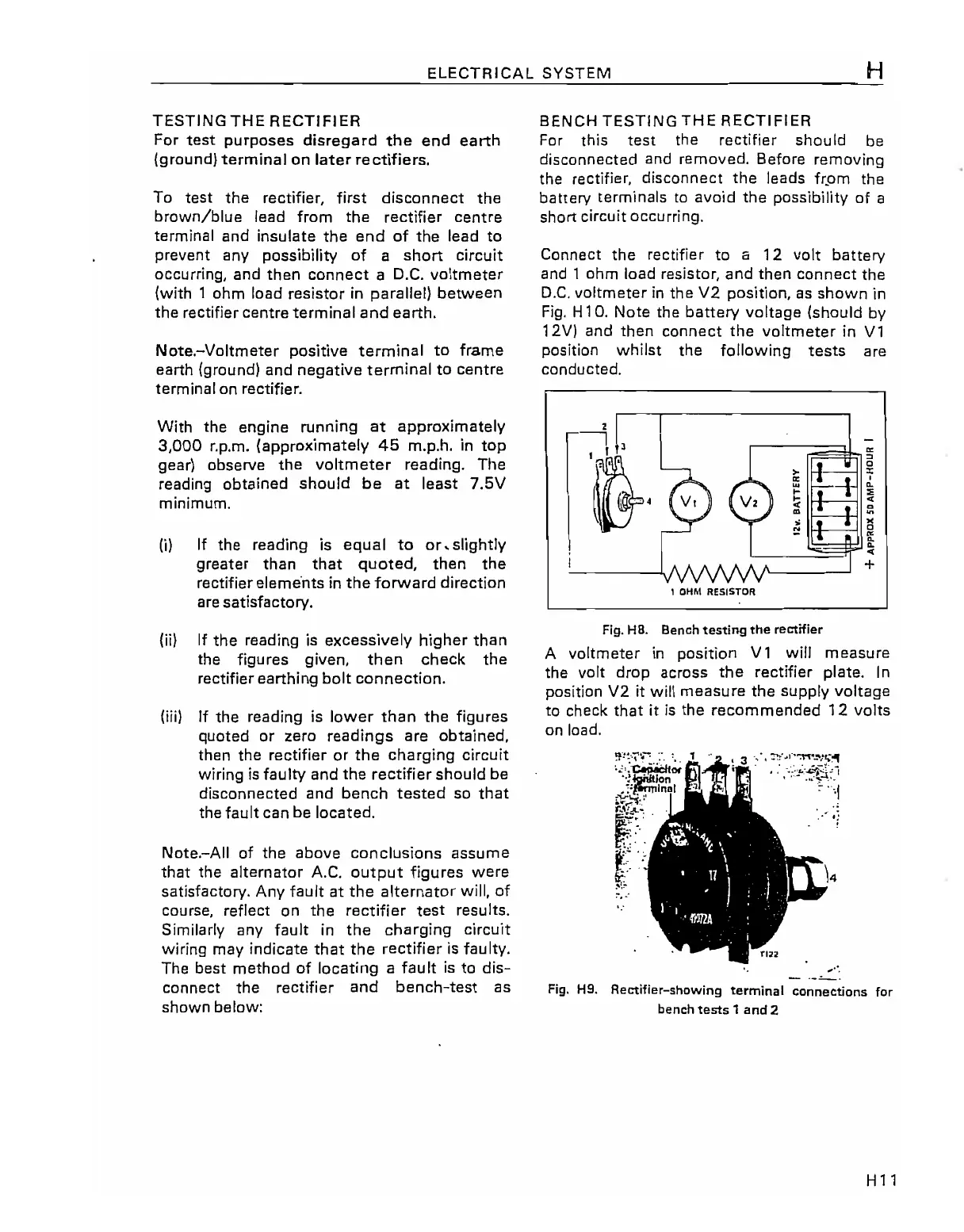
Connect
the
rectifier
to
a
12
volt
battery
and 1 ohm load resistor, and then
connect
the
D.C.
voltmeter
in
the
V2
position,
as
shown
in
Fig.
H1
O.
Note
the
battery
voltage
(should
by
12V) and then
connect
the
voltmeter
in
V1
position
whilst
the
following
tests
are
conducted.
,
OHM
RESISTOR
Fig. HB. Bench testing
the
rectifier
A
voltmeter
in
position
V 1
will
measure
the volt drop across
the
rectifier
plate. In
position
V2
it
will
measure
the
supply
voltage
to
check
that
it
is
the
recommended
12
volts
on load.
-,--'
,
Fig.
H9. Rectifier-showing
terminal
connections for
bench
tests
1 and 2
H
11
ClassicBike.biz

Table of Contents

Related product manuals