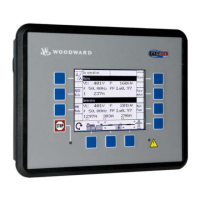
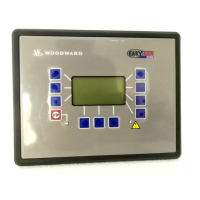
Manual 37443A DSLC-2 - Digital Synchronizer and Load Control
Page 130/226 © Woodward
Voltage Matching Adjustments
≡≡≡≡≡≡≡≡≡≡≡≡≡≡≡≡≡≡≡≡≡≡≡≡≡
The following steps will verify the correct operation of the synchronizer voltage matching function. Two proce-
dures are given. The first is for systems where voltage adjustment is done with a MOP using the “Voltage Raise”
and “Voltage Lower” relay output contacts. The second adjustment procedure is for systems using the voltage
bias output from the DSLC-2 control directly connected to the voltage regulator.
Preliminary Voltage Matching Setup
1. Select Menu 1 and set the Voltage matching (parameter 7513) setpoint to “Enabled”.
2. Select Menu 4 and set the Voltage high limit 5 % higher than the final expected value. Set the Voltage
low limit 5 % lower than the final expected value.
Voltage Matching With MOP Driven Voltage Regulator
1. Set the synchronizer mode switch to “Off”. Set the voltage ramp setpoint on Menu 4 to a value 10 %
greater than the time required to slew the voltage regulator MOP through its full range.
2. Select Menu 7 and monitor the voltages for generator and busbar.
3. Use the voltage raise input to adjust the generator voltage until generator phase L1 (A) voltage is ap-
proximately 5 % higher than bus voltage.
4. Set the synchronizer mode switch to “Check”. The DSLC-2 lower voltage relay output should energize
the lower voltage relay to drive the voltage regulator MOP in the decrease voltage direction. The lower
voltage discrete output should de-energize the lower voltage relay when phase A voltage enters the vol-
tage window as determined by the voltage window setpoint.
5. If generator voltage drops below the bus voltage and out of the voltage matching window, the DSLC-2
will provide a raise voltage relay output. If cycling above and below the voltage matching window oc-
curs, adjust the 3pos controller in Menu 4. This would be the Time pulse minimum (parameter 5651) and
the Gain Factor (parameter 5652). If you cannot get the desired results you may have to increase the
voltage window.
6. Set the synchronizer mode switch to “Off”. Manually lower the generator voltage until generator phase
L1 (A) voltage is approximately 5 % lower than bus voltage.
7. Set the synchronizer mode switch to “Check”. The DSLC-2 raise voltage relay output will energize to
drive the voltage regulator MOP in the increase voltage direction. The raise voltage relay output should
de-energize the raise voltage relay when phase L1 (A) voltage reaches bus voltage.
8. If generator voltage increases above the bus voltage and out of the voltage matching window, the
DSLC-2 will provide a lower voltage relay output. If cycling above and below the voltage matching
window occurs, adjust the 3pos controller in Menu 4. This would be the Time pulse minimum (parameter
5651) and the Gain Factor (parameter 5652). If you cannot get the desired results you may have to in-
crease the voltage window.
Proceed to final voltage matching setup.
Voltage Matching Using Voltage Bias Output
1. Set the synchronizer mode switch to “Off”.
2. Set the voltage regulator for rated voltage without the voltage bias connected.
3. Connect the voltage bias output to the voltage regulator. The voltage bias output should be configured
for the voltage regulator being used (Menu 6.2)
a. Example:
A Caterpillar CDVR requires a +/-10 Vdc signal to drive the generator voltage
+/-10 %. The Voltage control initial state will be set at 50 %, providing a “0” Vdc signal to the
voltage regulator.


 To Next Page
 Loading...