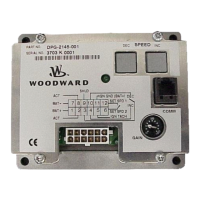
Manual 37443A DSLC-2 - Digital Synchronizer and Load Control
Page 160/226 © Woodward
Chapter 5.
Real Power Control Description
Introduction
≡≡≡≡≡≡≡≡≡≡≡≡≡≡≡≡≡≡≡≡≡≡≡≡≡
The DSLC-2 control provides several modes of generator load operation. These are:
• Droop (Droop tracking)
o Manual control of generator kW and kvar
• Isochronous load sharing and var sharing
o Automatic control for proportional kW sharing and var sharing
• Baseload control
o Automatic control of kW with either var or power factor control
• Process control
o Automatic control of a process signal with either var or power factor control
o Multiple DSLC-2s must be configured for the same process reference setting
Power Management Concepts
≡≡≡≡≡≡≡≡≡≡≡≡≡≡≡≡≡≡≡≡≡≡≡≡≡
This section provides a review of the operation of droop, droop tracking, isochronous, droop/isochronous, isoch-
ronous load sharing and base load. These concepts provide an understanding for power management.
Droop
Droop is a decrease in speed or frequency, proportional to load. That is, as the load increases, the speed or fre-
quency decreases. This reduction in speed is accomplished with negative feedback. The feedback increases as the
system is loaded. Droop is expressed as the percentage reduction in speed that occurs when the generator is fully
loaded. With a given droop setting, a generator set will always produce the same power output at a particular
speed or frequency. Droop sometimes is called the percent speed regulation.
If all generator sets in a droop system have the same droop setting, they will each share load proportionally. The
amount of load will depend on their speed settings. If the system load changes, the system frequency will also
change. A change in speed setting will then be required to offset the change in feedback and return the system to
its original speed or frequency. In order for each generator set in the system to maintain the same proportion of
the shared load, each generator will require the same change in speed setting.
This droop behavior can also be transmitted for the voltage controller. In this case an increasing inductive load
(lagging) reduces the voltage or an increasing capacitive load (leading) increases the voltage. The DSLC-2 in-
cludes a droop setting for the voltage biasing signal. Woodward recommends that you always use a droop CT on
the voltage regulator and set for around 3 % droop for best control.


 To Next Page
 Loading...