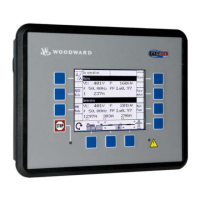
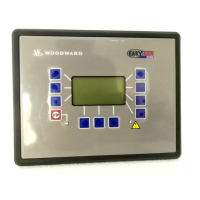
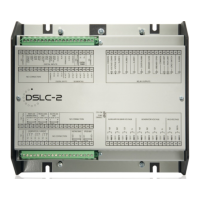
Manual 37443A DSLC-2 - Digital Synchronizer and Load Control
© Woodward Page 73/226
Var Loadshare
2 0.00 to 100.00 0.50 VAR load share gain is adjusted to provide stable var sharing. If
var sharing is unstable, lower the gain value. Remember the vol-
tage trim PID is active during var sharing mode.
Adjusts the weighting between var share error signal and voltage
trim error signal.
Example:
60 % - Will influence var sharing more than voltage trim
40 % - Will influence voltage trim more than var sharing
control
setpoint
1 50 to 650000 V 480 V This value is the reference for the voltage controller when per-
forming isolated and/or no-load operations. Usually the voltage
control setpoint is the same as the rated voltage setting. In some
cases it could be desired to have another setpoint in isolation op-
The different setpoint values are supplied to the controller via this
ramp. The slope of the ramp is used to alter the rate at which the
controller modifies the setpoint value. A greater value will create a
faster change in the setpoint.
5604
Reactive
load droop
2 0.0 to 20.0 % 0.0 % Woodward recommends having around 3 % droop in the voltage
regulator. Reactive load droop is not needed when the voltage
regulator has droop. Reactive load droop must be added if the vol-
tage regulator does not have droop.
In three situations the reactive load droop gets actived:
1. The “CB Aux” contact is open.
2. Discrete input 21 “Droop Tracking” is closed, the current
voltage biasing output is locked in at it’s present value.
3. Droop tracking missing device (parameter 4060) is “On”
and the communication monitoring detects an error
(Menu 5). The voltage bias output is locked at it’s
present value.
NOTE: The droop setting influences the voltage biasing signal
and cannot directly calculated into a voltage deviation.


 To Next Page
 Loading...