In scalar control, some standard features are not available.
See also section Operating modes of the drive (page 26).
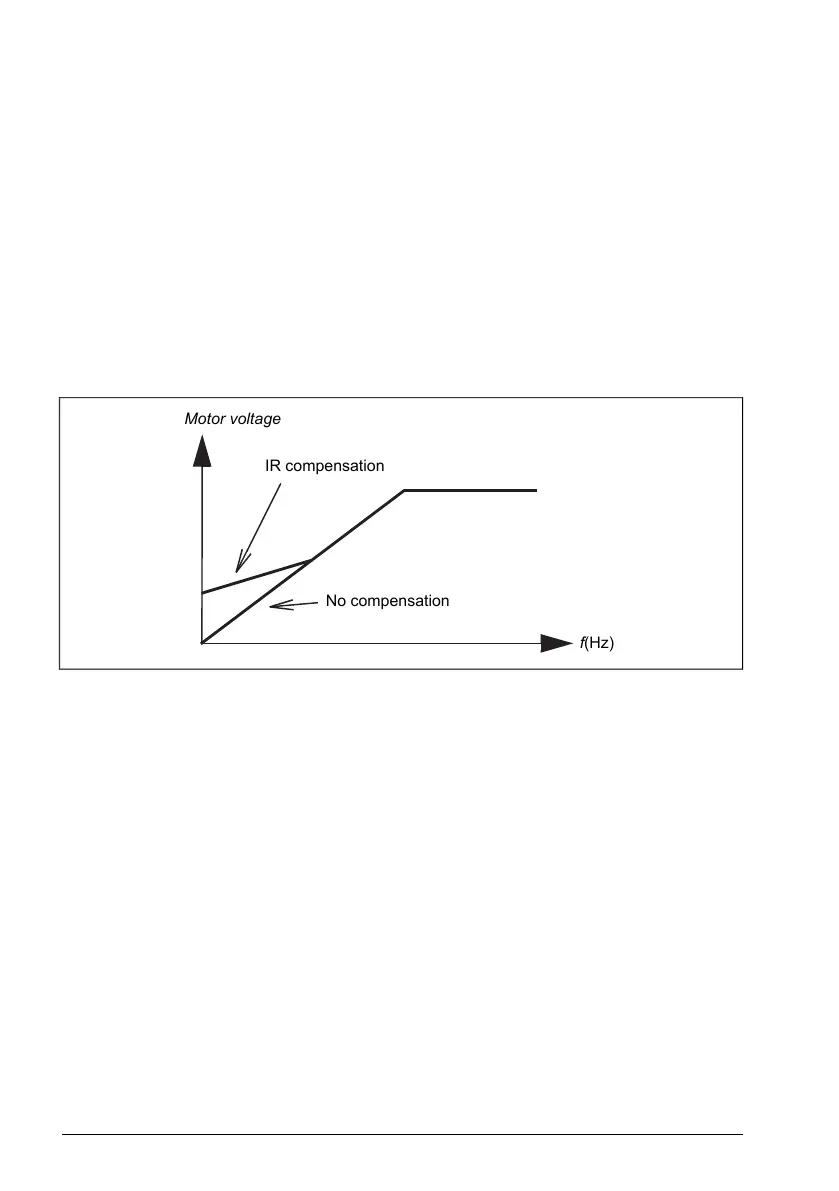
IR compensation for scalar motor control
IR compensation (also known as voltage boost) is available only when the motor control
mode is scalar. When IR compensation is activated, the drive gives an extra voltage
boost to the motor at low speeds. IR compensation is useful in applications that require
a high breakaway torque. In step-up applications, voltage cannot be fed through the
transformer at 0 Hz, so an additional breakpoint is available for defining the compensation
near zero frequency.
In Direct Torque Control (DTC), no IR compensation is possible or needed as it is applied
automatically.
Motor voltage
f(Hz)
IR compensation
No compensation
Settings and diagnostics
Parameters: 19.20 Scalar control reference unit (page 240), 97.12 IR comp step-up
frequency (page 522), 97.13 IR compensation (page 522) and 99.4 Motor control
mode (page 528).
Parameter group: 28 Frequency reference chain (page 305).
■ Autophasing
Autophasing is an automatic measurement routine to determine the angular position of
the magnetic flux of a permanent magnet synchronous motor or the magnetic axis of a
synchronous reluctance motor. The motor control requires the absolute position of the
rotor flux in order to control motor torque accurately.
Sensors like absolute encoders and resolvers indicate the rotor position at all times after
the offset between the zero angle of rotor and that of the sensor has been established.
On the other hand, a standard pulse encoder determines the rotor position when it
rotates but the initial position is not known. However, a pulse encoder can be used as
an absolute encoder if it is equipped with Hall sensors, albeit with coarse initial position
64 Program features


 To Next Page