14 Chapter 2 Flight Safety
The visual obstacle avoidance performance of the visual sensing system is not 100%
reliable, as the system may be affected by ambient lighting and object surface texture.
When the visual obstacle avoidance system is enabled during flight, always pay attention
to the image transmission screen in the Autel Enterprise App.
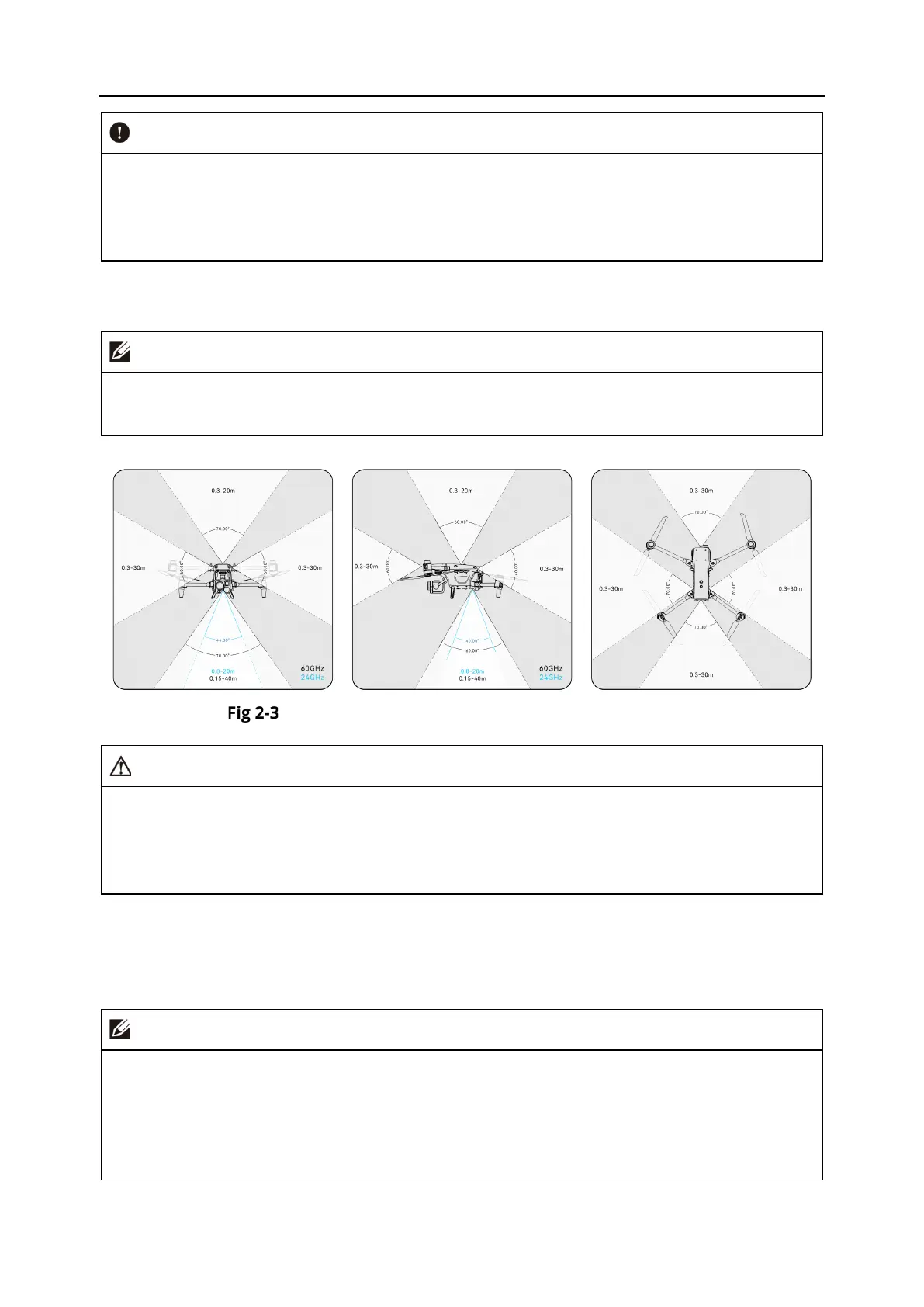
Observation Range of Millimeter-wave Radar Sensing System
Please be aware that millimeter-wave radars of different frequency bands may have varying
observation performance.
Observation Range of Millimeter-wave Radars
The obstacle avoidance distance of the millimeter-wave radar sensing system varies with
the obstacle's ability to reflect electromagnetic waves and its surface size.
The gray area represents the blind spot of a millimeter-wave radar, where the radar cannot
Observation Range of Radar and Visual Sensing Systems
With the integration of radar and visual sensing systems, the aircraft achieves 720°
omnidirectional obstacle avoidance and supports nighttime obstacle avoidance.
If the aircraft uses a 60 GHz bottom millimeter-wave radar, it supports nighttime obstacle
avoidance by millimeter-wave radars.
If the aircraft uses a 24 GHz bottom millimeter-wave radar, the front, rear, left, right and
top millimeter-wave radars are disabled by default. The aircraft does not support nighttime
obstacle avoidance by millimeter-wave radars and only supports visual obstacle avoidance




 To Next Page