5-14 QUALITY ASSURANCE Biodex Medical Systems, Inc. © 2014
Chi-Square
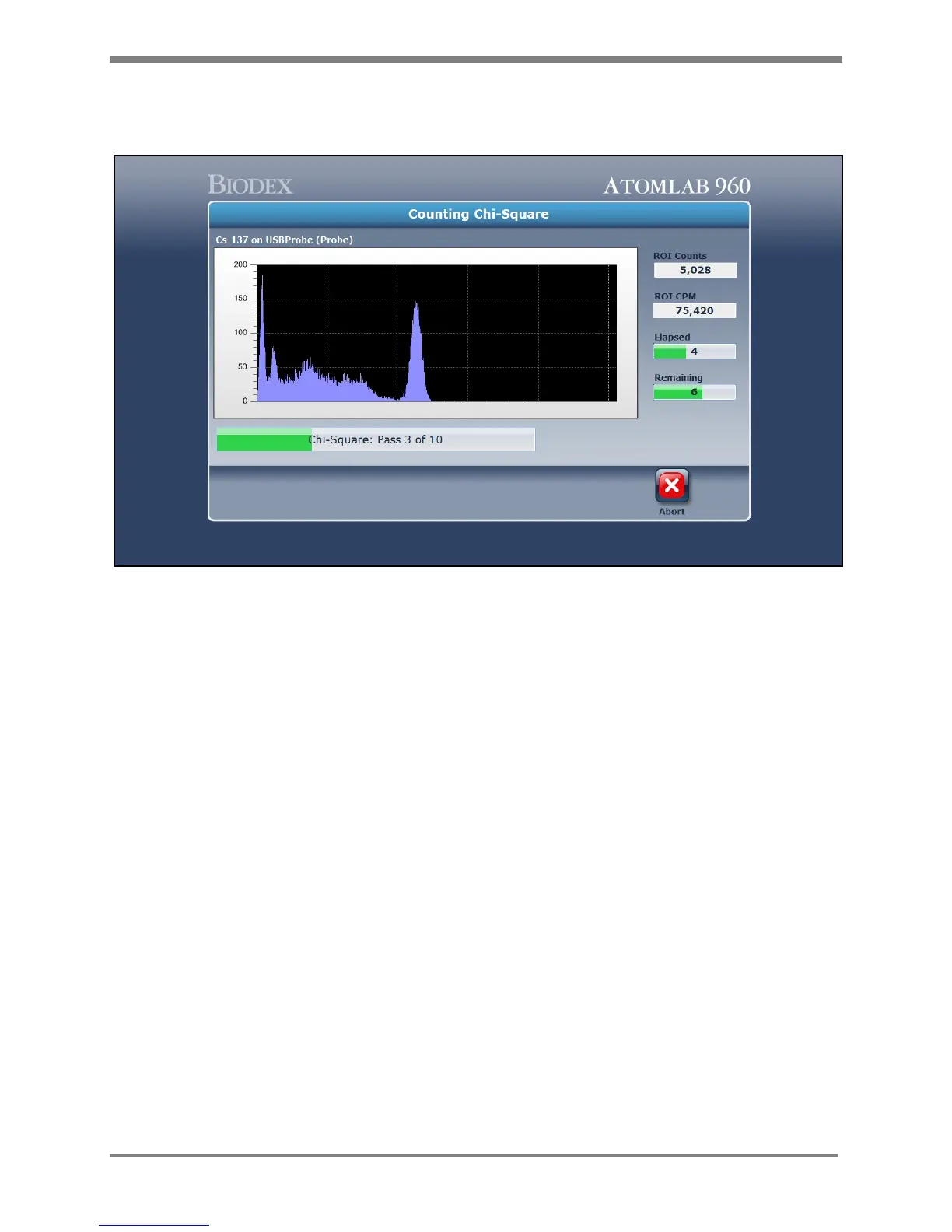
(See Figures 5.16. - 5.17.)
Figure 5.16. The Counting Chi-Square screen.
As is the case with Daily Calibration, Chi-Square is performed using a 10 µCi Cs-137 button
source. The Chi-Square Test is independent of the counting time, counting rate, and number of
counts performed. For this reason, Chi-Square is a very valuable test for a detector system
which is recording truly random events. For example, if systematic failure occurs at low
counting rates but passes at high rates, there is an indication of a non-random event occurring
which is comparable to the low counting rates. Since time is precise to within 10 microseconds
with a crystal controlled clock, 10-second count times should have very little error due to the
timer itself.
The number of counts performed is 10, which determines the number of degrees of freedom
(9) for the analysis. The lower limit is 4.168, the upper limit is 14.68. These correspond to a
90% probability for passing the lower limit, and 10% probability for passing the upper limit,
respectively. In all, one would expect a 20% failure rate frequency for the Chi-Square test. It is
not reasonable to always pass or always fail Chi-Square without raising concerns that there may
be a systematic problem in the detector or counter.
NOTE: The system stores the information for multiple Chi-Square tests performed on a
detector. Chi-Square can be performed as frequently as desired, but is generally performed
quarterly. A daily calibration must be performed before Chi Square can begin. If a daily
calibration has not been performed, the system switches to daily calibration.


 To Next Page