- The machines are only equipped with road lights. If the
machine is used at night or in tunnels, suitable external
lighting should be arranged.
- Never raise a load using just one fork.
- Do not lift, move or rotate the attachment above people.
Spillages from the attachment or knocking the attach-
ment against something can cause damage.
- Never authorise anyone to approach or pass below a load.
- In certain conditions, fragments of material may be expelled
while you are working. In this case, wear protective goggles
and keep anyone not equipped with goggles at a distance.
- Beware of collapsing walls, landslides, materials or
objects falling from the attachment that could break the
cab window and injure the operator.
- Never carry out any operations of any type below an
overhang; it could collapse and fall on the machine.
- Never attempt to overll attachments or carry loads that
could spill or turn over.
- Using two machines at the same time to handle heavy
or voluminous loads is dangerous and requires special
precautions. Only carry out this type of manoeuvre in
exceptional cases and when the person in charge of
handling the load is in attendance.
- Do not carry out manoeuvres near combustible materials.
- CAUTION -
While driving or manoeuvring the machine, keep the
height of the various parts of the machine in mind.
Remember certain parts protrude beyond the
dimensions of the cab.
- The machine is equipped with a safety cab that offers pro-
tection from falling objects (FOPS). It is compulsory to wear
a helmet if there is a risk of objects falling from above.
- Do not use the attachment at night, in dark or poorly lit
environments unless the machine is equipped with work
spotlights (optional). For more information, please con-
tact your dealer.
- CAUTION -
Before driving the machine onto a loading bridge, ensure that
the bridge is properly positioned and anchored, that the vehicle
to which it is connected (trailer, lorry, etc.) cannot move, that
the bridge can support the total weight of the machine and
its load and that the bridge is wide enough for the machine.
- Beware of loading bays, trenches, scaffolding and exca-
vations that have been recently excavated or lled.
- When driving the machine on the road and/or on slo-
pes, pay the utmost attention to the engine speed. High
engine speeds can cause mechanical malfunctions. Al-
ways keep an eye on the engine rpm and speed. When
the engine reaches 2350 rpm, the control panel will
trigger a continuous acoustic alarm to warn that the
engine is over revved and the “general alarm” pilot
lamp will light up on the central control panel.
- CAUTION -
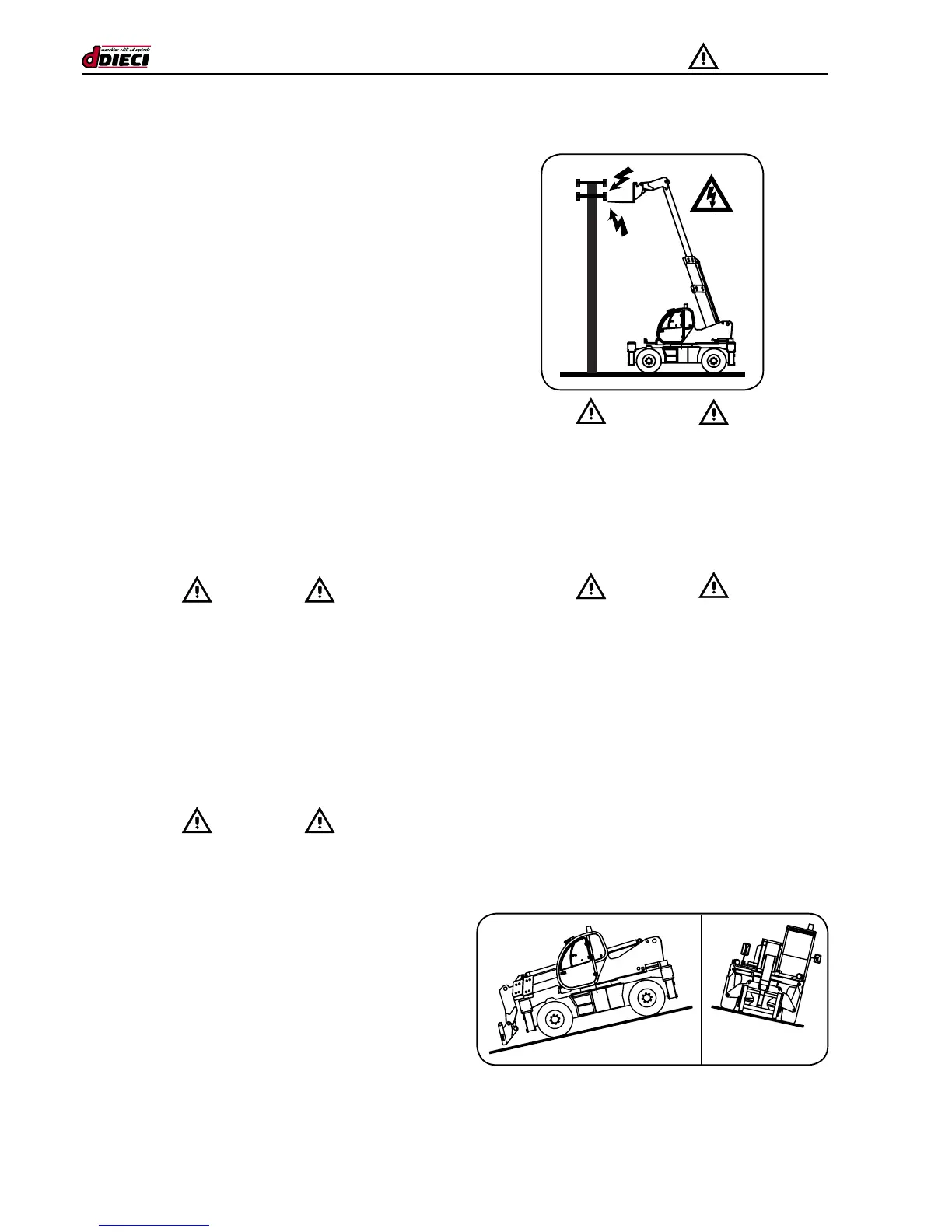
When working near overhead electricity lines, ensure
the safety distance between the machine and the elec-
tricity line is sufcient.
Ask your local electrical company for information.
Never work less than 5 metres from electric cables.
Damp ground increases the danger area affected by
electric discharges.
- CAUTION -
Do not work or park the machine near electricity cables;
you could be electrocuted or seriously injured.
DIECI strongly recommends that the safety regulations
employed onsite comply with the local regulations in ef-
fect for any type of work carried out near electricity lines.
- Use a person on the ground to signal when the machine
is too close to electricity cables.
- When working near electricity cables ensure that no one
approaches the machine. Always wear rubber shoes and
gloves to ensure you are prepared for any emergency.
Cover the seat with a rubber sheet and ensure you do
not touch the chassis with unprotected parts of the body.
- If the machine crashes into an electricity cable, to avoid
being electrocuted, the operator must not abandon the
cab until it has been conrmed that the electricity supply
has been disconnected.
- Driving sideways along slopes can cause the machine to
roll-over or slide. Adopt the due precautions.
- Do not leave a loaded machine on a slope with a gra-
dient over 15%, even if the parking brake is engaged.


 To Next Page