Need help?
Do you have a question about the EDAN Acclarix LX9 Series and is the answer not in the manual?
 General
| Brand | EDAN |
|---|---|
| Model | Acclarix LX9 Series |
| Category | Diagnostic Equipment |
| Language | English |
Lists critical warnings to prevent injury, death, or equipment damage during system operation.
Provides cautions for proper handling, maintenance, and usage to avoid equipment damage or data loss.
Explains the meaning of various symbols and labels found on the system and its packaging.
Details standard and optional components of the ultrasound system and their configurations.
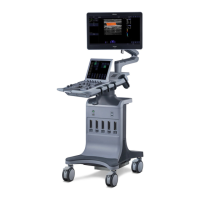
Provides a visual and descriptive overview of the main unit, control panel, and screen layout.
Guides users on preparing the system for use, including battery, AC power, and transducer connection.
Explains how to adjust the monitor's position for optimal viewing comfort and ergonomics.
Provides step-by-step instructions on initiating a new ultrasound examination and entering patient data.
Describes the interface for managing patient demographic and examination data.
Explains how to use the modality worklist for retrieving scheduled patient exams from a DICOM server.
Covers the fundamental B-mode imaging, including usage and optimization techniques.
Details the use and optimization of Color Doppler imaging for flow visualization.
Explains Pulsed Wave (PW) Doppler mode, including usage and image optimization.
Explains 3D/4D imaging capabilities, including acquisition, review, and rendering.
Covers Elastography imaging for mapping tissue elastic properties and strain estimation.
Lists available transducers, their types, applications, and applied regions.
Details procedures for cleaning, disinfecting, sterilizing, and storing transducers.
Explains the installation, usage, and calibration of needle biopsy guides for procedures.
Describes how to add annotations (text, arrows) to ultrasound images for clarification.
Explains how to add body mark graphics and transducer icons to images for anatomical reference.
Covers dual and quad imaging modes for displaying multiple ultrasound views simultaneously.
Explains how to review captured cine clips manually or automatically.
Describes basic measurements like distance, area, angle, volume, and stenosis applicable across modes.
Details measurements specific to clinical applications like Abdomen, Gynecology, Cardiac, etc.
Explains how to view, edit, and generate worksheets and reports of exam data.
Covers the process of storing static images and cine clips using the system's keys.
Describes how to access and manage past studies stored in the exam database.
Details methods for archiving studies to DICOM servers, FTP servers, USB/DVD, or mobile devices.
Guides users through configuring system settings like date, time, language, and network.
Allows configuration of measurement units, cardiac settings, OB/GYN, and HIP parameters.
Covers network configuration, including TCP/IP, DICOM, and Network Store settings.
Outlines procedures for system maintenance, license management, software upgrades, and export/import.
Lists daily checks to perform before and after system operation to ensure proper function and safety.
Offers solutions for common system malfunctions and error messages.
Details methods for cleaning and disinfecting the system surface, trackball, and ECG cable.
Details the electrical safety classifications according to various protection standards and ingress protection.
Lists general specifications including display modes and hard drive storage capacity.
Compares feature availability across different Acclarix LX9 models.
Specifies the environmental conditions for operating, storing, and transporting the system.
Provides center frequencies for various transducer models used with the system.
Explains ultrasound safety principles, focusing on the ALARA principle for minimizing patient exposure.
Defines Mechanical Index (MI) and Thermal Index (TI) for assessing ultrasound output and potential bioeffects.
Discusses how operator controls can influence ultrasound output and affect biological effects.
Lists recommended ultrasonic transducers with their models and part numbers for ordering.
Lists recommended needle guide bracket kits with their models and part numbers.
Declares the system's electromagnetic emission characteristics and intended environment.
Outlines the system's immunity to electromagnetic disturbances and recommended environments.
Provides instructions on how to connect the ultrasound gel warmer to the control panel.
Explains how to operate the gel warmer to heat ultrasound gel and its safety precautions.
Details the procedure and validated cleaning agents for cleaning the ultrasound gel warmer.

 To Next Page