The implanting physician can select any standard ventricular pacing leads with the
following characteristics:
• Bipolar lead approved for transvenous intracardiac ventricular pacing.
• Standard IS-1 bipolar connector.
• Active fixation with electrically-active corkscrew distal electrode with a minimal
electrically-active surface area of 3.6 mm
2
.
• Distal electrode coated with low-polarization coating (e.g. titanium nitride or
iridium oxide).
Note: The leads qualified for delivering CCM signals from OPTIMIZER IPGs must be
commercial models that are FDA approved.
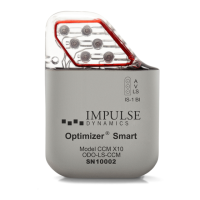
1.2 OPTIMIZER Smart IPG Lead Connectors
The connector block accepts three (3) bipolar IS-1-BI connectors. The terminals are
marked as follows:
• “A”: Atrium
• “V”: Ventricle
• “LS”: Local sense
1.3 OPTIMIZER Smart IPG Physical Characteristics
Height (mm) 69.4 ± 2.0
±
Thickness (mm) 11.5 ± 0.5
Volume (cm
) 30.5 ± 0.5
Mass (g)
46 ± 3.0
Exposed metallic surface
a
(cm
2
)
The ID comprises the following 3 elements:
• Impulse Dynamics Manufacturer ID: “ID”
• Model number code: “OS” for OPTIMIZER Smart
• Year code: A for 2015, B for 2016, C for 2017, etc.
“y” is replaced by the letter code for the year of
manufacture (see Appendix I).
Materials in contact with human tissue
b
Titanium, Epoxy resin, Silicone rubber
Lead connectors 3.2 mm; IS-1/VS-1
a
When using unipolar ventricular or atrial sensing, the case of the OPTIMIZER Smart device serves as indifferent electrode. The
local sense (LS) polarity is always bipolar.
b
Tests have revealed that these materials are biocompatible. The OPTIMIZER Smart IPG does not cause any temperature
elevation capable of damaging the surrounding tissue.


 To Next Page