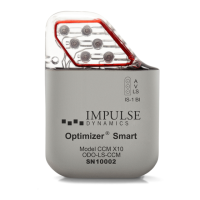
The OPTIMIZER Smart system delivers non-excitatory CCM signals to the heart and has no
pacemaker or ICD functions.
3. CONTRAINDICATIONS AND PRECAUTIONS
Use of the OPTIMIZER Smart system is contraindicated in:
1. Patients with a mechanical tricuspid valve
2. Patients in whom vascular access for implantation of the leads cannot be obtained
4. WARNINGS
4.1 Prohibited Use
• Neither the OMNI Smart Programmer nor the OPTIMIZER Mini Charger is
suitable for use in the presence of flammable mixtures of anesthetics with air,
oxygen, or nitrous oxide.
• Neither the OMNI Smart Programmer nor the OPTIMIZER Mini Charger is
suitable for use in an oxygen rich environment.
4.2 Potential Complications of Device Implantation
Just like any surgical procedure, implantation of an OPTIMIZER Smart IPG is associated
with a certain risk. Complications of IPG implantation reported in the literature include,
but are not limited to: arrhythmias induced by the IPG, including life-threatening
arrhythmias (e.g. ventricular fibrillation), infection, skin necrosis, device migration,
hematoma formation, seroma and histotoxic reactions (also see: Potential Adverse
Effects, Section 6).
Programming high sensitivities (i.e. sensitivity settings less than 2 mV) may increase the
system’s susceptibility to electromagnetic interference, which could either inhibit or
trigger signal delivery.
Acute and chronic complications reported in the literature include, but are not limited to:
lead fracture, lead displacement, atrial or ventricular perforation, and rare cases of
pericardial tamponade. Perforation of the ventricular wall can induce direct stimulation of
the phrenic nerve or the diaphragm. An impedance change demonstrated on a check-up
can be indicative of lead fracture, lead displacement, or perforation (also see: Potential
Adverse Effects, Section 6).
In very rare cases (<1%), transvenous lead placement can also lead to venous thrombosis
and subsequent SVC syndrome.
Loss of sensing shortly after implant can be the result of lead displacement. In addition,
loss of CCM signal delivery could be due to a lead fracture.
4.2.1 Atrial and Ventricular Arrhythmias Potentially Caused by Lead
Implantation
As noted above, the use of transvenous leads may lead to arrhythmias, some of
which may be life-threatening such as ventricular fibrillation and ventricular
tachycardia. The use of screw-in leads such as those used for CCM signal delivery
also have the potential of causing conduction disturbances such as bundle branch
block. These can be minimized by performing the implant with the use of
fluoroscopic guidance, ensuring that the leads are in appropriate position prior to


 To Next Page