With regard to use of CCM outside the United States, the 2016 European Society of
Cardiology practice guidelines has reviewed clinical studies of CCM in heart failure
patients and mentioned CCM as a treatment option that may be considered in selected
patient population. Summaries of some of these studies are available on Impulse
Dynamics’ website (http://www.impulse-dynamics.com/int/for-physicians/clinical-data/).
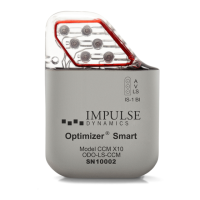
Over the years of evaluation of CCM therapy and use of the therapy outside the USA in
countries that accept the CE Mark, CCM was delivered using various models of the
OPTIMIZER
®
System, which includes an implantable pulse generator (IPG) that is
programmable and has a rechargeable battery. In principle, the OPTIMIZER
®
System is
implanted in a procedure which is similar to a pacemaker implantation. Unlike
pacemakers or defibrillators, the OPTIMIZER
®
System does not have integrated pacing
or defibrillation capabilities, and is only used for delivering CCM therapy. Often a patient
may have concomitant implantable devices, as may be indicated per patient. The
OPTIMIZER
®
is connected to the heart’s ventricles using leads, typically with the
electrodes fixated to the right ventricular septum. For example, the ventricular leads may
be spaced apart by a few centimeters and positioned on the septum, at or adjacent to an
intersection of the septum and right ventricular free wall. The electrodes are used for
sensing electrical activity of the heart and for delivery of CCM signals to the ventricular
muscle at the proper timing and signal configuration. The OPTIMIZER can be
programmed to deliver CCM therapy for several hours every day: typically 5 hours per
day in the US studies, and 7 or more hours per day in other countries. As part of the
OPTIMIZER algorithm, the circuitry records one or more local electrical activity (i.e.
activity in the vicinity of the electrode measured using the bipolar electrode
configuration) or non-local electrical activity (i.e. wide-field electrogram using unipolar
sensing between the electrode and the distant IPG can). The timing of the CCM delivery
is determined to be at a certain delay and duration from the sensing, designed to deliver
the CCM during the absolute refractory period of the muscle within the current beat
cycle; this may maintain the CCM signal non-excitatory. The algorithm also applies
criteria for delivery of the CCM signal or inhibiting the delivery of the CCM signal
according to the relative timing of events, for example using criteria for minimum and
maximum acceptable heart rate (R-R intervals), minimum and maximum acceptable time
between sensed events in two locations on the RV septum, inhibition if signals are
detected at an unexpected timing, and/or the use of an alert window in order to detect
unexpected events and potentially block CCM delivery. The parameters of the algorithm
are configured per patient, with the purpose of enabling the normal delivery of the
contractility modulating signal when the trace of events is indicative of an expected
activation sequence of the heart.
2. INDICATIONS
1
The OPTIMIZER Smart system is indicated for use in patients who are older than 18 years of
age with symptomatic heart failure due to systolic left ventricular dysfunction despite appropriate
medical therapy.
1
The safety and performance of the OPTIMIZER Smart System is based on clinical investigations conducted with the prior
generation device, the OPTIMIZER IVs and III Systems given the similarities between the Systems with regard to function,
intended use, design characteristics, and the CCM signals. Summaries of these studies are available on Impulse Dynamics’
website.
(http://www.impulse-dynamics.com/int/for-physicians/clinical-data/)


 To Next Page