6. POTENTIAL ADVERSE EFFECTS
Examples of adverse effects that may occur as the result of the surgical procedure are listed
below in the order of their clinical severity:
1. Death
2. Arrhythmias (brady- or tachyarrhythmias including fibrillation)
3. Stroke or TIA (“transient ischemic attack”)
4. Respiratory/ventilatory failure
5. RA/RV perforation
6. Hemorrhage
7. Infection
8. Pleura or pericardial effusion
9. Pneumothorax
Examples of additional adverse effects potentially occurring secondary to CCM signal delivery
are listed in the table below in the order of their clinical severity:
1. Abnormal cardiac function
2. Atrial and Ventricular Tachyarrhythmias
3. Atrial and Ventricular Bradyarrhythmias
4. Worsening heart failure
5. Myocardial tissue damage
6. Chest pain
7. DEVICE IMPLANTATION
7.1 General Considerations
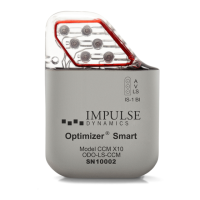
Generally, the OPTIMIZER Smart IPG is implanted in the right pectoral region.
Subclavian venous access is preferred over access via the axillary or cephalic vein,
because a total of three intracardiac leads have to be inserted. Two right ventricular leads
are placed for CCM signal delivery, one of these preferably in an anterior septal and the
other in a posterior septal location, approximately half way between base and apex.
Placing both leads in an anterior or posterior septal location is an acceptable alternative,
provided the leads are separated by at least 2 cm. In patients who carry an ICD, one needs
to ensure that there is adequate separation between CCM leads and ICD lead.
Warning: Avoid Subclavian crush by proper lead placement. Patients need to be
monitored closely after the implantation procedure.
Warning: Exercise care while placing the leads to avoid swelling of the steroid plug or
formation of a blood clot, which could prevent retraction of the corkscrew.
Warning: It is important to avoid prolonged manipulation of the leads and catheters in
the venous system, which could lead to venous thrombosis.


 To Next Page