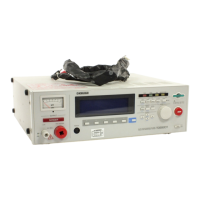
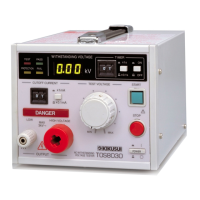
TOS3200
181
Four Principal Tests for Evaluating the Safety of Electrical and Electronic Products
Appx
Withstanding Voltage Test
The withstanding voltage test evaluates whether the electric insulation section of an electric
equipment or parts have sufficient dielectric strength for the working voltage. It is also called
dielectric withstand test or hipot test.
In this test, a voltage stress that is much higher than the voltage that is normally applied to
the insulation section for a specific time to see whether a dielectric breakdown occurs. If a
current flowing through the insulation section exceeds the limit during the test period, it is
assumed that a dielectric breakdown occurred. If a dielectric breakdown does not occur, the
insulator is assumed to have sufficient dielectric strength.
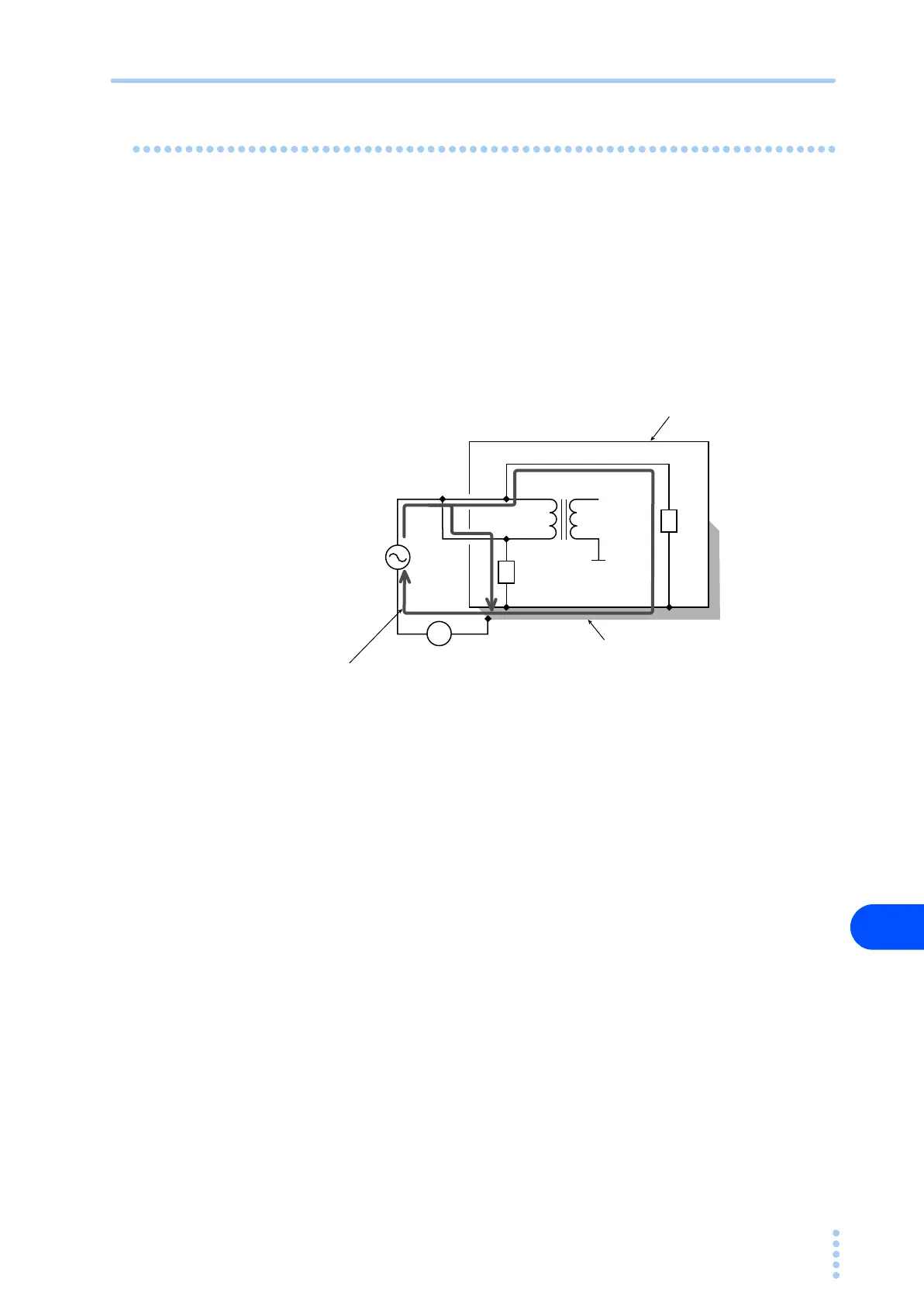
Measurement principle of the withstanding voltage test
Fig. B-2 Withstanding voltage test
AC test and DC test
For the test between the primary circuit and an accessible section as shown in Fig. B-2, an
AC voltage is normally applied. If a filter for eliminating the electromagnetic interference is
present in the location corresponding to Z1 or Z2 and its capacitive component is large, the
distinction between the current flowing through the filter and the current used to assume a
dielectric breakdown will be difficult. In this case, it is recommended that the test be per-
formed using a DC voltage equal to the peak value of the specific AC voltage.
N
L
Z1
Z2
Enclosure
Electronic Equipment
Secondary
Primary
Accessible conductive part
A
Output of the withstanding
voltage tester
Ammeter of the withstanding voltage tester
Measures the current flowing through Z1 and Z2


 To Next Page