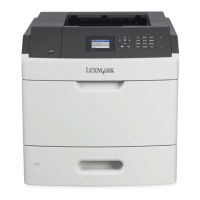
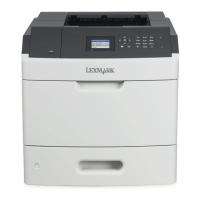
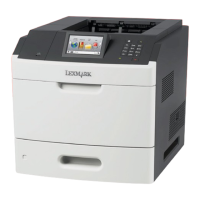
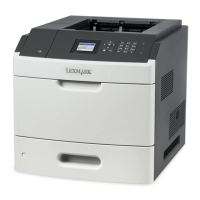
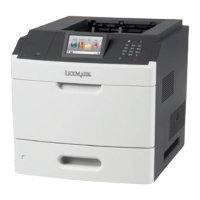
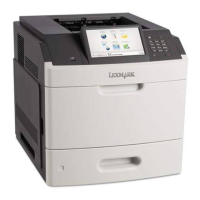
When using optional trays:
• Always use a caster base when the printer is configured with a 2100‑sheet tray.
• The 2100‑sheet tray must always be at the bottom of a configuration.
• A maximum of four optional trays may be configured with the printer.
• The optional 250‑ and 550‑sheet trays may be installed in any order.
Paper guidelines
Paper characteristics
The following paper characteristics affect print quality and reliability. Consider these factors before printing on them:
Weight
The printer trays and multipurpose feeder can automatically feed paper weights between 60–176 g/m
2
(16–47‑lb) grain
long
paper. The 2100‑
sheet tray can automatically feed paper weights up to 60–135 g/m
2
(16–36‑lb) grain long paper.
Paper lighter than 60 g/m
2
(16 lb) might not be stiff enough to feed properly, and may cause jams.
Note: Two‑sided printing is supported for 60–176 g/m
2
(16–47‑lb) paper.
Curl
Curl is the tendency for paper to curl at its edges. Excessive curl can cause paper feeding problems. Curl can occur after
the
paper
passes through the printer, where it is exposed to high temperatures. Storing paper unwrapped in hot, humid,
cold, or dry conditions, even in the trays, can contribute to paper curling prior to printing and can cause feeding
problems.
Smoothness
Paper smoothness directly affects print quality. If paper is too rough, toner cannot fuse to it properly. If paper is too
smooth, it can cause paper feeding or print quality issues. Always use paper between 100 and 300 Sheffield points;
smoothness between 150 and 250 Sheffield points produces the best print quality.
Moisture content
The amount of moisture in paper affects both print quality and the ability of the printer to feed the paper correctly.
Leave paper in its original wrapper until it is time to use it. This limits the exposure of paper to moisture changes that
can degrade its performance.
Store paper in its original wrapper in the same environment as the printer for 24 to 48 hours before printing. Extend
the time
several days if the storage or transportation environment is very different from the printer environment. Thick
paper may also require a longer conditioning period.
Grain direction
Grain refers to the alignment of the paper fibers in a sheet of paper. Grain is either grain long, running the length of
the paper, or grain short, running the width of the paper.
For 60–176 g/m
2
(16–47‑lb) paper, grain long paper is recommended.
4063
General information
30


 To Next Page