determine the tripping time according to the overfluxing magnitude value and
the set characteristic.
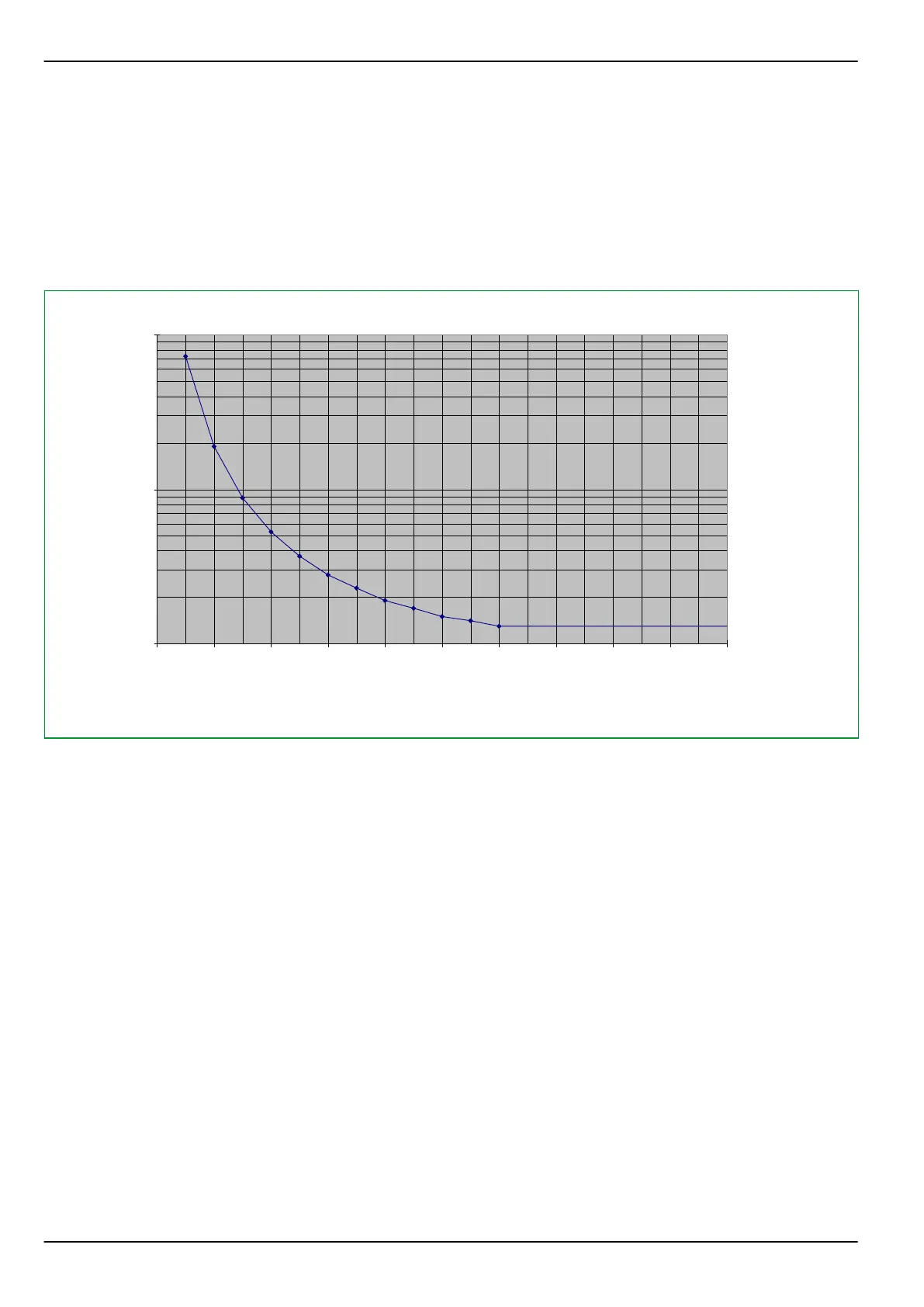
The variable-time tripping characteristic is set by defining 12 pairs of overfluxing
values and their associated tripping time values. Intermediate values are
obtained by interpolation. The setting of the characteristic is checked for
plausibility with regard to a monotonically decreasing characteristic. With values
of V/f > 1.6 the tripping time is limited to the value set for V/f = 1.6. The tripping
characteristic with default setting values is displayed in Fig. 3-145, (p. 3-192).
1
10
100
1.00 1.10 1.20 1.30 1.40 1.50 1.60 1.70 1.80 1.90 2.00
V/f
t/s
P1852ENa
1
10
100
1.00 1.10 1.20 1.30 1.40 1.50 1.60 1.70 1.80 1.90 2.00
V/f
t/s
P1852ENa
Fig. 3-145: Example of a tripping characteristic (with default settings)
After a starting, the elapsed starting time is accumulated in a buffer. When the
starting drops out, the buffer memory is discharged. The discharge gradient is
defined by the set cooling time. When the starting recurs the buffer memory is
again accumulated with starting time values. If the accumulated starting time
reaches the tripping time value determined by the P634 then the trip signal will
be issued. The buffer memory content during an interrupted starting is shown in
Fig. 3-146, (p. 3-193). In case A, the tripping time determined by the P634 is not
reached by the accumulated starting time. In case B, on the other hand, a trip
signal is issued.
P634
3 Operation
3-192 P634/EN M/R-42-A // P634‑311‑653


 To Next Page