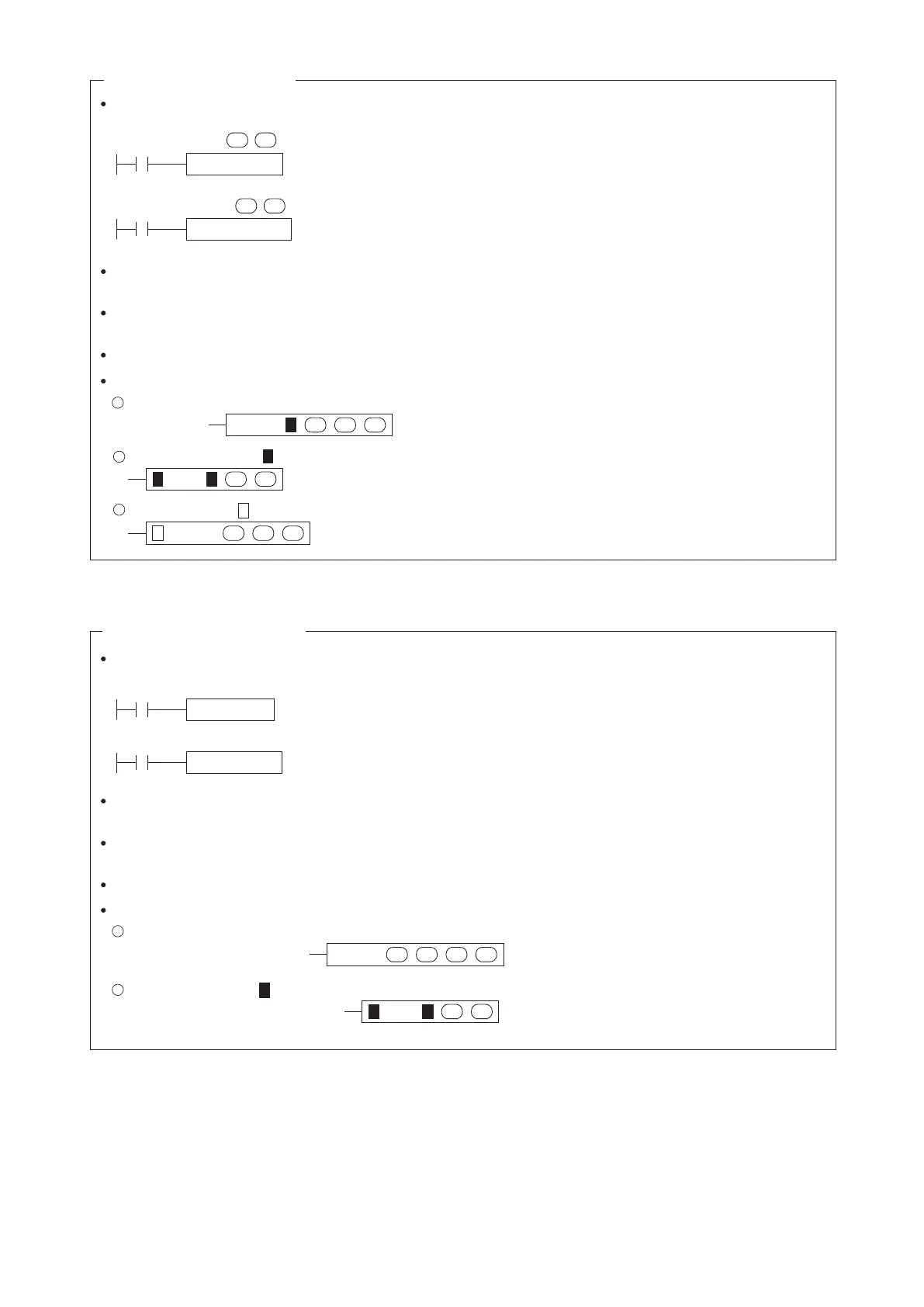
Based on requires, some application instruction can be organized into continuous execution instruction or pulse
execution instruction.
16-bit or 32-bit Instructions
Pulse Execution Instructions
Sequential execution instruction: When X20=”ON”, the instruction will be executed once
in each scan cycle.
Pulse execution instruction: The instruction is only executed once when
X20=“OFF” → “ON”.
Because of different Operand value sizes, some of the application instruction can be organized into 16-bit instruction
or 32-bit instruction.
MOV D0 D10
S
D
DMOV D0 D10
S
D
X20
MOV D0 D1
MOVP D0 D1
X20
2
3
1
B M O V P
S
D
n
D
D M O V P
S
D
2
1
There is no other extra sign on the right of instruction, this indicates that the instruction is sequential execution
instruction only. For example,
N C D
I
S
D
S1 S 2
D
n
D
D H S C S
S1 S 2
D
D M O V P
122
A 16-bit instruction, the content of D0 is transferred to D10.
A 32-bit instruction, the contents of (D1, D0) are transferred to (D11, D10).
A 32-bit instruction is displayed with a “D” (to be added directly BEFORE the instruction mnemonic), e.g. MOV
represents a 16-bit instruction, while DMOV represents a 32-bit instruction.
The device ID. number specied by an Operant of a 32-bit instruction can be an even or odd number. In order not to
get confusion, it is recommended to use an even number, if it is possible.
The 32-bit Counter (C200~C255) can be used as the Operand of a 32-bit instruction only.
At the instruction list, if a sign is marked on the left side of the instruction mnemonic, the explanation is below:
There is no other extra sign on the left of instruction, this indicates it can be executed by the way of 16-bit only.
For example,
There is a reverse out on the left, this indicates that it can be either 16 or 32-bit instruction. For example:
There is a framed on the left, this indicates that the instruction is only 32-bit instruction. For example:
A pulse instruction displayed with a “P” (to be added directly AFTER the instruction mnemonic), e.g. MOV represents
a sequential execution instruction, while MOVP represents a pulse execution instruction.
Suitable using pulse execution instructions to replace sequential execution instructions in a program, can cut down
unnecessary execution time.
When X20=“OFF”, both MOV and MOVP instuctions are not executed.
At the instruction list, if a sign is marked on the right side of the instruction mnemonic, the explanation is below:
P
There is a reverse out on the right, this indicates that it can be either a sequential execution instruction or pulse
execution instruction. For example:


 To Next Page