ELECTRICAL COMPONENTS
8-175
4. Check:
• Battery charge
▼▼▼▼ ▼ ▼▼▼▼▼▼▼▼▼ ▼ ▼▼▼▼ ▼ ▼▼▼▼ ▼ ▼▼▼▼▼▼▼
a. Connect a pocket tester to the battery termi-
nals.
• The charge state of an VRLA (Valve Regulated
Lead Acid) battery can be checked by measur-
ing its open-circuit voltage (i.e., the voltage
when the positive battery terminal is discon-
nected).
• No charging is necessary when the open-cir-
cuit voltage equals or exceeds 12.8 V.
b. Check the charge of the battery, as shown in
the charts and the following example.
▲▲▲▲ ▲ ▲▲▲▲▲▲▲▲▲ ▲ ▲▲▲▲ ▲ ▲▲▲▲ ▲ ▲▲▲▲ ▲▲▲
5. Charge:
• Battery
(refer to the appropriate charging method)
EWA13300
Do not quick charge a battery.
ECA1MC1002
• Never remove the VRLA (Valve Regulated
Lead Acid) battery sealing caps.
• Do not use a high-rate battery charger
since it forces a high-amperage current
into the battery quickly and can cause bat-
tery overheating and battery plate damage.
• If it is impossible to regulate the charging
current on the battery charger, be careful
not to overcharge the battery.
• When charging a battery, be sure to remove
it from the vehicle. (If charging has to be
done with the battery mounted on the vehi-
cle, disconnect the negative battery lead
from the battery terminal.)
• To reduce the chance of sparks, do not
plug in the battery charger until the battery
charger leads are connected to the battery.
• Before removing the battery charger lead
clips from the battery terminals, be sure to
turn off the battery charger.
• Make sure the battery charger lead clips are
in full contact with the battery terminal and
that they are not shorted. A corroded bat-
tery charger lead clip may generate heat in
the contact area and a weak clip spring may
cause sparks.
• Positive tester probe →
positive battery terminal
• Negative tester probe →
negative battery terminal
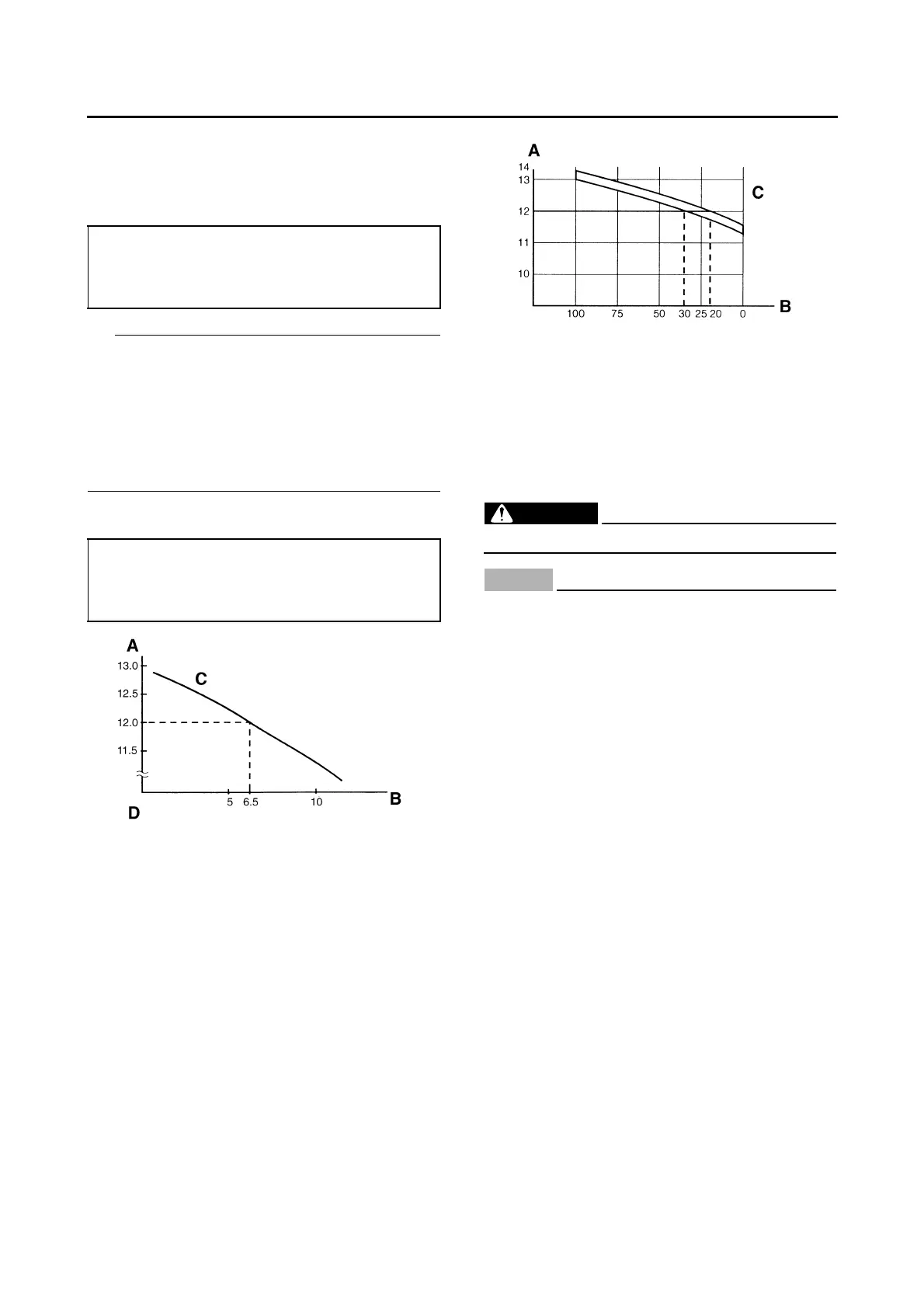
Example
Open-circuit voltage = 12.0 V
Charging time = 6.5 hours
Charge of the battery = 20–30%
A. Open-circuit voltage (V)
B. Charging time (hours)
C. Relationship between the open-circuit voltage
and the charging time at 20 °C (68 °F)
D. These values vary with the temperature, the
condition of the battery plates, and the
electrolyte level.
A. Open-circuit voltage (V)
B. Charging condition of the battery (%)
C. Ambient temperature 20 °C (68 °F)




 To Next Page