
 Need help?
Do you have a question about the GRAPHTEC FC4200-50 and is the answer not in the manual?
Explains the classification of safety precautions (DANGER, WARNING, CAUTION) and symbols.
Details the meaning of safety symbols like warning, prohibited, and imperative actions.
Lists critical safety warnings regarding electrical shock, moving parts, and improper use.
Lists safety cautions related to environmental conditions and improper handling.
Warnings about damaged power cords, dust on plugs, and direct contact with cutter blades.
Cautions regarding direct sunlight, dust, humidity, water, and fluid spills.
Warnings about pulling cables, using solvents, and ensuring proper illumination.
Precautions for loose media edges and the importance of test cuts before critical operations.
Requirement to use properly shielded and grounded cables for FCC compliance.
Guide to selecting appropriate power cables based on voltage ranges and plug configurations.
Advice on avoiding injury when handling sharp cutter blades.
Precautions regarding the cutter pen's blade extension and safe storage.
Step-by-step instructions for securely attaching a cutter pen to the plotter.
Procedure for attaching a plotter pen to the pen station for plotting operations.
Initial recommendations for setting FORCE, SPEED, and QUALITY for test cuts.
Important safety notes regarding pen carriage and Y bar movement after powering up.
Procedures for cleaning the plotter's casing and writing panel, avoiding solvents.
Recommendations for protecting the plotter from dust, dirt, sunlight, and high temperatures during storage.
Verify all included items after unboxing the plotter.
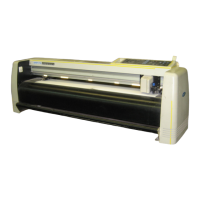
Detailed diagram and description of each part of the plotter.
Table detailing different cutter blades, their specifications, and suitable applications.
Explanation of cutter pen plungers and their components, including blade length adjustment.
Step-by-step instructions for safely replacing a cutter blade.
How to correctly adjust the cutter blade extension for optimal cutting depth.
Overview of the plotter's indicator lamps, including POWER and PROMPT status.
Explanation of the four function keys (F1-F4) and their roles in menu navigation and setting selection.
Description of POSITION keys, PAUSE, ENTER, ORIGIN, COPY, CONDITIONS, TEST, and CANCEL/VIEW keys.
Visual representation of the plotter's menu hierarchy for accessing functions.
Instructions for connecting the plotter to a computer via RS-232C serial or Centronics parallel interfaces.
Procedure for powering on the plotter and its initialization sequence, including safety warnings.
Guidance on how to properly load and secure media onto the plotter's writing panel.
Methods for securing media on FC4200-50 with electrostatic adhesion.
Methods for securing media on FC4200-60 with polyvinyl writing panel.
Table of recommended FORCE, SPEED, and QUALITY settings for various media and blades.
How to register and select up to four sets of user-defined cutting conditions.
How to set the corrective offset value for the cutter blade tip.
Setting the cutting FORCE parameter for cutter or plotting pens.
Setting the travel SPEED parameter for cutter or plotting pens.
How to adjust the QUALITY parameter for acceleration rate to improve cut finish.
How to enable and configure the THICK MODE for specialized media cutting.
Procedures for performing test cuts and evaluating results to fine-tune settings.
How to analyze test cut patterns to adjust OFFSET and FORCE settings for ideal results.
How to define a new starting origin for cutting or plotting operations.
Instructions for making duplicate cuts of stored data using the internal buffer memory.
Examples of how copied patterns are laid out, with and without MIRROR mode.
How ROTATE settings affect the output of copied patterns.
Procedure to calibrate and adjust pen width settings for precise plotting alignment.
Detailed steps for adjusting X and Y axis deviations for pen width calibration.
How to manually control the pen's up/down movement using the PEN U/D function.
Procedure to clear cutting data stored in the plotter's internal buffer memory.
How to assign different condition sets (COND Nos.) to pen holders 1 and 2.
Setting the origin point (bottom left or center) specifically for HP-GL command mode.
Setting the Lower Left (L.L.) and Upper Right (U.R.) corners to define the operational area.
How to set the U.R. point and understanding the "ILLEGAL PLOT AREA" message.
Enabling the ROTATE mode to change the orientation of the image's coordinate system.
Steps to enable or disable the ROTATE mode, with settings retained in RAM.
How to enable and configure the THICK MODE for specialized media cutting.
Enabling the MIRROR mode to reverse the coordinate system and create mirror images.
How the MIRROR setting affects output and if it's retained after power off.
Using the PEN SORT function to minimize pen changes and optimize plotting time.
Notes and cautions regarding the PEN SORT function's impact on cutting sequences.
Introduction to using registration marks for precise automatic alignment and cutting.
Details on valid registration mark patterns and the required reading areas for detection.
Information on media types unsuitable for recognition and causes of recognition failure.
Setting the MARK MODE for automatic or manual recognition of registration marks.
Setting MARK MOVE parameters to shorten recognition time and handle mark intervals.
Step-by-step guide for manually aligning the plotter using registration marks.
Procedures for inputting first, second, and third points for manual alignment.
Aligning coordinate axes using two registration marks for X-axis tilt correction.
Aligning coordinate axes using three registration marks for tilt and distance precision.
Selecting between Pattern 1 and Pattern 2 for registration mark recognition.
Setting the size of registration marks within a specified range for accurate detection.
Adjusting distance precision for registration marks using automatic or manual methods.
Adjusting the registration mark sensor by plotting and reading cross symbols.
Moving the registration mark origin point using the MARK OFFSET function.
Steps for adjusting X and Y coordinates to set the registration mark offset.
Using cross patterns to determine corrective values for sensor adjustment.
Setting the travel speed of the pen when it is in the raised (PEN UP) status.
Specifying the cutting pressure for initial blade control during plotter operations.
Setting a reference angle to optimize initial blade control and reduce cutting time.
Adjusting the minimum distance unit for processing short line segments to improve quality.
Switching the display of coordinate values between millimeters and inches.
Adjusting distance values to correct deviations in line segment lengths.
Detailed description of eight special functions for advanced control and customization.
Determining the position where initial blade control is performed.
Controlling pen movement behavior during PEN UP status.
Checking for pen presence in holders before pen changes.
Step-by-step guide to enable or disable various special functions via plotter settings.
Procedure to print a list of all currently selected plotter conditions.
Running the self-test to verify plotter operation independently of interface functions.
Using character dump mode to check data reception from the computer.
Solutions for issues when the plotter does not turn on or respond.
Solutions for issues with rounded or pointed cut corners.
Solutions for blade skipping or undulation during solid line cutting.
Solutions for zigzagged curves and media corners peeling off.
Solutions for blades cutting into backing sheets or falling out of the plunger.
Solutions for incorrect image sizes, abnormal noise, and medium discoloration.
Solutions for issues with setting retention and deformed characters during plotting.
Solutions for misaligned image points and issues with blade smoothness.
Solutions for problems preventing correct alignment of coordinate axes during registration mark detection.
Explanations of general error messages like position alarms and beeper/prompt lamp indicators.
Specific error codes and messages encountered when using the GP-GL command mode.
Specific error codes and messages encountered when using the HP-GL command mode.
Instructions for configuring the plotter for use with a Centronics parallel interface.
Setting the minimum distance unit for pen movement in GP-GL mode.
Setting up baud rate, data length, parity, and handshake for RS-232C communication.
Details on available parameter values for Baud rate, Data length, Parity, and Handshake.
Choosing between GP-GL and HP-GL command modes to match software application requirements.
Comprehensive list of technical specifications for FC4200-50 and FC4200-60 models.
Information on the optional dedicated stand accessory.
Diagram showing the external dimensions of the FC4200-50 plotter model.
Diagram showing the external dimensions of the FC4200-60 plotter model.



 To Next Page

 General