Page 12 - CEAST 9340 - Instructions for Use and Maintenance 7510.000MN1r ed. 1 rev. 1
••
••
• Test chamber: see para. 1.1.3.
Both chambers (standard and environmental) can be equipped with different stands,
such as:
- Fixed Height Stand;
- Adjustable Height Stand;
Many other stands are available according to the Client needs.
- Automatic clamping device: it clamps the specimen on the support before the
striker impact.
••
••
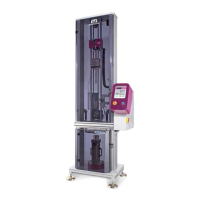
• Control box: it is the box attached to the right side of turret and it is provided of the
following parts:
- Power ON: it is a push-button to energize the instrument;
- Emergency: it is used only when an emergency condition arises.
When this button is pressed it cuts off the electrical power to the instrument.
To re-energize the instrument, disengage the Emergency button (half a turn in
clockwise direction) and re-press the Power ON push-button.
- Alphanumeric keypad with LCD display: it is used to program and manage the
tests.
It allows to enter all the test parameters required to carry out the automatic
impact cycle and to recall the results on display at the cycle end.
The instrument memory is able to store up to 25 sets of test parameters.
- Striker: it is used to strike the specimen surface when the impact test is carried out.
Striker can be of two different types:
Non-instrumented: it is used for a simple statistical check of the material impact
strenght (visual check of the specimen: broken/not broken).
Instrumented: it provide full details of the impact event from initial contact to
final breaking of the specimen by recording the force/time curve of the entire
impact event through a data acquisition system connected to a PC.
Data acquisition system (option) at which the instrumented striker is connected
can be of two different types: CEAST DAS 8000 Junior or CEAST DAS 16000.
The number identifies the max. number of points acquired during the impact
event.
For further details about strikers see the Appendix B attached to this manual.
- Striker antirebound system (option): it stops the striker after impact to avoid its
rebound on the specimen. This system intervenes only in case of striker rebound.
- Residual energy absorbers: they are used to damp the striker residual energy
after impact and they are placed on the turret base at the left and right sides.
- Impact and rebound velocity optical detector: it is used to measure the veloc-
ity of the striker just
before the impact and to activate the striker antirebound
system in case of striker rebound.
It consists of a photocell fixed with a bracket to the turret structure and a flag
fixed to the striker holder. When the striker holder is released for test, the flag
pass through the photocell interrupting the light-ray two time consecutively.


 To Next Page